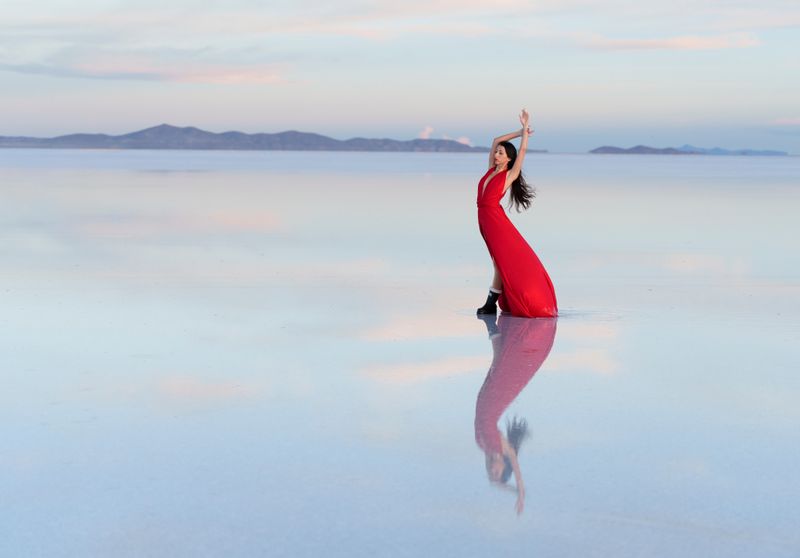
The best light for photographing the Uyuni mirror effect lasts roughly 1–2 hours after sunrise — from the moment the sun clears the eastern horizon until the wind picks up and breaks the surface. Bolivian photographers who have spent three or more rainy seasons on the salar will tell you the same thing: you either wake up at 4 a.m. or you miss it entirely.
The Salar de Uyuni covers 10,582 km² at an altitude of 3,656 meters above sea level, making it the largest salt flat on Earth. The salt crust beneath your feet is up to 10 meters thick in places and holds an estimated 10 billion tonnes of salt. During the dry season, it is an endless white canvas. During the rainy season — November through March — a thin layer of water transforms the surface into the largest natural mirror on the planet. The magic happens when that water sits between 2 and 5 centimeters deep: shallow enough to walk through, deep enough to hold a perfect reflection.
When to Go and What to Expect
January and February are the peak months for the mirror effect, and the window is narrow. By 7 a.m. most mornings, the altiplano wind has already started rippling the surface. By 9 a.m., the reflection is gone. This is not a place for slow risers.
The drive from Uyuni town to the salar takes about 20 minutes. Most photographers head toward the area around Isla Incahuasi, roughly 80 km from the edge of town — a journey of an hour and a half on a flat salt road. From here you get an unobstructed 360-degree horizon, which is essential for the symmetrical reflection shots that have made this place famous worldwide.
Bring warm layers. At 4 a.m. in January, temperatures on the salar regularly drop to -5°C even in the middle of summer. The altitude amplifies everything: cold feels colder, sun feels stronger, and your lungs need time to adjust if you have come directly from sea level.
“The salar teaches you patience. I spent my first season chasing the perfect reflection and getting frustrated. By my third season I stopped fighting the light and started listening to the wind instead. The salar tells you when it is ready.” — Marco Mamani, photographer from Colchani
Camera Settings and Practical Technique
For the mirror effect, a wide-angle lens is your best tool — 16mm to 24mm on a full-frame body. The ultra-wide field of view captures both the sky and its reflection, creating the disorienting infinity effect that defines this kind of image.
Shoot in RAW. The color temperature on the salar shifts dramatically from blue predawn to warm golden sunrise in under 10 minutes, and you will want the flexibility to correct in post without losing detail in the highlights. The white salt and mirror surface together are highly reflective; your histogram will spike hard to the right if you are not careful. Expose to the right, but watch for blown highlights in the sky.
For silhouette shots with people or vehicles, position your subjects between 10 and 30 meters from the camera. Any closer and the reflection disappears beneath their feet. Any further and the human scale is lost against the immensity of the flat. Local guides carry small wooden stools or crates for low-angle compositions — rent a tour that includes gear, or bring a waterproof ground pad.
A circular polarizer helps cut glare on the water surface when the sun is higher, but in the golden hour it actually reduces the reflection quality. Leave it off for the first hour of shooting.
Getting There: Tours and Logistics
Uyuni town is the base for all salar visits. It is connected to La Paz by night bus (9–10 hours, $15–25 USD) and by daily flights on Boliviana de Aviación (1 hour, $80–150 USD depending on season). From Potosí the bus takes 3–4 hours and costs around $8 USD.
The cheapest way to visit the salar is to join a group tour from Uyuni. A standard sunrise photography tour lasting 4–5 hours costs between $15 and $30 USD per person including transport. For the mirror effect specifically, ask tour operators for the “amanecer en el salar” option — not all tours guarantee the pre-dawn departure.
Private jeep hire runs $80–150 USD for a half day and gives you full control over timing and location, which matters enormously for photography. The difference between a group tour and a private jeep is the difference between arriving at the same spot as 15 other vans or having a section of salar to yourself.
If you want to go deeper into the salt flat — toward the geometric patterns of the hexagonal salt polygons or the lesser-visited southern sections — plan for a full-day private hire at $150–250 USD.
The Dry Season Alternative
The mirror effect only exists during the rainy season, but the dry season salar (April through October) has its own photographic value. The white salt crust against a cobalt sky creates forced-perspective illusions that are just as striking and considerably easier to capture. You need no specific timing, the surface is walkable without wet boots, and the salt polygons are at their most geometric.
The trade-off is heat and wind. Midday sun reflects off the white surface with brutal intensity — sunscreen rated SPF 50 or higher is essential, and UV-rated sunglasses protect both your eyes and your camera sensor from glare fatigue. Shoot in the first two hours after sunrise or the last hour before sunset for the best dry-season light.
Gear Checklist for the Salar
- Wide-angle lens (16–24mm full-frame equivalent)
- Waterproof camera bag or dry bag for wet season visits
- Waterproof boots — the shallow water gets into trail runners in minutes
- Spare batteries — cold at altitude drains lithium batteries fast
- Microfiber cloths — salt spray accumulates on lenses constantly
- Remote shutter release for long-exposure star trails
- Warm layers including gloves — cold fingers cannot operate camera controls
- SPF 50+ sunscreen and UV sunglasses
- 2 liters of water minimum — altitude dehydration is faster than you expect
- Cash in bolivianos — no card machines on the salar
The salar does not reward impulsive visits. Three seasons in, the photographers who keep returning to Uyuni are not chasing the same shot — they are learning the rhythms of a landscape that changes with the hour, the season, and the depth of the water underfoot. That is the real reason to come back.
Key facts
- → Salar de Uyuni covers 10,582 km² at 3,656 m above sea level — the world's largest salt flat.
- → The mirror effect requires 2–5 cm of water depth and occurs during the rainy season (November–March).
- → Peak mirror-effect photography conditions: January and February, early morning before wind disrupts the surface.
- → The crust is composed of approximately 10 billion tonnes of salt, averaging 10 m thick.
Frequently asked questions
When is the best time to photograph the Uyuni mirror effect? +
January and February offer the most reliable conditions, with shallow rainwater covering the flat. Arrive at dawn before wind disturbs the surface.
How long does the mirror effect last each day? +
The clearest reflections occur in the first 1–2 hours after sunrise. By mid-morning, wind typically creates ripples that reduce clarity.