Skip to content
Laguna Chalalan — ecolodge comunitario quechua-tacana dentro del Parque Nacional Madidi, Bolivia. Foto: Wikimedia Commons
perezoso
— Community ecolodge · Madidi National Parkdesde 1998

Chalalan
Ecolodge.

Laguna Chalalan at dawn. Giant otters. 98% of visits see primates. Owned by the Quechua-Tacana community of San José de Uchupiamonas since 1998. The benchmark community ecolodge of the Bolivian Amazon.

Founded
1998
Owner
Quechua-Tacana comm.
Primates
98% sighting rate
From Rurrenabaque
4–5h by boat
Birds in area
600+ species
Minimum stay
3 nights
— How long you need

Three stays. One community.

3 nights
  • Day 1: La Paz → Rurrenabaque (flight) → boat up Beni + Tuichi (4–5h) → Chalalan arrival
  • Days 2–3: Guided forest trails · dawn chorus · lake canoe · night walk
  • Day 4: Final dawn → return boat → Rurrenabaque → La Paz flight

The recommended minimum. Enough for all four primate species and the lake's giant otters. Always book direct.

4 nights
  • Days 1–4: Chalalan — full programme with different trails each day
  • Day 5 exploration: dawn lake (otters), night trail (kinkajous), dedicated bird trail
  • Day 5: Return to Rurrenabaque

The optimal itinerary. An extra day allows more remote trails and higher probability of tapir and elusive terrestrial wildlife.

7 nights (combo)
  • Days 1–2: Pampas del Yacuma — pink dolphins, anacondas
  • Day 3: Transit — night in Rurrenabaque
  • Days 4–7: Chalalan — deep primary jungle

The most complete Bolivian Amazon combination: flooded grasslands + primary jungle. Two ecosystems, one week.

— What to do at Chalalan Ecolodge

Six unique experiences.

🛶
Oxbow lake · primary forest

Laguna Chalalan at Dawn

Giant otters on a glass-still lake

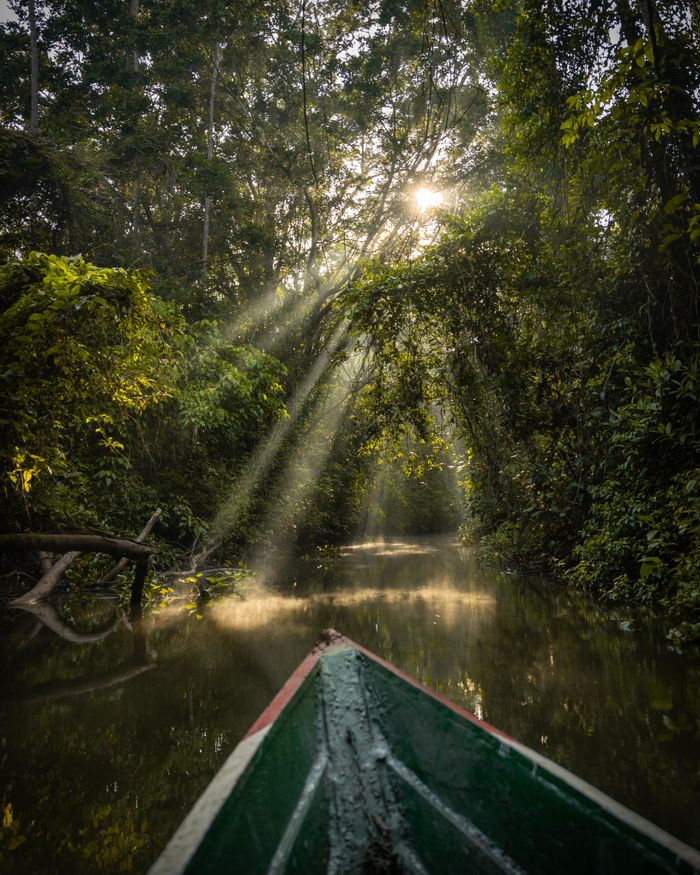
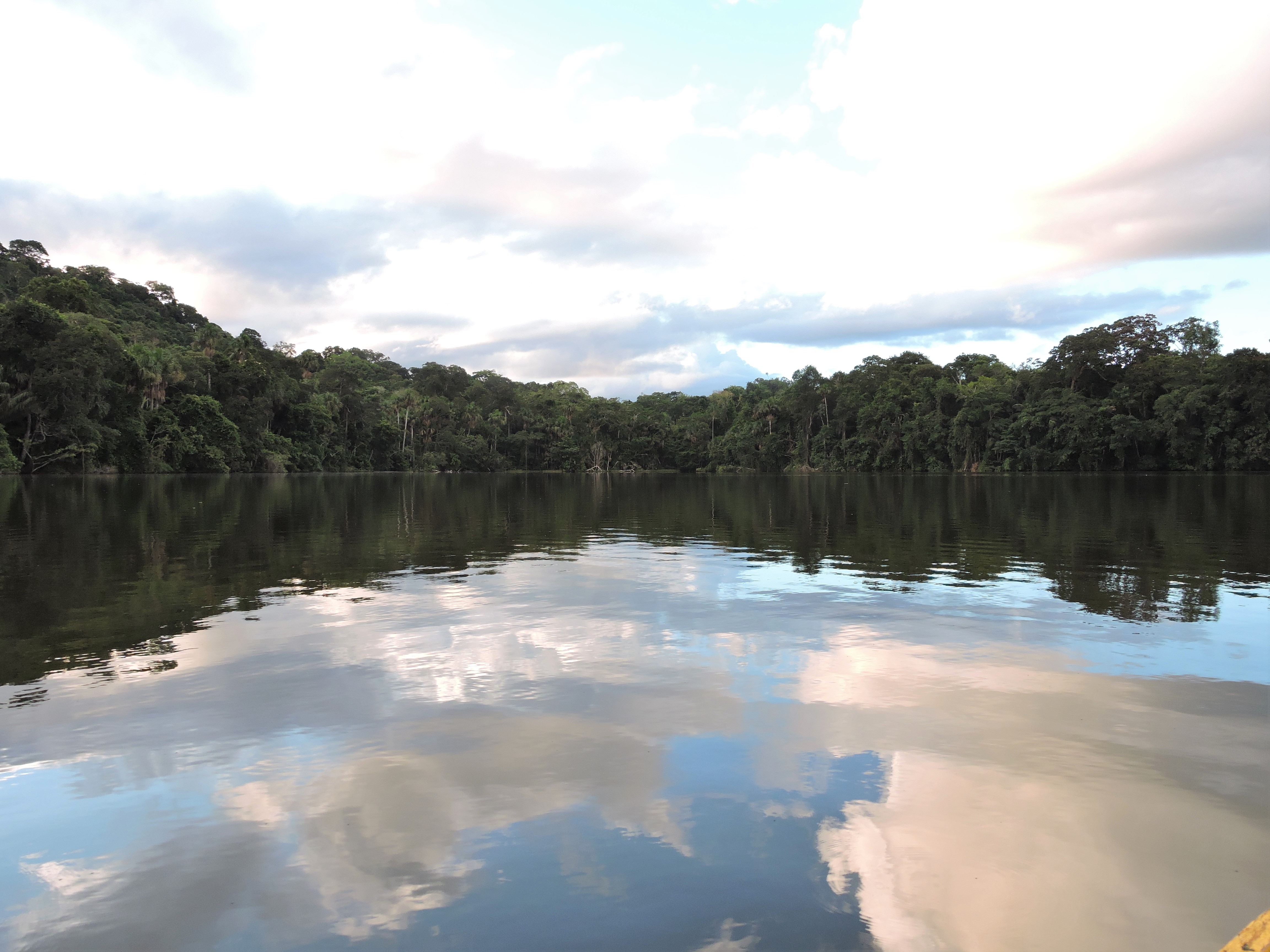
Laguna Chalalan is an oxbow lake — a former meander of the Tuichi river — surrounded on all sides by primary forest. At 5am, before the first light, you board a canoe in absolute silence. The lake surface reflects the jungle canopy. Giant otters begin vocalising at first light. In the absence of wind, the calls echo across the water and the reflections are perfect. It's one of the most composed natural scenes in the Amazon.

Local tip
Request a dedicated dawn canoe before any trail walk. Giant otter activity peaks in the first 90 minutes of light. Bring waterproof bags for your camera and binoculars — the lake is flat and visibility is exceptional.
🐒
Forest trails · all day

Primate Tracking

4 species · 98% sighting guarantee

Chalalan has documented primate sightings on 98% of guided walks. Four species: howler monkeys (their dawn bellow is audible from the lodge at 5am — a prehistoric resonance), capuchin monkeys (intelligent tool-users, common in mid-canopy), squirrel monkeys (in family groups of 30–50, fast-moving through the canopy edge), and spider monkeys (the largest, in the high canopy, rare to find but present).

Local tip
Ask your guide to lead with howler tracking at dawn — they are loudest and most locatable then. The capuchins are easiest to photograph. Don't pursue spider monkeys if they move away — Chalalan's guides know their territories and will intercept them on the next circuit.
🔦
Primary forest trails · 8pm

Night Walk

Kinkajous, tarantulas, tree frogs

The primary forest at night around Chalalan is a sensory experience of a different order. Your guide leads with a red-light headlamp (less disruptive to nocturnal animals). On a typical night: giant tarantulas on tree trunks, kinkajous (nocturnal relatives of the raccoon) in the canopy, sleeping birds on low branches, leaf frogs in luminescent lime-green, caimans in the lake stream, and — very occasionally — a tapir or ocelot crossing the trail.

Local tip
Wear rubber boots — no exceptions, day or night. The night trail at Chalalan is cleared and well-maintained but the forest floor always has surprises. A silent approach produces more encounters than a fast one. Listen — your guide hears more than you do.
🦜
Lodge surrounds · dawn + all day

Birding

600+ species in the lodge area

The area around Chalalan has 600+ confirmed bird species. The transition from the lake edge to primary forest to riverside creates multiple habitat interfaces — each with its own avifauna. Dawn at the lake produces great black hawk, sunbittern, sungrebe, ringed kingfisher and multiple heron species. Forest trails: euphonias, trogons, jacamars, puffbirds, and the occasional Harpy Eagle sighting reported.

Local tip
The clay lick on the Tuichi (accessible by canoe from Chalalan) is one of the richest macaw sites in Madidi — arrive before 6am and wait in silence. At peak the lick can produce 200+ parrots and macaws simultaneously. A spectacle matched nowhere else in Bolivia.
🏡
San José de Uchupiamonas

Community Life

Conservation in practice since 1998

Chalalan was established in 1998 when the Quechua-Tacana community of San José de Uchupiamonas chose ecotourism over timber and subsistence hunting. With support from WCS and the IDB, they built the lodge themselves and trained community members as guides, cooks, boatmen and administrators. 100% of lodge revenue stays in the community — 30% to school and infrastructure, 20% to conservation monitoring, 50% to salaries and operations.

Local tip
Ask your guides about the community's conservation history — why they made the choice, what they gave up and what they gained. The answers are more instructive than any lecture on biodiversity. Many guides are third-generation community conservationists.
🌿
5 trail circuits · all difficulty levels

Guided Forest Trails

Named trails into primary jungle

Chalalan has five named trail circuits: the Laguna Circuit (easy, along the lake edge), the Mirador trail (to a forest overlook), the Yuchán trail (deep primary forest), the Colpa trail (to the macaw clay lick), and a dedicated birding transect. Each is walked with a guide who identifies every sound, track and plant encountered — building a cumulative picture of the forest that grows richer each day.

Local tip
Don't repeat the same trail twice — vary the circuits each day. The forest changes with the direction you walk and the hour of day. Your guide knows where each species is most likely at each time of day — let them lead the sequence.
— Why Chalalan is different

There\'s no other like it in Bolivia.

Many lodges call themselves ecolodges. Few are. Chalalan has spent 25 years demonstrating that conservation and community profitability aren't just compatible — they require each other.

🌱
100% community-owned
Full ownership by the Quechua-Tacana community of San José de Uchupiamonas. No external investors, no intermediaries. Every dollar spent at Chalalan directly funds conservation, education and local salaries.
🔬
Measurable conservation
Since 1998, zero documented deforestation incidents in the community's Madidi territory. The lodge funds a camera-trap wildlife monitoring programme that updates the park's species inventory annually.
🦁
98% primate sighting rate
Not marketing — it's the documented rate across 25+ years of operation. Chalalan knows the territories of every primate group and actively tracks them. Your guide knows where they'll be.
☀️
Full solar power
The lodge has run entirely on solar power since 2015. No generator — total silence. Nights in the jungle are completely dark. Mornings begin with the bird chorus, not with engines.
🎓
Third-generation guides
Chalalan's guides are community members who grew up in the forest. Many are sons or grandchildren of the lodge founders. The ecosystem knowledge they transmit is generational, not from a manual.
🏆
25+ years as benchmark
Chalalan is cited in 200+ academic publications as a successful community conservation case study. It has received the United Nations Sustainable Tourism award. It is the model 40+ other community lodges in Bolivia try to emulate.
— Booking & logistics

How to book and how to get there.

📋

How to book Chalalan

  • Book directly with Chalalan — not through third-party platforms
  • La Paz office: search "Chalalan Ecolodge La Paz" online or contact via Love Bolivia
  • Book 4–8 weeks ahead in peak season (July–August). Off-peak: 2–3 weeks
  • Price includes: boat transfer from Rurrenabaque, Quechua-Tacana guides, all meals and activities
  • 30% deposit to confirm. Cancellation 30+ days ahead for full refund
  • The lodge is small — only 8–12 guests at a time. Limited capacity guarantees quality
✈️

How to get to Chalalan

  • Step 1: Fly La Paz → Rurrenabaque (25 min, ~$60–100 USD, TAM or Amaszonas)
  • Step 2: Night before: stay in Rurrenabaque — Chalalan does the briefing here
  • Step 3: Early morning (7–8am): motorised boat 2h along the Beni to the Tuichi junction
  • Step 4: 2–3h more up the Tuichi to Laguna Chalalan
  • Total from Rurrenabaque: 4–5h. The arrival at the lake after hours on the river is cinematic
— When to visit Chalalan

Chalalan opens all 12 months.

Jan
Feb
Mar
Apr
May
Jun
Jul
Aug
Sep
Oct
Nov
Dec
May – October
Dry season — ideal
Dry and walkable trails, ideal river navigation levels, clear skies, avifauna at peak activity. July and August are peak season — book 8 weeks ahead. The lake at dawn in dry season is particularly clear.
Year-round for birds
Avifauna has no low season
Chalalan operates all 12 months and birdlife is excellent in every season. Rainy days in primary jungle produce intense singing the moment they clear. Some specialists prefer the wet season: more vocal activity and fewer tourists.
November – April
Wet season — Chalalan still works
Tuichi river levels rise — the boat journey is faster. Trails become muddier (rubber boots essential). Vegetation is more lush. Primates and arboreal wildlife don't decrease. Book 3+ weeks ahead even in low season.
FAQ

Questions about Chalalan.

Everything you need to know before booking.

Book with our help →

Chalalan Ecolodge is a community lodge inside Madidi National Park, owned and operated by the Quechua-Tacana community of San José de Uchupiamonas since 1998. It sits on Laguna Chalalan — an oxbow lake in primary forest. It is one of South America's oldest and most successful community conservation tourism models, cited in 200+ academic papers on sustainable tourism.

Book directly with Chalalan's La Paz office — not through third-party booking platforms. Search "Chalalan Ecolodge La Paz" or contact us at Love Bolivia and we'll facilitate the connection. Minimum recommended stay: 3 nights. Book 4–8 weeks ahead in peak season (July–August), 2–3 weeks in low season. Price includes: boat transfer from Rurrenabaque, Quechua-Tacana guides, all meals and activities.

Primate sightings on 98% of guided walks (four species: howler, capuchin, squirrel and spider monkeys). Giant river otters on the lake (a resident family of 5–8). 600+ bird species in the lodge area. Night walks: kinkajous, tarantulas, luminescent tree frogs, sleeping birds. Caimans in the lake stream. Tapirs and ocelots occasionally on trails. Harpy Eagle documented sightings near the lodge.

Chalalan is 4–5 hours from Rurrenabaque by motorised boat: 2h down the Beni River to the Tuichi junction, then 2–3h up the Tuichi to Laguna Chalalan. The river journey is part of the experience — the transition from the wide Beni to the narrowing Tuichi and into primary forest canopy is gradual and dramatic. Chalalan's boats depart Rurrenabaque at 7–8am.

Chalalan costs approximately $280–350 USD per person per night, all-inclusive (boat transfer from Rurrenabaque, guides, meals and activities). This is not cheap — but 100% stays in the community, funds conservation monitoring and maintains the forest that makes the experience possible. It is the most ethically solid option in Madidi. Compared to equivalent lodges in the Peruvian Amazon, Chalalan is competitive.

May to October (dry season) is ideal: walkable trails, navigable river, clear skies and peak bird activity. July and August: peak season — book 8 weeks ahead. Chalalan operates year-round. The wet season (Nov–Apr) has muddier trails but equally rich wildlife and fewer tourists. Birding specialists sometimes prefer the wet season for its intense vocal activity.

— Your Chalalan stay

The lake at dawn.
We\'ll be waiting.

45 minutes. We help you book Chalalan directly with the community and design your full itinerary from La Paz.

$90 · €85 · Bs. 623

Book consultation → $90 · €85 · Bs. 623Madidi guide →