The Eduardo Avaroa Reserve — Bolivia's most extreme landscape
The Reserva Nacional de Fauna Andina Eduardo Avaroa (REA) covers 714,745 hectares of Bolivia's southwestern corner — a high-altitude desert at 4,000–5,000 m that holds the highest concentration of coloured lagoons, active geothermal fields, and flamingo colonies in South America. Named after Bolivian hero Eduardo Avaroa, who died defending Bolivia's access to the Pacific in the War of 1879, the reserve is the centrepiece of the Southwest Circuit. Within a single day's drive inside the reserve, it is possible to see all three flamingo species, the world's highest accessible geothermal field, a blood-red lake the size of a small city, a surrealist volcanic desert, and an impossibly turquoise lake at the foot of an active stratovolcano. No other place on earth concentrates this many superlatives in a single day.
Three flamingo species — Bolivia is the only place on earth
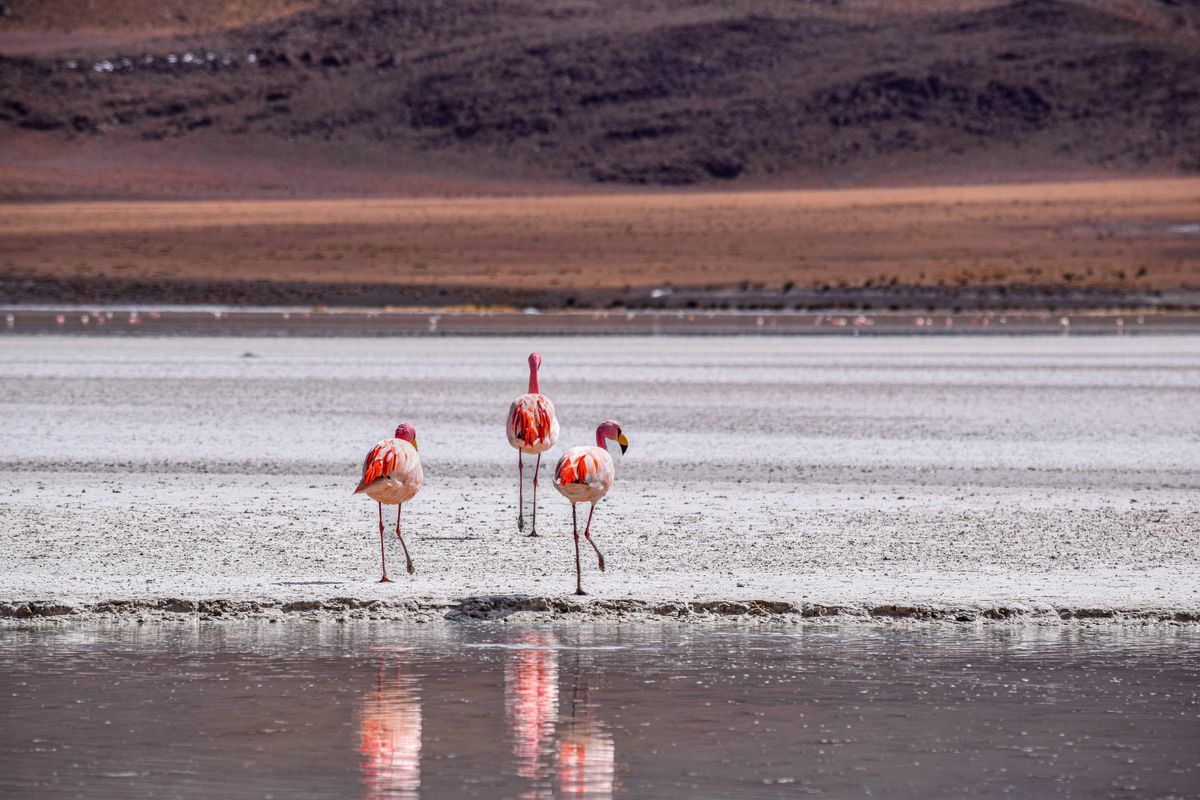
Bolivia is the only country on earth where all three high-Andean flamingo species share the same lake in the same day. James's flamingo (Phoenicoparrus jamesi) is the rarest of the three — an Andean endemic with a restricted range limited to the altiplano above 4,000 m. The Andean flamingo (Phoenicoparrus andinus) is the second largest flamingo species in the world, identified by its bright pink and white plumage and yellow feet. The Chilean flamingo (Phoenicopterus chilensis) is the most widespread and easily identified by its distinctively pink-and-white plumage and grey legs with pink joints. Laguna Hedionda and Laguna Colorada within the reserve see all three species simultaneously during the breeding season (November–February), when the combined flock at Laguna Colorada alone can exceed 50,000 individuals — one of the largest flamingo gatherings on earth.
Laguna Colorada — the blood-red lake at 4,278 m
Laguna Colorada ('Red Lake') takes its extraordinary colour from a combination of red and orange algae (Arthrospira and Dunaliella) and reddish mineral sediments in the shallow water. The lake covers 60 km² at 4,278 m above sea level and has a maximum depth of 35 cm in most sections — shallow enough for flamingos to wade and feed throughout. The lake's colour intensifies during the dry season when evaporation concentrates the algae, and at dawn and dusk when low-angle sunlight turns the surface crimson against the white salt islands at its centre. White borax islands rise from the red water in the centre of the lake — the contrast between the red algae, white islands, pink flamingos, and cobalt-blue Andean sky is the defining image of the Bolivian southwest. Laguna Colorada is protected as one of the most important flamingo breeding sites in South America.
Sol de Mañana geysers — the highest geothermal field on earth
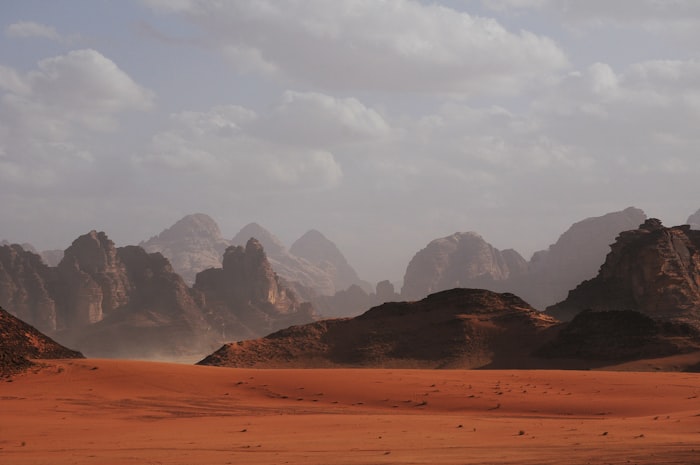
At 4,850 m above sea level, the Sol de Mañana geothermal field is the highest accessible geothermal area on earth. The name means 'Morning Sun' — an indication of when to visit. The field contains more than 80 active craters, mud pools, and steam vents spread across a volcanic plateau, with steam columns reaching 50 m in the cold air of pre-dawn. At this altitude, the boiling point of water is 84°C rather than 100°C — still enough to maintain highly active eruptions. The geysers are most dramatic at dawn (5–7 am), when cold air temperatures make the steam visible at maximum height against the dark sky. Reaching Sol de Mañana at dawn requires a 4 am departure from accommodation — cold (well below freezing), dark, and altitude-demanding, but one of the most extraordinary natural spectacles in South America. The nearby Desierto de Dalí, named for its resemblance to Salvador Dalí's surrealist landscapes, lies en route from the geysers back to the lagoons.
— Itinerary
Day by day
7 carefully designed stages. Every itinerary adapts to your group and dates.
— What's included
Everything you need, nothing more.
— Gallery
The landscape, in images.

— Testimonials
Those who already travelled.
"The Laguna Colorada at sunset with 40,000 flamingos was the single most spectacular thing I have ever seen. Full stop."
"We've done Uyuni with a regular tour before. The southwest circuit Love Bolivia designed took us somewhere completely different. The Dalí Desert alone is worth it."
— Related articles
Read before you go.


Start planning your El Flamenco route.
45 minutes. We listen and design an exact plan for your trip.
$90 · €85 · Bs. 623 per session · Deducted from the final price