Always within the Salar tour.
- Salar de Uyuni tour (full day or half day)
- Incahuasi Island: standard tour stop (1.5–2h)
- Ascent to island viewpoint: 20min walk
- Descent and return to the Salar
Incahuasi Island is the mandatory stop on all Salar de Uyuni tours. It is automatically included in the standard 4×4 circuit. It is not visited independently — always within the Salar tour.
- 7:00am: Leave Uyuni
- 7:15am: Train Cemetery (30min)
- 8:00am: Colchani · salt village
- 10:00am–12:00pm: Salar interior + perspective photos
- 12:30pm: Incahuasi Island (lunch + 1.5h exploration)
- 2:30pm–5:00pm: Return + Salar sunset
The standard 1-day circuit from Uyuni. The Island is the centrepiece of the tour — lunch here (brought by the operator) with Salar views in every direction is one of Bolivia's most unique moments.
- Day 1: Cemetery + south Salar + Incahuasi + sunset
- Day 2: Coloured lagoons + Andean fauna (Laguna Colorada, Verde)
- Day 3: Sol de Mañana geysers + San Pedro de Atacama (Chile)
The full circuit. Three days covering the Bolivian southwest into the Atacama Desert in Chile. Incahuasi appears on day one. Specialist operator only. Altitudes up to 5,000m at the southern lagoons.
Millennial cacti and reflected sky.
An island in the centre of the world's largest salt flat with 1,200-year cacti, fossilised coral, a 360° viewpoint and the planet's most spectacular mirror effect.
Giant Cacti · 1,200+ Years Old
The Echinopsis atacamensis cacti that cover Incahuasi Island are among the oldest living organisms in Bolivia. The largest specimens are estimated at 1,200–1,500 years old, growing at an average rate of just 1 cm per year — a 10-metre cactus is roughly 1,000 years old. The density of the cacti on the island (thousands of specimens covering every surface) creates a unique visual landscape: an island covered in 10-metre green columns emerging from the flat white salt.
Island Viewpoint · Panoramic Salar
The island has a marked trail to a viewpoint at its highest point (approximately 100m above the Salar surface). From this viewpoint, the Salar de Uyuni extends to the horizon in all 360 degrees — there is no other elevated point in the centre of the Salar from which you can see the full extent of the 10,582 km² salt flat. During mirror effect season (November–March), the island appears to float on reflected sky. The viewpoint also gives the clearest perspective on the perfect geometric hexagonal patterns of the salt crystals.
Coral Fossils · Prehistoric Lake Evidence
The rocky surface of Incahuasi Island contains fossilised marine coral from the prehistoric lake that occupied the Uyuni basin 10,000–40,000 years ago. The Salar de Uyuni is the evaporated residue of Lake Ballivián (later Lake Minchin), which covered an area of approximately 60,000 km² — the salt flat, Lake Titicaca and several other altiplano lakes are all remnants. The coral fossils on Incahuasi are visible as white rounded formations on the rock surface: the same organisms that grew in tropical marine environments millions of years ago later survived in the altiplano lake.
Inca Sacred Site · "Inca Huasi"
The name "Incahuasi" (or "Inca Huasi") means "house of the Inca" in Quechua — the name itself documents the island's role as an Inca sacred site. The Inca Empire (1438–1533) incorporated the Salar de Uyuni and its salt resources into its administrative and religious network. Incahuasi's position at the exact centre of the Salar likely gave it cosmological significance in Inca worldview. The island also served as a waystation on the Inca road network (Qhapaq Ñan) that crossed the altiplano. Archaeological remains on the island include foundation walls consistent with Inca construction.
Mirror Effect · Best Viewpoint
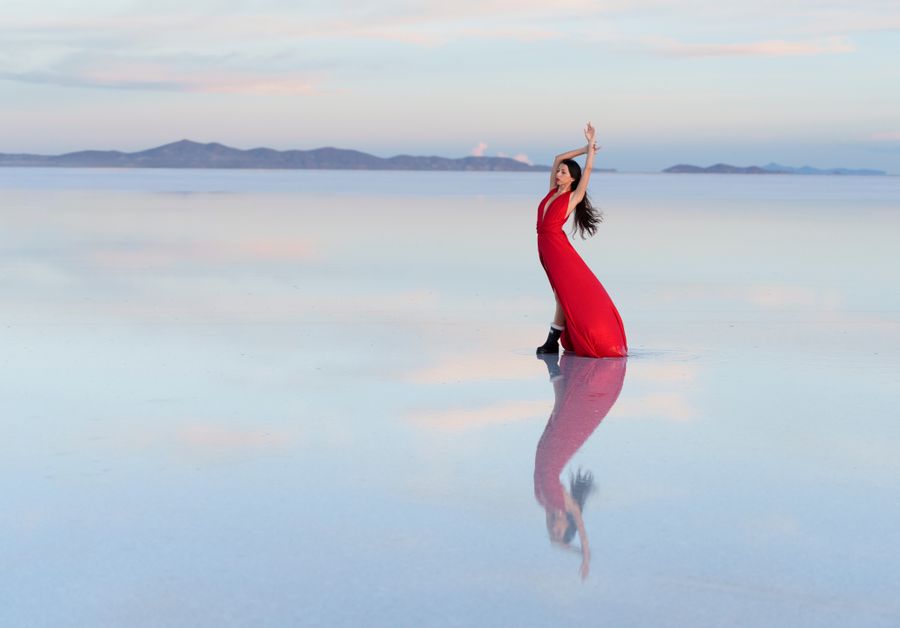
During the wet season (November–March), when 2–5cm of water covers the Salar surface, the mirror effect creates one of the world's most spectacular natural phenomena: the sky and clouds reflect perfectly in the water, and the horizon disappears. Incahuasi Island is the only elevated point from which to observe the mirror effect from the centre of the Salar — the viewpoint on the island gives you a 360° horizon of reflected sky with the giant cacti emerging around you. January and February are the peak months.
Island Museum · Geology and Inca History
Incahuasi has a small museum at the island entrance building (which also includes a restaurant and toilet facilities). The museum covers three themes: (1) the geology of the Salar de Uyuni and the prehistoric lakes that preceded it; (2) the coral fossils found on the island as evidence of these lakes; (3) the Inca occupation of the island and the Qhapaq Ñan road network across the altiplano. The museum is small but well-curated — allow 15–20 minutes.
The lake that was and the salt flat that remained.
Six contexts to understand the prehistoric geology, Inca history and global significance of the island at the centre of the salt flat.
The complete southwest circuit.
Salar de Uyuni · The Full Circuit
Incahuasi Island is the centrepiece of the standard Salar de Uyuni 1-day 4×4 circuit. The full circuit from Uyuni covers: Train Cemetery (7:15am, 30min) → Colchani salt village (8:00am, 30min) → Salar interior perspective photos (10:00am, 2h) → Incahuasi Island (12:30pm, 1.5h including lunch) → Salar sunset (5:00pm) → Uyuni (6:30pm). All operators in Uyuni run this circuit. Prices range from Bs 200 (budget, shared) to Bs 500+ (private, quality vehicle).
Tunupa Volcano · Northern Shore
Tunupa Volcano (5,321m) is on the northern shore of the Salar — the reverse approach to the circuit. Instead of approaching Incahuasi from the south (standard tour), the Tunupa-Salar circuit approaches from the north: Uyuni → flamingo lagoons → Tahua village → Tunupa ascent (optional) → cross Salar south → Incahuasi → Uyuni. The Aymara legend of Tunupa says the goddess's tears created the Salar — making Incahuasi the centre of that sacred geography. The Tunupa circuit (2 days) is the most complete version of the Uyuni experience.
Train Cemetery · Uyuni
The Train Cemetery is the standard first stop of the Salar 4×4 tour (7:15am, 30 minutes). The ~30 British steam locomotives from the 1890s (imported for the Antofagasta-Bolivia Railway) sit 3km from Uyuni town at 3,669m. The site is free and open 24h. For serious photographers, the Train Cemetery deserves a separate pre-dawn visit (5:00–7:00am) for the golden sunrise light — not possible within the standard tour schedule that arrives at 7:15am when the best light has already passed.
Potosí · UNESCO Silver City
Potosí (4,090m, 160km from Uyuni) is the natural historical complement to the Salar circuit. The silver mined at Cerro Rico funded the Spanish Empire for 200 years (1545–1825) and the FCAB railway (whose locomotives are at the Train Cemetery) was built to transport this ore. Potosí has the Casa de la Moneda (Royal Mint, 1773), spectacular Baroque churches, and guided tours into the active Cerro Rico mines. The city is a UNESCO World Heritage Site. Combine: Uyuni (2 nights) → Potosí (2 nights) → Sucre (1 night).
Only by 4×4, only on a tour.
How to get to Incahuasi Island
- Incahuasi is 90km from Uyuni — only accessible by 4×4 through the Salar interior
- No independent transport — visited exclusively within an organised tour
- Book the Salar tour in Uyuni (Bs 200–350 budget · Bs 500+ private)
- The tour includes transport, guide, island lunch and all entries
- Flights to Uyuni (UYU) from La Paz and Cochabamba with BoA
- There is no way to reach Incahuasi independently in any standard vehicle
On the island: what to know
- Standard tour visit time: 1.5–2h on the island
- Viewpoint trail: 20min ascent (moderate, rocky terrain)
- The cacti are protected — do not touch or climb under any circumstances
- The island restaurant serves lunch (included in most tours)
- The only toilet facilities in the Salar interior are on the island
- Altitude: 3,656m — if it's your first day in Bolivia, take it easy
Mirror effect or dry salt?
— Gallery
Bolivia in focus
Real photography from our routes. No stock images. Hover to explore.

Questions about Incahuasi Island.
The 5 most common questions about the island at the centre of the world's largest salt flat.
Plan your trip with us →At the centre of the world.
Surrounded by sky.
45 minutes. We design your Salar tour with the right operator, the correct season and the complete itinerary.
$90 · €85 · Bs. 623