Skip to content
Mercado de Tarabuco Bolivia — mercado dominical indígena jalq\'a y yampara con tejidos únicos a 64km de Sucre
vicuna
— Sunday market · Jalq'a textiles · 3,200m

Tarabuco Market,
Bolivia.

The most important indigenous Sunday market of the Bolivian valleys. Jalq'a and Yampara traders in traditional dress. Unique textiles. 64km from Sucre — Sundays only.

Altitude
3,200m
From Sucre
64km · 1.5h
Market day
Sundays only
Cultures present
Jalq'a and Yampara
Department
Chuquisaca
Mean temperature
15–18°C
— How long do you need

Three ways to experience Tarabuco.

1 day
  • Morning: Tarabuco market (Sundays, 8am–2pm) — Jalq'a and Yampara textiles, potters, local producers
  • Afternoon: town walk, local museums and artisans in their workshops
  • Return to Sucre at sunset

Tarabuco is essentially a Sunday day trip from Sucre. The market closes at 2pm — arrive before 9am to experience the full atmosphere at its peak.

2 days
  • Day 1 (Sunday): Tarabuco market (8am–2pm) — full market immersion
  • Day 1 afternoon: explore the village, visit weavers at home, dine in Tarabuco
  • Day 2 (Monday): excursion to Maragua (lunar landscape 30km) + return to Sucre

Staying one night lets you see Tarabuco without tourists on Sunday afternoon and access Maragua on Monday at leisure.

Weekend
  • Saturday: arrive in Sucre + colonial historic district visit (UNESCO World Heritage)
  • Sunday: early departure to Tarabuco (7am) + full market (8am–2pm)
  • Sunday afternoon: return to Sucre + Casa de la Libertad + Recoleta viewpoint
  • Monday: optional — Maragua or Chataquila before the return flight

The standard weekend combining colonial Sucre with the Tarabuco market. Highly recommended.

— Things to do in Tarabuco Bolivia

Six authentic experiences.

Selected by Bolivians. The market and Jalq'a textiles without the standard tourist circuit.

🧶
Main plaza · every Sunday · 8am–2pm

Tarabuco Sunday Market

Bolivia's most important indigenous textile market

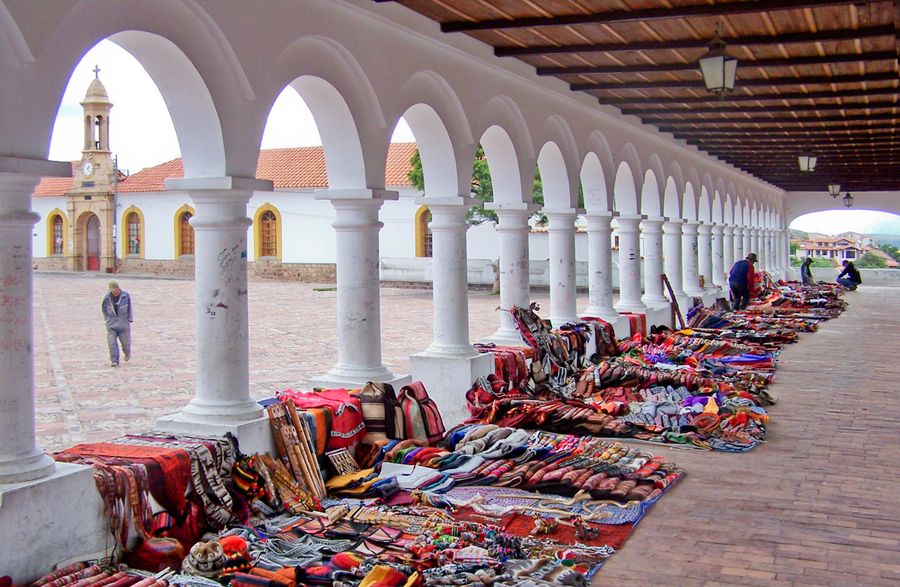
Every Sunday, Tarabuco's main plaza fills with Jalq'a and Yampara indigenous traders who arrive from surrounding communities wearing traditional dress — the men's distinctive colonial-style helmets, coloured ponchos and the women's intricately woven aqsu (wraparound skirts). The market trades in handwoven textiles, pottery, local produce and everyday goods. The textile section is the main attraction: Jalq'a weaving is among the most technically complex in the Andes, with asymmetrical animal figures (khurus) on dark backgrounds. The market peaks between 9–11am.

Local tip
Arrive before 9am to see traders setting up and the atmosphere at its fullest. Textile prices are fair and set — aggressive bargaining is inappropriate and culturally disrespectful. Ask permission before photographing people (a small tip is customary). The best textiles are sold directly by the weaver families who bring their own work, not resellers. Buy direct.
🪡
Weavers' homes · textile workshops

Jalq'a Weaving

Asymmetric animal worlds on dark backgrounds · 2,000+ hours per piece

Jalq'a weaving is one of the most distinctive textile traditions in the Americas. On a dark red or brown background, weavers create asymmetrical compositions of strange animals (khurus) — hybrid creatures that inhabit the underworld. Unlike the symmetrical, ordered compositions of other Andean traditions, Jalq'a textiles are deliberately chaotic and dense, representing the ukhu pacha (inner world). A single large piece can take 2,000+ hours of work. The Centro de Capacitación Artesanal in Tarabuco offers the chance to meet active weavers and watch the process.

Local tip
The ASUR (Anthropologists for the Study of Indigenous Cultures) foundation has a museum and workshop in Sucre and a sales outlet in Tarabuco — their pieces come with documentation of the weaver's identity and community. This is the gold standard for ethical textile purchase. A small wall hanging: from 200 Bs. A full aksu: 1,500–4,000 Bs. These are pieces that take months; pricing reflects that.
🪘
Tarabuco market · surrounding communities

Yampara Culture & Dress

Colonial-era helmets · red and black textiles · living tradition

The Yampara people of the Tarabuco area wear one of Bolivia's most recognisable indigenous dress combinations: leather helmets modelled on Spanish colonial helmets (a deliberate inversion of the conquest), red and black ponchos with geometric designs, and ch'uspas (small bags) for coca leaves. Women wear the aqsu with elaborate belt weaving. This is not folk costume — it is daily dress worn to the Sunday market by working people from the surrounding communities. The Pujllay festival in March is the major Yampara cultural event of the year.

Local tip
The Pujllay festival (usually the third Sunday of March) is the largest cultural event in the Tarabuco area — a UNESCO Intangible Heritage celebration with music, dance and elaborate costume. If your visit aligns with this date, plan around it: accommodation must be booked months in advance and the atmosphere is extraordinary. Outside Pujllay, the Sunday market remains the best window into living Yampara culture.
🏺
Market · artisan workshops · side streets

Pottery & Local Crafts

Hand-thrown vessels · pre-Columbian techniques · everyday objects

Alongside the dominant textile trade, Tarabuco market has a significant pottery section. Local potters from the surrounding communities bring hand-thrown vessels using pre-Columbian techniques — coil-built rather than wheel-thrown, fired in wood kilns. The pieces are functional: cooking pots, serving bowls, storage vessels, water carriers. Prices are low and the quality is high. Look also for carved wooden spoons, hand-braided baskets and the locally produced chicha (fermented maize beer) sold by the litre in clay vessels.

Local tip
The pottery stalls are typically set up on the west side of the market, away from the main textile area. Smaller pieces travel well and cost 20–80 Bs. The clay cooking pots (ollas) are functional art — ask the potter to show you the wood-firing marks that give each piece its unique surface. Buying directly from the producer supports the family economy in a direct and proportionate way.
🌽
Market food stalls · Sunday morning

Local Food & Chicha

Caldo de maní · chicha morada · traditional Andean lunch

The food section of Tarabuco market is a complete Sunday lunch scene. Local women serve caldo de maní (peanut broth with potato and charque), fricase de cerdo, and the local llajwa-spiced chicharrón. Chicha (maize beer) is poured from large clay pots — the deep purple chicha morada is sweeter and less fermented than the standard chicha. The market food is genuinely home-cooked by the people who produce the ingredients. The full lunch experience costs 20–40 Bs and is among the most authentic eating experiences in the Bolivian valleys.

Local tip
The food area is inside the covered market hall, usually to the north or east of the central plaza. Arrive hungry — market food stalls start serving from 9am and are best between 10–12pm. Point to what looks good; menus don't usually exist. Bring cash in small notes (10–20 Bs). The caldo de maní is the local signature dish: a dense, fortifying peanut and potato broth that is essential eating.
🎭
Tarabuco · third Sunday of March

Pujllay Festival

UNESCO Intangible Heritage · the most spectacular Yampara celebration

The Pujllay (from Quechua: "to play") is the annual harvest celebration of the Yampara people, held on the third Sunday of March to commemorate the Battle of Jumbati (1816), where the Yampara defeated a royalist force during Bolivia's independence war. The festival fills the streets with music from wind instruments (pinkillus, tarkas), elaborate costumes, circular group dances and the ceremonial watering of the pujllay figure (a decorated pole). It is recognised by UNESCO as Intangible Cultural Heritage of Humanity and draws visitors from across Bolivia and internationally.

Local tip
Pujllay falls in March — book accommodation in Tarabuco or Sucre at least 2 months ahead. The festival itself is on Sunday but preparations and satellite events happen Saturday and the following Monday. The best viewing positions for the circular dances are the raised steps around the main plaza. Bring sun protection (the high-altitude sun at 3,200m is intense) and arrive by 9am. Photography is generally welcome if done respectfully — ask before getting close.
— What makes Tarabuco special

The most authentic market in the valleys.

Six keys to understanding why the Tarabuco market is one of Bolivia's most important cultural events.

🗺️
Why Tarabuco is unique in the Andes
Tarabuco is the only place in Bolivia where Jalq'a and Yampara cultures converge weekly in a market that was not designed for tourists but for trade and exchange between communities. The people who come to the market wear their traditional dress because that is their everyday clothing — not because they are performing for visitors. This authenticity is extremely rare in any Andean market with relatively easy access.
🧵
Jalq'a weaving: technique and meaning
Jalq'a weaving uses the backstrap loom double-faced complementary warp technique — one square centimetre can contain up to 200 threads. The design vocabulary is distinctive: asymmetrical compositions of khurus (strange animals — hybrids of real and fantastical creatures) on dark red or brown backgrounds, representing the ukhu pacha (inner world). Unlike most Andean textile traditions, Jalq'a designs are deliberately non-symmetrical and chaotic. A full-size piece takes months of work.
⚔️
The Battle of Jumbati and the Pujllay
In 1816, during Bolivia's independence war, a Yampara guerrilla force led by Gerónimo Quispe defeated a royalist contingent in the Jumbati ravine near Tarabuco. This victory is commemorated annually with the Pujllay festival — the third Sunday of March. The Pujllay tradition predates the battle but was reinforced by it. UNESCO inscribed the Pujllay on the Intangible Cultural Heritage List in 2011.
🏔️
The altitude of the market
At 3,200m altitude, Tarabuco is 400m higher than Sucre and significantly colder. The high-altitude sun can be intense even at cool temperatures. The combination of altitude and Andean sun makes sun protection essential — and warm layers equally necessary, especially in winter months (June–August) when the Sunday market can begin with below-zero temperatures before the sun warms the day. Layering is non-negotiable.
🚗
Sundays only: the logic of the market
The Tarabuco market operates only on Sundays. Monday to Saturday, Tarabuco is a small Bolivian valley town without particular tourist activity. This weekly concentration is precisely what gives the market its character: it is the event of the week for communities in the area, and Sunday is the only day when everyone arrives in town — sellers, buyers, artisans and families. Planning the visit on a Sunday is not an option; it is a requirement.
💼
Ethical textile buying
Jalq'a and Yampara textiles are objects of genuine cultural and economic value. Buying directly from weavers (not intermediaries) ensures income reaches the person who did the work. The ASUR foundation in Sucre certifies pieces and can connect buyers with weavers from specific communities. Asking the weaver's name and community of origin before buying is correct practice. A well-made textile is always cheaper in Tarabuco than in any craft shop in La Paz or Sucre.
— Excursions from Tarabuco and Sucre

The valley surroundings.

Excursion
64km · 1.5h

Sucre — UNESCO Colonial Capital

Bolivia's constitutional capital · white city · Casa de la Libertad

Sucre is the logical base for a Tarabuco visit — and a major destination in its own right. The UNESCO World Heritage colonial centre is one of the best-preserved in Latin America: the Casa de la Libertad (where Bolivian independence was signed in 1825), the Cathedral, the Convento de San Felipe de Neri with its rooftop views, the Mercado Central and the Recoleta viewpoint. Sucre's white-painted buildings, year-round spring climate (19°C average) and strong café and restaurant scene make it one of Bolivia's most pleasant cities.

Tip
Sucre is the base for any Tarabuco visit — stay 2–3 nights minimum. The altitude (2,810m) is gentle compared to La Paz and most visitors acclimatise without difficulty. The Mercado Central food hall is one of the best in Bolivia for breakfast and lunch: saice (Sucre's signature beef and vegetable dish), buñuelos and the local api morado. The Dinosaur Park (Cal Orcko, 5km from centre) has the world's largest dinosaur trackway wall — 300+ dinosaur species, 10,000 tracks.
Excursion
~45km from Tarabuco · ~2h by road

Maragua Crater

Geological moonscape · 3,500m · rural valley communities

Maragua is a geological formation that looks like an eroded meteor crater — a circular valley at 3,500m with multi-coloured geological layers exposed by erosion: red, white, purple and green sedimentary rock in visible horizontal bands. The surrounding communities maintain traditional weaving (both Jalq'a and local styles). The Maragua trek is one of the classic walks in the Sucre area: a 2–3 day route from Chataquila through Maragua to Potolo, with overnight stays in community guesthouses. Single-day access from Tarabuco is possible via 4×4.

Tip
4×4 is strongly recommended for the Maragua road — sections are steep and unpaved. Sucre agencies organise day trips combining Maragua with Tarabuco (Sunday market in the morning, Maragua in the afternoon via a different return route). The Chataquila–Maragua–Potolo multi-day trek is best organised through Sucre agencies: 2–3 days, medium difficulty, outstanding geological and cultural scenery throughout.
Excursion
~30km from Sucre · 1h

Chataquila Viewpoint & Trek Start

Andean viewpoint at 3,800m · start of the Maragua trek

Chataquila is a small community at 3,800m above Sucre with one of the finest panoramic views in the department — on a clear day you can see the entire Sucre valley, the surrounding mountain range and the beginning of the geological formations that lead to Maragua. It is the standard starting point for the Maragua multi-day trek. Chataquila has a small Sunday craft market of its own. The road from Sucre is paved to the turnoff and then 4×4 track for the final section.

Tip
The Chataquila viewpoint is best at sunrise before clouds build (most mornings are clear until 10am at this altitude). From Sucre: taxi or agency vehicle, ~1h. The Chataquila–Maragua trail is well-marked for the first section but becomes complex in the Maragua crater — go with a local guide for anything beyond the viewpoint. Chataquila has no services: bring food, water and sun protection.
Excursion
~90km from Sucre · 3h (4×4)

Potolo — Jalq'a Weaving Community

Living Jalq'a weaving village · direct artisan access · no tourism infrastructure

Potolo is the most important Jalq'a weaving community — a remote village at the end of the Maragua trek route accessible by 4×4 from Sucre (approximately 3 hours). Potolo is where the Jalq'a textile tradition is most concentrated: the ASUR foundation has a long-standing weaving development programme here, and visitors can meet weavers in their homes and commission specific pieces. The landscape around Potolo is striking: deep quebradas, multi-coloured rock formations and the characteristic Chuquisaca valley panorama.

Tip
Potolo visits are best arranged through the ASUR foundation in Sucre (+591-4-6453841) or through Sucre travel agencies specialising in community tourism. The road requires 4×4 with good clearance — do not attempt in a standard vehicle. A day visit allows time to meet 2–3 weaving families and make purchases at fair prices documented by the foundation. Overnight is possible in very basic community guesthouses — ask ASUR about current options.
— Travel logistics

Getting there and getting around.

🚌

How to get to Tarabuco

  • From Sucre: minibus from the Mercado Campesino (Junín street and Av. de las Américas) every Sunday, departs 7am, ~1.5h, 15–20 Bs. Buses leave when full.
  • Organised tour from Sucre: Sucre travel agencies offer Sunday market excursions with transport and guide included, ~100–150 Bs per person.
  • Private taxi from Sucre: ~200–300 Bs return including 3–4h wait in Tarabuco — most comfortable option for groups of 3–4.
  • Own vehicle: the paved Sucre–Tarabuco road is in good condition, ~1h by private car or motorbike.
  • From La Paz or Cochabamba: flight to Sucre (BoA, 50–60 min) + transport to Tarabuco on Sunday. Sucre has direct flights from La Paz, Cochabamba, Santa Cruz and Tarija.
  • Important: the market operates ONLY on Sundays. Plan to arrive in Sucre on Saturday at minimum.
🚶

How to get around Tarabuco and the area

  • Tarabuco village is completely walkable — everything done on foot from the central plaza.
  • For Maragua and Chataquila excursions: organised from Sucre in agency 4×4 vehicles.
  • For Potolo: only with contracted 4×4 vehicle, organised from Sucre (no regular public transport).
  • Taxis in Tarabuco: available on the plaza for short journeys on market day, ~20 Bs per local trip.
  • Return to Sucre: buses return from 1pm to 3pm (when most vendors leave). Don't leave it too late — transport fills up quickly.
  • Accommodation in Tarabuco: very limited. If you want to sleep in Tarabuco, book well in advance — practically all accommodation is in Sucre.
— Climate and seasons in Tarabuco Bolivia

When to visit Tarabuco.

Jan
Feb
Mar
Apr
May
Jun
Jul
Aug
Sep
Oct
Nov
Dec
March (Pujllay)
The best Sunday of the year
The third Sunday of March is Pujllay — the area's most important festival, UNESCO Intangible Heritage. The Tarabuco market that Sunday is larger, more colourful and more intense than any other Sunday of the year. Book months ahead if you want to coincide with Pujllay.
April – October
Dry season — optimal visit
The dry season (April–October) offers clear skies, passable roads for excursions to Maragua and Potolo, and the best conditions for the market's outdoor sections. Sucre in dry season is pleasant: sunny days at 19–22°C and cool nights. June and July have cold nights (5–8°C) — bring warm layers.
January – February
Wet season
The wet season (November–March) brings rain mainly in the afternoons around Sucre and Tarabuco. The Sunday market happens rain or shine — vendors come with their awnings. Roads to Maragua and Potolo can become difficult with heavy rain. Temperatures are milder: 18–22°C during the day.
FAQ

Questions about Tarabuco.

The 8 most common questions about the Tarabuco market and Jalq'a textiles.

Plan your trip with us →

The Tarabuco market is the largest indigenous Sunday market in the Bolivian valleys, held every Sunday in Tarabuco's central plaza, 64km from Sucre. It is the weekly commercial and social gathering of the Jalq'a and Yampara indigenous peoples, who arrive from surrounding communities in traditional dress. The market trades in handwoven textiles (Jalq'a weaving is among the most complex in the Andes), pottery, local produce and everyday goods. It operates only on Sundays from approximately 8am to 2pm.

Tarabuco is 64km from Sucre, approximately 1.5 hours. Options: (1) Sunday minibus from Sucre's Mercado Campesino (Junín street / Av. de las Américas), departing ~7am, 15–20 Bs. (2) Organised tour from a Sucre travel agency with guide included, ~100–150 Bs per person. (3) Private taxi return with wait, ~200–300 Bs for up to 4 people. The road is paved and in good condition. Important: transport back to Sucre fills up after the market closes — return buses run from 1pm to 3pm.

Jalq'a weaving is one of the most technically complex textile traditions in the Americas. Weavers use a backstrap loom with double-faced complementary warp technique — one square centimetre can contain up to 200 threads. The design vocabulary is distinctive: asymmetrical compositions of khurus (strange animals — hybrids of real and fantastical creatures) on dark red or brown backgrounds, representing the ukhu pacha (Andean inner world). Unlike most Andean textile traditions, Jalq'a designs are deliberately non-symmetrical and chaotic. A full-size piece takes months of work.

Pujllay (Quechua: "to play") is the annual Yampara harvest festival held on the third Sunday of March in Tarabuco. It commemorates the Battle of Jumbati (1816), where Yampara guerrillas defeated a royalist force during Bolivia's independence war. The festival fills Tarabuco's streets with music (pinkillus and tarkas), circular group dances, elaborate traditional costumes and the ceremonial watering of the pujllay pole. UNESCO inscribed it as Intangible Cultural Heritage in 2011. It is the largest cultural event in the Tarabuco area — accommodation must be booked months in advance.

Any Sunday is valid, but March (Pujllay festival, third Sunday) is the cultural highlight of the year. The dry season (April–October) offers the best weather: clear skies, mild days (18–22°C in Sucre, 15–18°C in Tarabuco), and passable roads for excursions to Maragua and Potolo. June and July are cold at night (5°C). The rainy season (November–March) brings afternoon rain but the Sunday market happens regardless. The Pujllay festival in March is worth planning a trip around.

Tarabuco itself is a Sunday day trip from Sucre (1 day). For the full experience of the area: 3–4 days in Sucre + Sunday in Tarabuco + 1 day for Maragua or Chataquila. Sucre deserves at least 2 full days independently — the colonial UNESCO centre, the dinosaur footprint park (Cal Orcko), the Casa de la Libertad and the textile museum (ASUR) are all worthwhile. The Maragua multi-day trek (Chataquila–Maragua–Potolo) is 2–3 days and completely changes the depth of the valley experience.

Sucre is the base — Tarabuco has very limited accommodation. Sucre has a range of options from hostels (~80–150 Bs/night) to boutique hotels (~300–600 Bs/night). Recommended areas: around the Plaza 25 de Mayo (central, walking distance to everything), and the Recoleta neighbourhood (quieter, good views). Book accommodation for the Pujllay festival weekend (third Sunday of March) at least 2 months in advance. Tariffs in Sucre are lower than La Paz or Santa Cruz for equivalent quality.

Always ask permission before photographing individuals at the Tarabuco market — a small tip (5–10 Bs) is customary and respectful. Many vendors are comfortable being photographed; others prefer not to be. The general market scene, textiles and products can be photographed freely. Avoid pointing cameras at people without acknowledgement — the Tarabuco market is not a performance for tourists but a working commercial event. The people there are going about their weekly business. Respectful, permission-based photography is always welcome.

— Plan your Tarabuco & Bolivia trip

The market is waiting.
Sundays only.

45 minutes. We design your Tarabuco, Sucre and Bolivian valleys itinerary with logistics, boutique accommodation and a realistic budget.

$90 · €85 · Bs. 623

Book consultation → $90 · €85 · Bs. 623El Perezoso route →