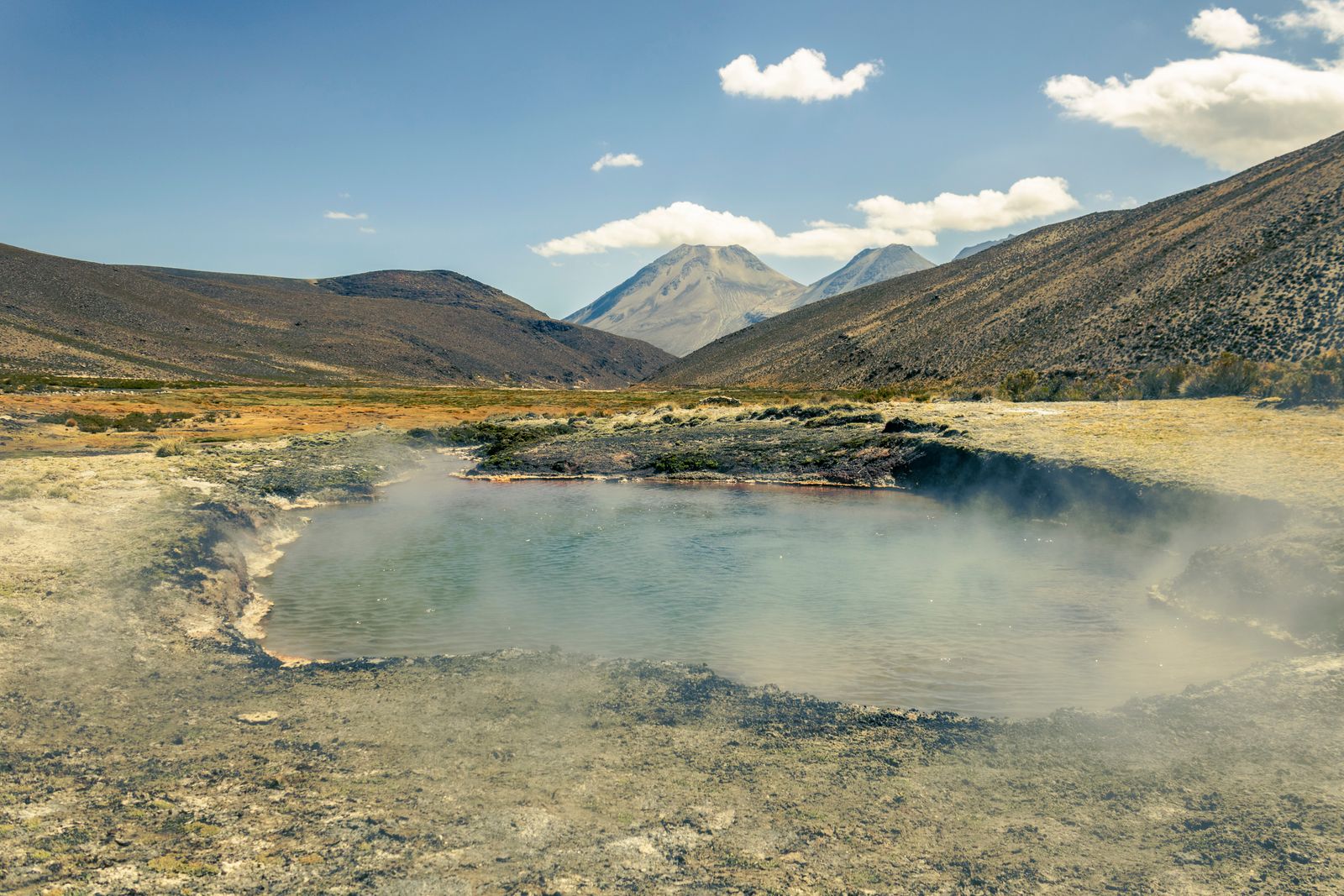
Bolivia’s best-known hot spring, Termas de Polques, sits at about 4,400 metres on the shore of Laguna Salada, and the water holds steady near 29–30 °C. On a July morning the air above it is often below freezing. That contrast — not the temperature itself — is why people remember it. But Polques is only one stop on a country that sits directly on top of one of the most active volcanic belts in the Andes, and several of Bolivia’s other thermal pools are warmer, quieter and far more comfortable than a concrete basin at dawn in the Lípez desert.
Here is what we would actually tell a friend about each one.
Why Bolivia has so many hot springs
The western third of the country runs along the Central Volcanic Zone of the Andes. Magma sits close enough to the surface that groundwater filtering down through the altiplano comes back up hot, mineralised and — in the far southwest — sometimes boiling. The result is a scatter of thermal sites from the Chilean border down to the Lípez, most of them above 3,400 metres.
Two things follow from that geography, and both matter for planning:
- Altitude comes with the water. There is no low, easy hot spring in Bolivia. The mildest option on this list is still at 3,450 m.
- Almost none of them are developed resorts. Expect a changing room, a concrete edge and a cash box. Sometimes not even that.
Termas de Polques: the one on every Uyuni itinerary
If you book a three-day southwest circuit out of Uyuni, you will end up here on the morning of day three, usually between six and eight. It is not optional and it is not a detour — Polques sits on the only road through the reserve.
The setting
The pool is small, shallow and edged in concrete, built into the shoreline of Laguna Salada at the foot of Cerro Polques. There is no roof. You get out of a Land Cruiser in a hat and three layers, change in a breeze-block hut, walk twenty metres across frozen gravel, and slide into water at body temperature while flamingos work the shallows across the lagoon.
Getting there and what it costs
Access is by 4×4 only, as part of an organised tour from Uyuni or coming the other way from San Pedro de Atacama. There is no public transport and no sensible independent option: the altitude, the cold and the total absence of fuel or help make this a guided route.
The Eduardo Avaroa Andean Fauna National Reserve charges 150 Bs for foreign visitors and 30 Bs for Bolivians. That is roughly USD 13 at the 2026 exchange rate of about 11.87 Bs to the dollar. It is collected in cash at the control post and is almost never included in the tour price your agency quotes. Bathing at Polques carries a small separate fee of a few bolivianos.
The reserve itself is enormous — 7,147.45 km², established in 1973, spanning everything between 4,200 and 5,400 metres. Laguna Colorada, 4,278 m and 60 km² but less than a metre deep, sits on the same route, along with three flamingo species: Andean, James’s and Chilean.
Practical notes
- Pack your swimsuit on top of your duffel the night before. Digging through a frozen bag at 6 am in front of twelve strangers is a rite of passage nobody needs.
- Bring a small towel of your own. Tours do not supply them.
- Change fast on the way out. Wet hair at 4,400 m in a Lípez wind is genuinely unpleasant, and the drive to the Chilean border comes straight after.
Sol de Mañana: look, don’t touch
Fifteen minutes further up the road sits Sol de Mañana, at roughly 4,900 metres — among the highest geothermal fields anywhere that visitors can walk into. Across about 10 km² you get steam vents, boiling mud pools, hot springs and fumaroles that reach 70 °C. Under the right conditions the steam and water emissions climb as high as 200 metres. The field puts out enough heat to show up from orbit in ASTER satellite imagery.
It is spectacular, it smells strongly of sulphur, and it is not a bathing site.
The crust around the mud pools is thinner than it looks and gives way without warning. Every guide on this circuit keeps groups on the compacted ground, and every one of them has a story about why. Follow the person who lives here.
Sajama: the pools under Bolivia’s highest mountain
If you would rather soak properly than tick a box on a tour itinerary, go to Sajama National Park in Oruro instead.
Created in 1939, it is Bolivia’s oldest protected area: 1,002 km² of high dry puna built around Nevado Sajama, the country’s highest peak at 6,542 m, with the twin Payachata volcanoes on the Chilean border behind it. The park was added to Bolivia’s UNESCO World Heritage Tentative List in 2003, largely for its queñua (Polylepis tarapacana) woodland, some of the highest forest on Earth.
The thermal pools at Manasaya are the reason to stay. The water runs around 35 °C — noticeably warmer than Polques — and the community built proper facilities in 2016: showers, changing rooms, toilets and a restaurant, run by local comunarios. Entry is 30 Bs for foreign visitors and 15 Bs for Bolivians.
The difference from Polques is the pace. Sajama village is about 360 km from La Paz, and there is lodging there. You can arrive in the afternoon, sleep, and get into the water when you feel like it rather than when a convoy schedule says so. Sitting in 35 °C water at dusk with a 6,542 m volcano turning pink in front of you is, for our money, the best thermal hour in the country.
Termas de Urmiri: the weekend escape from La Paz
For paceños, thermal water means Urmiri. Termas de Urmiri sits at 3,450 m, about 98 km and two hours by road from La Paz, tucked into a canyon that shelters it from the altiplano wind — which is the whole trick. It is several degrees warmer down there than on the plateau above.
Three groups of springs feed two main pools plus smaller baths, and there is a hotel on site. It is the one place on this list you can reach on a Saturday morning without a 4×4 or a tour agency, and the one where locals actually outnumber travellers.
Oruro’s everyday termas
The Oruro altiplano has a scatter of smaller thermal complexes — Obrajes and Capachos are the two most people mention — used far more by Bolivian families on a Sunday than by anyone with a backpack. They are municipal in feel: tiled pools, a canteen, kids everywhere. If you happen to be in Oruro around Carnaval and want somewhere to recover, ask locally; they are cheap, unglamorous and exactly what a sore body needs.
When to go
- May to September (dry season) gives you clear skies and the sharpest hot-cold contrast. It is also when night temperatures in the Lípez drop well below zero, which makes the pool better and the walk back worse.
- November to March brings rain and softer nights. Roads in the southwest can wash out and some circuits shorten or reroute. Sajama and Urmiri stay accessible year-round.
- Whatever the season, morning is when Polques happens — that is simply how the Uyuni circuit is timetabled.
Altitude, cash and other things that catch people out
Acclimatise first. Every site here is high. Hot water dilates your blood vessels and can make mild altitude symptoms feel worse for the first few minutes. If you flew into La Paz two days ago and have not spent a night above 3,600 m, keep the soak short.
Carry cash in bolivianos. No card works at any of these places. Reserve entry, bathing fees, tips and the odd bottle of water are all cash. Draw it in Uyuni, La Paz or Oruro before you leave.
Do not drink from thermal sources. The mineral content that makes the water good on your skin makes it a poor idea internally, and in the Lípez there is arsenic in some groundwater.
Sun at 4,400 m is unforgiving. Wet skin at that altitude burns fast even when the air is freezing. Sunscreen goes on before you get in.
If you are building a southwest itinerary around Polques and Sol de Mañana, our three-day Uyuni circuit guide covers the route day by day, and the altitude guide is worth reading before you fly into La Paz. Questions about which spring suits your trip? The FAQ below covers the ones we get asked most.
Key facts
- → Termas de Polques sit at about 4,400 m on the shore of Laguna Salada, with water holding steady near 29–30 °C.
- → The Eduardo Avaroa Andean Fauna National Reserve covers 7,147.45 km² between 4,200 m and 5,400 m and was established in 1973.
- → The Sol de Mañana geothermal field lies at roughly 4,900 m and spreads steam vents, mud pools and fumaroles reaching 70 °C across about 10 km².
- → Sajama National Park, created in 1939, is Bolivia's oldest protected area at 1,002 km² and contains Nevado Sajama, the country's highest peak at 6,542 m.
- → The Manasaya community pools inside Sajama National Park hold water at around 35 °C and charge 30 Bs for foreign visitors and 15 Bs for Bolivians.
- → Termas de Urmiri lie at 3,450 m, roughly 98 km and two hours by road from La Paz.
- → Entry to the Eduardo Avaroa reserve costs 150 Bs for foreign visitors and 30 Bs for Bolivians, cash only — about USD 13 at the 2026 rate near 11.87 Bs to the dollar.
Frequently asked questions
Is Termas de Polques included in the Uyuni three-day tour price? +
The stop is included, but the money is not. Almost every three-day southwest circuit pulls in at Polques around seven in the morning, and the reserve entrance of 150 Bs is normally charged separately in cash. Bathing itself carries a small extra fee of a few bolivianos collected at the pool. Bring the notes with you from Uyuni — there is no ATM anywhere on the circuit.
Can you swim in the Sol de Mañana geysers? +
No, and you should not try. Sol de Mañana is a geothermal field at roughly 4,900 m where fumaroles reach 70 °C and steam can shoot up to 200 metres under the right conditions. The crust around the mud pools is thin and gives way without warning. Guides keep groups on marked ground for good reason. The bathing pool is at Polques, about fifteen minutes back down the road.
Which Bolivian hot spring is best if I am not doing the Uyuni circuit? +
Sajama National Park in Oruro. The Manasaya community pools sit at around 35 °C — warmer than Polques — directly beneath Nevado Sajama, Bolivia's highest peak at 6,542 m, and you can stay overnight in the village instead of arriving frozen at dawn. Entry is 30 Bs for foreign visitors. If you only have a weekend from La Paz, Termas de Urmiri at 3,450 m is two hours away.
What is the water temperature at Termas de Polques? +
Around 29–30 °C, which is pleasant rather than hot. On a July morning the air outside can sit below freezing, so the contrast feels far stronger than the number suggests. The pool is shallow, concrete-edged and open to the sky, looking straight across Laguna Salada. Most people last twenty to thirty minutes before the walk back to the changing rooms becomes the hard part.