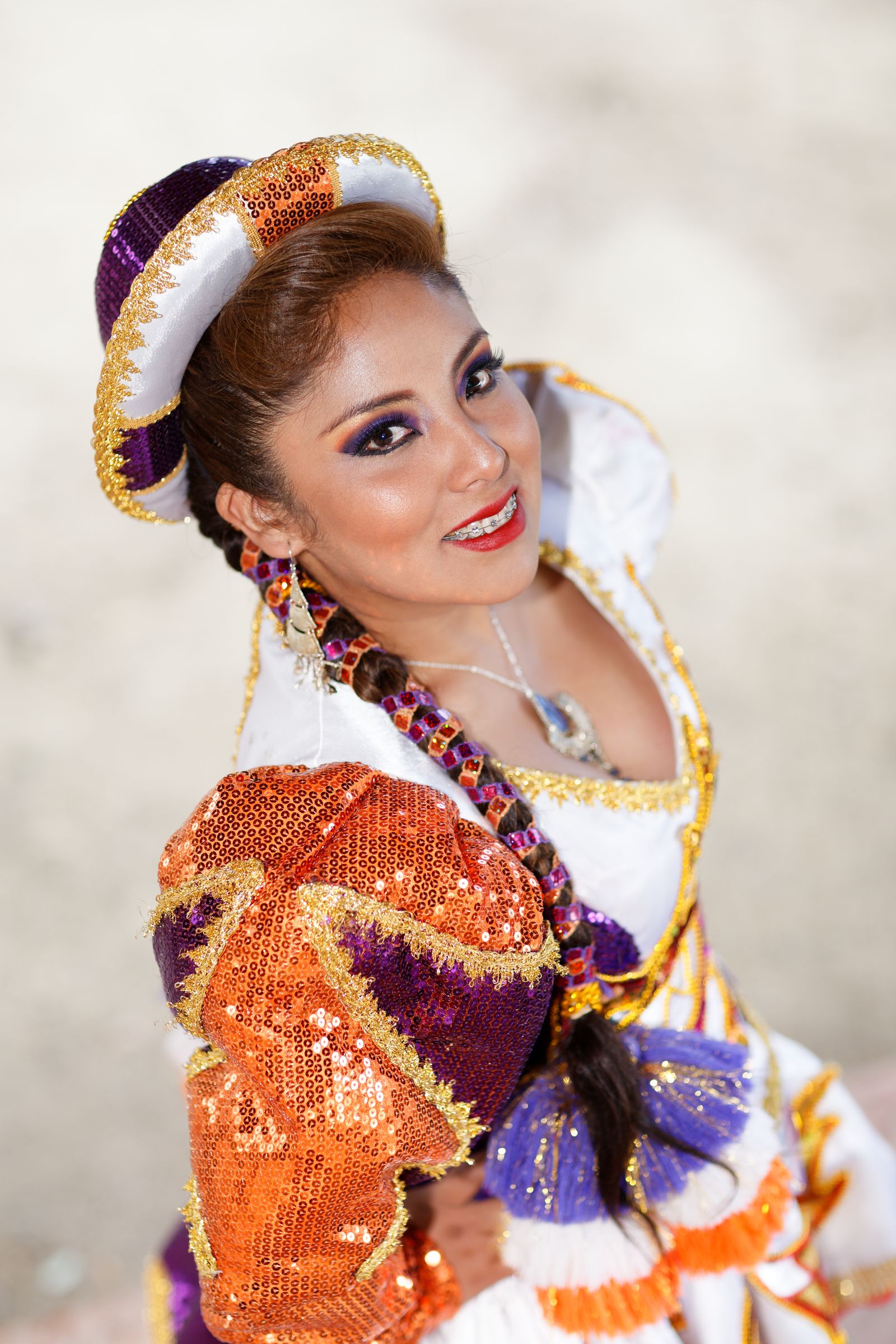
Bolivian traditions are not something you go looking for. They find you: the taxi driver who splashes the first mouthful of his soda onto the road, the bread shaped like a baby in a bakery window at the end of October, the dried llama foetus hanging in a market stall two blocks from your hotel. This guide covers the twelve customs a traveller is most likely to meet on a normal trip, what each one means, and how to behave around them without causing offence.
Three of them carry UNESCO status on the Representative List of the Intangible Cultural Heritage of Humanity — the Carnival of Oruro, the Alasita ritual journeys and the Gran Poder festival of La Paz — but the ones that will shape your trip most are the small, daily gestures that nobody bothers to explain.
What “tradition” means here
In Bolivia the word rarely means something preserved. Roughly two-thirds of the population identifies with an Indigenous people, and Aymara and Quechua practice was never separated cleanly from Catholicism after the conquest — it was layered under it. What survives is not folklore performed for outsiders but a working religion with a calendar, a set of specialists and a price list.
That layering is why the same person will light a candle to a saint on Sunday and burn an offering to the earth on Tuesday, and see no contradiction at all.
Rituals for the earth
1. The ch’alla
The single most common ritual act in Bolivia. Before drinking, you tip a little of your beer, chicha or singani onto the ground for Pachamama — the earth. It happens at construction sites, in offices on the first Friday of the month, at family lunches and in dive bars in El Alto.
You will be offered a glass and expected to do it. Pour a splash, drink, pass the glass on. In many rural settings there is only one glass for the whole group, refilled and handed round, and refusing it outright reads as a rejection of the company rather than of the alcohol. Taking a sip and passing it along is enough.
2. The mesa
A mesa is a bundle of offerings — sugar tablets moulded with symbols, coloured wool, sweets, herbs, incense, sometimes a llama foetus — assembled to be burned for the earth. In La Paz you buy the components at the Mercado de las Brujas on Calle Linares and Calle Sagárnaga. Expect about $3 to $10 for a small pre-assembled bundle. A full ceremony conducted by a yatiri, an Aymara ritual specialist, typically runs $30 to $70 depending on the occasion.
Travellers are sometimes offered a mesa de salud or a blessing for the journey. It is a legitimate thing to accept if you are respectful about it. It is not a photo opportunity.
3. August, the hungry month
August is Pachamama’s month. The earth is said to be open and hungry, and the first of August is when the year’s most serious offerings are made. If you travel in August you will smell burning koa and palo santo in the streets, hear firecrackers set off to drive away bad energy, and see ribbons tied around trucks, market stalls and shop doorways. It is the best month of the year for anyone genuinely interested in living Andean practice.
The calendar traditions
4. Alasita — 24 January
Alasita is the miniature fair, and it is glorious. Beginning every 24 January in La Paz and running two to three weeks, it revolves around Ekeko, the household god of abundance: a small plump figure loaded with tiny versions of everything you want. You buy a miniature of the thing you hope for that year — a house, a diploma, a passport, a stack of banknotes, a truck — and have it blessed, either by an Andean ritualist or by a Catholic priest, usually both being available within the same block.
UNESCO inscribed the ritual journeys of Alasita in 2017. Miniatures start under a dollar. It is the cheapest and most charming souvenir in the country.
5. Carnaval de Oruro
The biggest single expression of Bolivian tradition. More than 28,000 dancers and 10,000 musicians in roughly fifty groups move along a four-kilometre route and repeat it for twenty hours without stopping. The Diablada — the devil dance — leads, and the whole thing is an offering to the Virgen del Socavón, the miners’ virgin.
Oruro sits at 3,706 m, about 3.5 hours by bus from La Paz for $5 to $8. Grandstand seats along the route are sold in advance and typically cost $20 to $60 for the main Saturday. Book accommodation months ahead; the town roughly triples in population.
6. Gran Poder — La Paz
Held on the weekend around the Feast of the Holy Trinity, usually late May or June, Gran Poder is La Paz’s own entrance: around 40,000 dancers, 7,000 musicians and 69 fraternities, inscribed by UNESCO in 2019. It began as a neighbourhood festival in Ch’ijini and became the city’s statement of Aymara urban wealth and pride. Unlike Oruro it is free to watch from the street, and it is the better choice if you want to see the tradition without the tourist infrastructure around it.
7. Willkakuti — 21 June
The Aymara New Year, marking the southern winter solstice and the return of the sun. It has been an immovable national holiday since Supreme Decree 173 of 2009. The best-known ceremony takes place at Tiwanaku, 72 km from La Paz at roughly 3,850 m, where thousands stay up all night to raise their palms to the first light.
Be honest with yourself about the cold. Night temperatures at the solstice regularly drop below freezing on the altiplano and the ceremony runs from about 4 a.m. Organised transport from La Paz costs around $20 to $35 return.
8. Todos Santos — 1 and 2 November
The most moving of them all. Families believe the ajayu, the soul of the dead, returns to visit. On 1 November households build a table of offerings for children who have died; on 2 November the observance turns to adults, and families take the food to the cemetery to eat with their dead.
The centrepiece is the t’anta wawa — Aymara for “bread baby” — a sweet roll shaped and decorated as an infant, with a painted plaster face. Bakeries sell them from around $1 to $2. You will also see sugar cane arches, ladders made of bread to help the soul climb, and enormous quantities of food that is later given away.
A Bolivian cemetery on 2 November is not a sad place. There are bands, beer, children playing between the graves and someone crying quietly in a corner, all at once. If you are invited, go — and take bread.
Everyday customs
9. Coca
Legal, ordinary and everywhere. A bag of leaves costs one to two dollars in any market. People chew it to work, to travel, to blunt hunger and altitude, and yatiris read it. Accepting a handful when it is offered is good manners. Do not try to take it home.
10. The pollera and the bowler hat
The layered skirt, the fringed shawl and the borsalino hat worn by cholitas are daily clothing, not costume, and a single good pollera outfit can cost several hundred dollars. Over the last two decades the look has moved from a marker of discrimination to one of status — there are cholita fashion shows, cholita wrestling in El Alto and cholita climbers who have summited Illimani in full skirts. Ask before photographing.
11. The aptapi
A shared meal where everyone lays what they brought on a cloth on the ground and the whole group eats from it with their hands — potatoes, chuño, broad beans, cheese, dried meat. If you are travelling around Lake Titicaca or on a community tour you will almost certainly be invited to one. Bring something to add.
12. Día del Peatón
Not ancient at all, but genuinely Bolivian. Law 150 of 2011 created the National Pedestrian and Cyclist Day in Defence of Mother Earth on the first Sunday of September, when motor traffic is banned from city streets and La Paz fills with families, bicycles and street games. Some years municipalities add extra car-free Sundays. If your dates land on one, do not fight it — walk.
How to take part without getting it wrong
Four rules cover almost everything.
- Accept what is offered, in small amounts. Coca, a glass, a plate of food. Refusing outright is the only real offence.
- Ask before photographing people; never during private ritual. Processions are fine, ceremonies are not.
- Do not haggle over ritual goods. Bargaining is normal in Bolivian markets and inappropriate for offerings.
- Use the names. Saying ch’alla, aptapi or t’anta wawa rather than “the drink thing” or “the bread” changes the whole tone of the interaction.
Planning around the traditions
If you want the greatest concentration of tradition with the most reliable weather, aim for the dry season overlap in late May and June: Gran Poder in La Paz and Willkakuti at Tiwanaku both fall in that window, and the altiplano skies are clear. February gives you Carnaval but also the heart of the rainy season, which is a fair trade if Oruro is the reason you came.
For everything else, August is the quiet answer. Fewer crowds than Carnaval, clear cold days, and a whole country making offerings to the earth in plain sight.
Key facts
- → The Carnival of Oruro gathers more than 28,000 dancers and 10,000 musicians in about 50 groups along a four-kilometre route, danced for twenty hours without interruption; UNESCO proclaimed it in 2001 and inscribed it on the Representative List in 2008.
- → Alasita begins every year on 24 January in La Paz and lasts two to three weeks; UNESCO inscribed its ritual journeys in 2017.
- → The festival of the Señor Jesús del Gran Poder in La Paz involves around 40,000 dancers, 7,000 musicians and 69 fraternities, and was inscribed by UNESCO in 2019.
- → Willkakuti, the Aymara New Year, is celebrated on 21 June at the southern winter solstice and became an immovable national holiday under Supreme Decree 173 of 17 June 2009; the main ceremony is held at Tiwanaku, 72 km from La Paz at about 3,850 m.
- → Todos Santos is observed on 1 and 2 November, with 1 November dedicated to children who have died and 2 November to adults.
- → Law 150 of 11 July 2011 created Bolivia's National Pedestrian and Cyclist Day in Defence of Mother Earth on the first Sunday of September, when motor traffic is banned from city streets.
Frequently asked questions
What is the ch'alla and can travellers take part? +
The ch'alla is the act of pouring the first sip of beer, singani or chicha onto the ground before drinking, as a share for Pachamama. Yes, you can and should join in — it costs nothing and it is the single gesture that most reliably makes Bolivians smile. Tip a small splash onto the earth, say a quiet thank you, then drink. Nobody expects you to say anything in Aymara.
When is the best month to see Bolivian traditions? +
There is no dead season, but three windows stand out. Late January brings Alasita in La Paz. February or March brings Carnaval, with Oruro as the largest expression. August is the month of Pachamama, when offerings and ch'allas are everywhere and small ceremonies happen on almost every street corner. If you can only pick one, February gives you the biggest spectacle and August the most intimate one.
Is it acceptable to photograph women in traditional dress? +
Not without asking. The pollera, the shawl and the bowler hat are everyday clothing for hundreds of thousands of Bolivian women, not a costume put on for visitors. Ask first, in Spanish, and accept a no without argument. During public processions such as Gran Poder or Carnaval the dancers are performing and photography is expected, so those are the easy contexts to shoot in.
What should I know about coca leaves before arriving? +
Chewing coca is legal and ordinary in Bolivia. Leaves are sold openly in every market for around one to two US dollars a bag, and coca tea is served in most highland hotels. It is used socially, for work and in ritual reading. Do not attempt to carry leaves out of the country: coca is controlled almost everywhere else, and airport seizures of travellers' souvenir bags are routine.