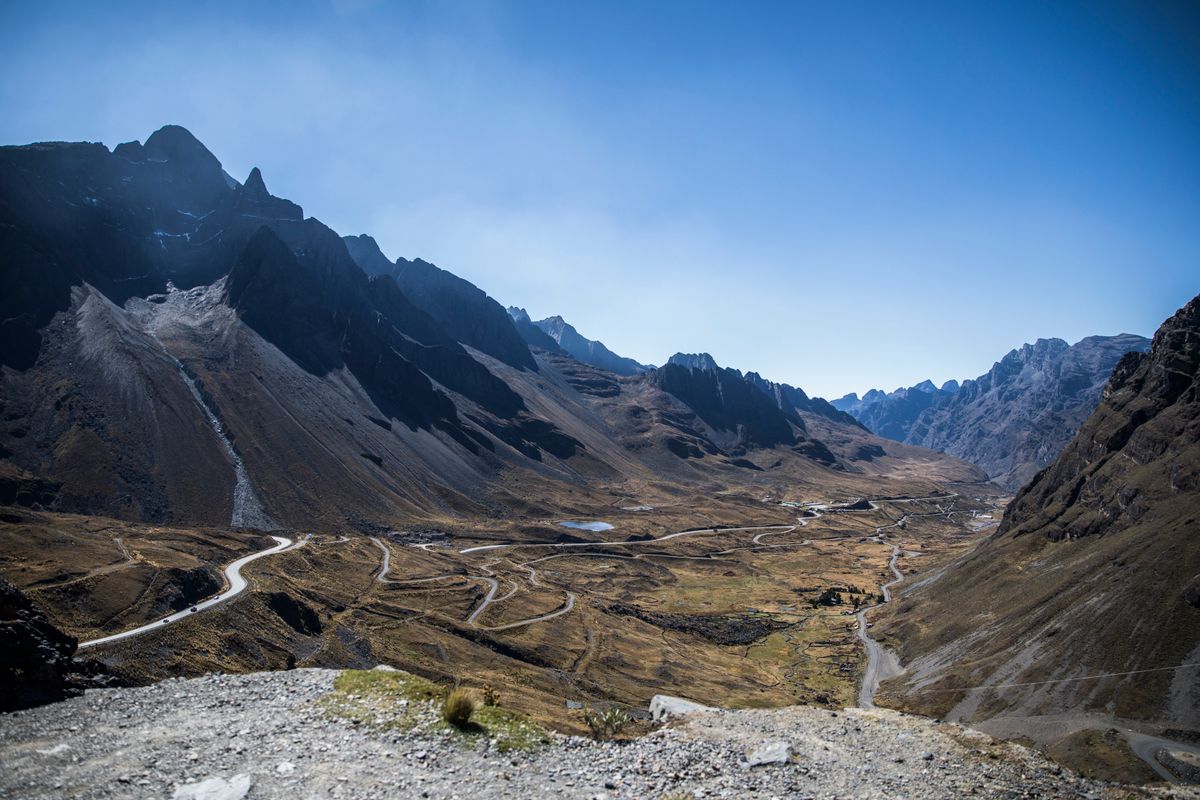
Bolivia’s Death Road — officially the North Yungas Road — is a roughly 64-kilometre mountain route that falls from the icy edge of the Andes into steaming subtropical jungle, and today it is the most famous bicycle descent in South America. You start in freezing fog near 4,650 metres and finish, three to five hours later, sweating in banana country close to 1,200 metres. In between lies about 3,500 metres of near-continuous downhill on a single-lane dirt track with no guardrails. It earned its nickname the hard way, and it remains one of the defining adventures of any trip to Bolivia.
Why they call it the world’s most dangerous road
The reputation is not marketing. In 1995 the Inter-American Development Bank formally named this the most dangerous road in the world, and the label stuck for good reason. Before the modern bypass existed, the North Yungas Road was the only link between La Paz and the Yungas, so fully loaded trucks and buses squeezed past each other on a track barely three metres wide, often in cloud, often at night. An estimated 200 to 300 people died on it every year, and long-term averages put it at roughly 209 accidents and 96 deaths annually.
To manage the terror of two vehicles meeting, drivers here broke Bolivia’s normal right-hand rule and used left-hand traffic: the downhill driver had to hug the outer edge, so they could lean out the window and watch their wheel against the void. Small stone shrines and crosses still mark the corners where trucks went over. Those unfenced drops fall hundreds of metres straight down.
The route: from the pass to the jungle
Almost every ride begins at La Cumbre, a high pass above La Paz at around 4,650 metres where the air is thin and the wind is cold enough to sting. The first stretch is actually on smooth asphalt, a fast warm-up descent through bleak altiplano scenery where you often see snow on the peaks. After roughly 20 kilometres, at a police checkpoint near Unduavi, the tour turns off onto the original gravel road — the Death Road proper.
From there the transformation is extraordinary. Over the next 40-odd kilometres the track clings to the mountainside as it drops toward Coroico and the village of Yolosa, and the landscape shifts from grey rock to green cloud forest dripping with waterfalls — some of which spill directly across the road. You lose about 3,500 metres of altitude in a single morning, which is why the ride feels less like cycling and more like controlled falling.
What a Death Road bike tour is really like
You will spend far more time braking than pedalling. Operators run the route as a guided convoy: a lead guide sets the pace, a second guide sweeps the back, and a support van follows carrying water, spare parts and anyone who decides they have had enough. The group stops every fifteen or twenty minutes to regroup, drink water, shed layers as it warms, and hear where the next section gets technical.
The surface is loose gravel, rock and, in the wet, slick mud, with blind corners and those unprotected edges always on one side. It is genuinely thrilling rather than genuinely terrifying if you ride sensibly — the danger comes almost entirely from speed and showing off, not from the road ambushing you. Most people finish grinning, filthy, and quietly proud. Tours usually end with a shower, lunch and often a pool at an animal refuge near Yolosa before the drive back up to La Paz on the safe new highway.
How much it costs and choosing a safe operator in 2026
A guided full-day descent from La Paz typically costs US$80 to US$130 in 2026. A fair price should include a well-maintained full-suspension mountain bike, a helmet and body armour, gloves, an experienced guide, the support vehicle, breakfast and lunch, and your transfer back to the city. Bring a little extra cash for a small community road toll collected at a checkpoint, which is not always in the ticket price.
This is the one Bolivian activity where you should not book the cheapest option you can find. The gap between a US$45 tour and a US$110 tour is usually brakes, bikes and guides — precisely the things keeping you on the mountain. Ask what bikes they use, whether pads and rotors are replaced regularly, the maximum group size, and how many guides ride with each group. Reputable, safety-focused companies have run this route for over two decades; choose one of them, read recent reviews, and never feel pressured to ride faster than you want.
When to go and what to expect from the weather
You can ride the Death Road year-round, but conditions vary sharply with Bolivia’s two seasons. The dry season, roughly May to October, is the safest and most popular window: firmer gravel, better grip and clearer views into the valley. The wet season, November to March, brings mud, fog that can swallow the drop-offs, more waterfalls across the track and a higher chance of small landslides. Serious operators still run in the rain with extra caution, but if you have a choice, aim for the dry months and an early-morning start before the afternoon cloud builds.
Whatever the month, dress in layers. You begin in near-freezing alpine air and end in humid tropical heat, so you will peel off a windproof jacket and gloves as you descend. Sunglasses or clear glasses matter more than people expect, both for the cold wind at the top and the grit kicked up on the trail.
How to prepare — and the altitude question
The single most important preparation has nothing to do with cycling: acclimatise first. The ride launches from 4,650 metres, and La Paz itself sits around 3,600 metres, so spend at least two or three days in the highlands before you go. If you arrive and immediately throw yourself down a mountain, altitude sickness can turn a bucket-list day into a miserable one. Our Bolivia altitude guide covers how to adjust, from coca tea to taking it slow.
Beyond that, you need very little. Closed shoes with grip, a small daypack, sunscreen, a bandana for dust, and a camera or action cam you can mount rather than hold — keep both hands on the bars. You do not need to be an athlete; the route is downhill and beginners complete it daily. You do need working brakes and honest judgement about your own comfort with heights and speed.
Is the Death Road safe to ride today?
Far safer than its name and history suggest — with an important caveat. Since the paved bypass opened in 2006, almost all the trucks and buses that caused the old carnage now use the new highway, so you will rarely share the gravel with a vehicle. The road today exists mostly for tourism, drawing about 25,000 cyclists a year.
But it is not risk-free. At least 18 cyclists have died on it since 1998, and those deaths were overwhelmingly caused by riders going too fast, riding too close to the edge, or losing focus on a photo. Treat it with respect, stay well inside the outer line, brake before corners rather than in them, and follow your guides, and the odds are strongly in your favour. If you want the wider picture on travel risks in the country, see our honest Bolivia safety guide.
Beyond the ride: Coroico and the Yungas
The Death Road is a descent into one of Bolivia’s most beautiful and overlooked regions. Coroico, the small town where most tours end their day, is a warm, green hill town surrounded by coffee and coca farms, waterfalls and walking trails — a perfect place to spend a night or two decompressing after the ride rather than rushing straight back to the cold of La Paz. Many travellers pair the descent with a couple of relaxed days in the Yungas before continuing their journey.
Ridden with the right operator and the right mindset, the North Yungas Road is not a reckless dare but a genuinely world-class adventure: a single unforgettable morning that carries you from Andean ice to Amazonian green, down the most storied road on the continent. For where it fits in a wider trip, see our Bolivia Andes travel itinerary.
Key facts
- → The North Yungas Road runs about 64 km (40 mi) from La Paz toward Coroico and descends roughly 3,500 m (11,500 ft) from the La Cumbre pass to the Yungas valley floor.
- → In 1995 the Inter-American Development Bank named it the world's most dangerous road; before a bypass highway opened in 2006, an estimated 200 to 300 people died on it each year.
- → The original road is only about 3 metres wide in places, with cliffs plunging hundreds of metres and no guardrails, and uses left-hand traffic so downhill drivers can watch their outer wheel.
- → Around 25,000 tourists ride the Death Road every year, almost all on guided mountain-bike descents; at least 18 cyclists have died on it since 1998.
Frequently asked questions
Is the Death Road still dangerous now that there's a new highway? +
The through traffic that caused most deaths moved to the paved bypass in 2006, so you will rarely meet a bus on the old road. The real risk today is cyclist error on loose gravel beside unfenced drops. At least 18 riders have died since 1998, almost always from going too fast or too close to the edge.
How much does a Death Road bike tour cost in 2026? +
A guided full-day descent from La Paz typically costs US$80 to US$130 in 2026. That usually covers a quality mountain bike, helmet and body armour, an English-speaking guide, a support van, breakfast and lunch, and the transfer back to the city. Very cheap tours often cut corners on brakes and guides, so this is not the place to save money.
Do I need to be very fit or an expert cyclist? +
No. The route is almost entirely downhill, so you brake and steer far more than you pedal, and beginners ride it every day. What matters is comfort on a mountain bike, working brakes, and the discipline to ride within your limits. You should also spend two or three days acclimatising in La Paz first, because the ride starts at about 4,650 m.