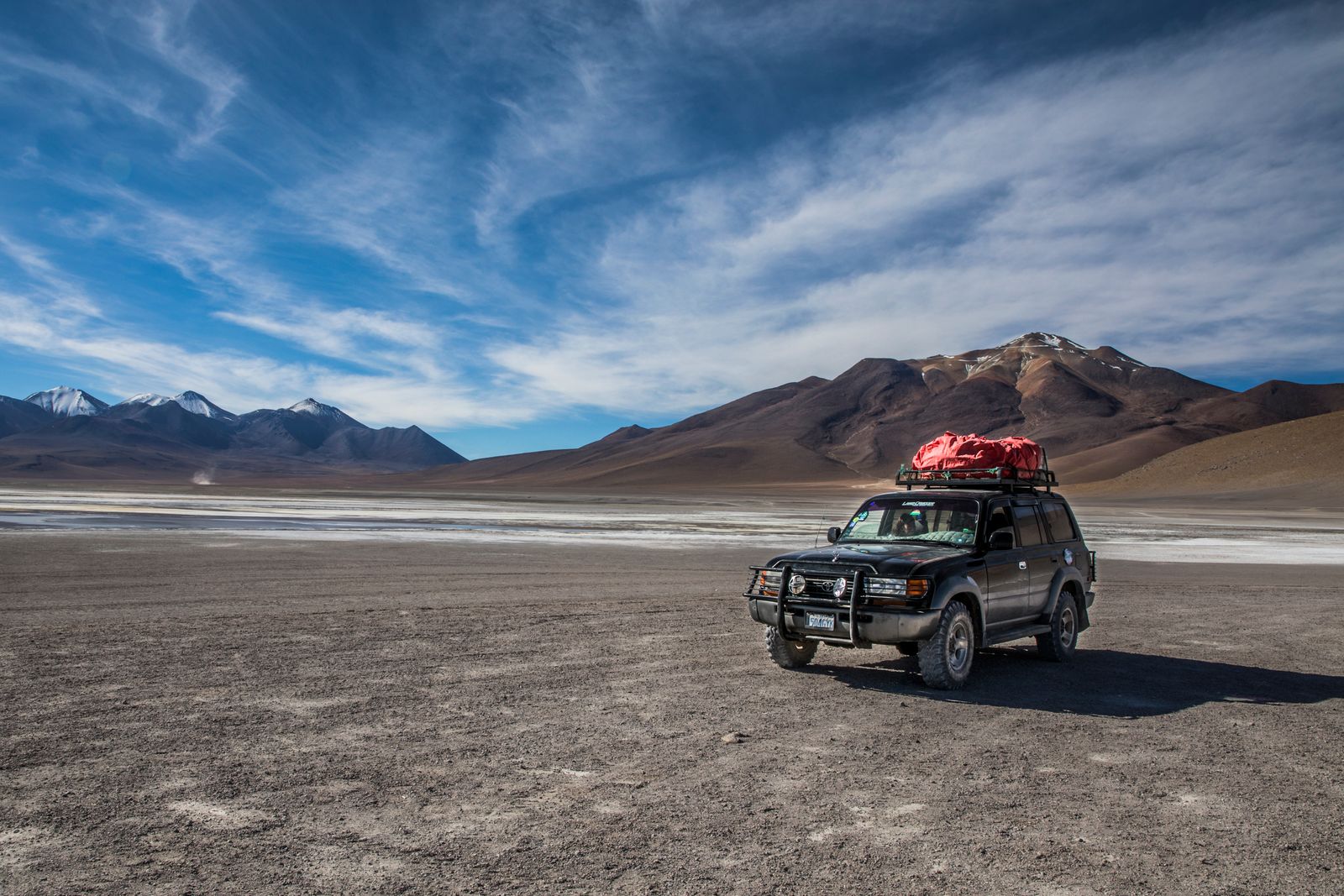
Yes, you can drive yourself around Bolivia, and on some routes it is genuinely the best way to travel. But the country splits cleanly into roads where a rental car is a pleasure and roads where it is a mistake, and the line between them is not always where a foreign driver expects it. This guide covers what it costs, what the paperwork actually requires in 2026, and which corridors are worth the steering wheel.
The short version: rent for the valleys, the Chiquitanía and Lake Titicaca. Take a bus or a flight for the long altiplano hauls. Never take a rental onto the salt flat or into the southwest lagoons.
What it costs in 2026
Car hire in Bolivia is cheaper than in Chile or Peru but not free. Expect around USD 34 a day for a small hatchback booked in advance, and USD 52–56 a day for a standard sedan picked up in La Paz or Santa Cruz. A proper 4x4 — a Toyota Hilux or a Land Cruiser Prado, which is what local agencies actually stock — runs closer to USD 90–130 a day, more in high season.
Fuel is where Bolivia surprises people. Since Supreme Decree 5516 came into force on 13 January 2026, prices are fixed nationwide:
- Gasolina especial: 6.96 Bs per litre (about USD 0.59)
- Diesel oil: 9.80 Bs per litre (about USD 0.83)
- Gasolina premium: 11.00 Bs per litre
At the unified 2026 exchange rate of roughly 11.87 Bs to the dollar, filling a 50-litre tank costs around 348 Bs — close to USD 29. That is still cheap by South American standards, and it is one of the strongest arguments for driving here.
The foreign-plate rule that does not apply to you
You will read online that foreigners pay triple for fuel in Bolivia. That is out of date, and it was never about the driver’s nationality anyway — it was about the plates on the vehicle.
The ANH sets a separate gasolina especial internacional price of 8.68 Bs per litre for foreign-plated vehicles, a differential of 1.72 Bs over the domestic rate. Diesel for foreign plates is charged at the same 9.80 Bs, with no differential at all. If you are driving your own overland vehicle down from Chile or Brazil, that surcharge is what you pay. If you rented the car in La Paz, it has Bolivian plates and you pay the domestic price like everyone else.
The old three-to-one foreign fuel surcharge is gone. What remains is a modest 1.72 Bs differential on gasoline, and only for vehicles registered abroad.
Paperwork: licence, SOAT and the documents in the glovebox
Bolivia has not ratified the 1949 or 1968 road traffic conventions, which means no treaty obliges the country to accept an International Driving Permit. That sounds like you do not need one. In practice you do, because the rental agency will ask for it and because a transit officer at a rural checkpoint will move much faster through a document he can read.
Carry, every time you drive:
- Your original home driving licence
- An International Driving Permit
- Your passport (or at minimum a good photocopy plus the SIGEMIG entry record)
- The vehicle’s tarjeta de propiedad and the rental contract
- Proof of SOAT — the compulsory accident insurance
- The warning triangle, which is legally required to be in the car
SOAT costs 90 Bs a year for a private vehicle in 2026 — the fifth consecutive year without a price change — and covers up to 24,000 Bs in medical expenses per accident and up to 22,000 Bs in the event of death. Any car you rent from a legitimate agency will already have it; check the sticker on the windscreen before you drive off. Foreign-plated vehicles entering the country provisionally or temporarily are exempt from SOAT for a maximum of 30 days, though that exemption does not release the driver from civil or criminal liability in a crash.
Minimum age varies by agency: some rent from 21, most want 25 and at least one year of licence history, and nearly all require a credit card in the driver’s name for the deposit.
Road rules and what actually happens on the road
Bolivia drives on the right. Typical limits are 50 km/h in built-up areas, 70 km/h on rural roads and 80 km/h on highways, and you should follow posted signs where they differ. There are effectively no speed cameras — enforcement is done by the Policía de Tránsito stopping vehicles directly.
Three things catch visitors out:
Trancas. These are the toll and control posts on every major highway. You stop, you pay a small fee (usually 3–15 Bs depending on the road and vehicle class), you keep the receipt. Keep coins and small notes within reach; nobody wants to break a 200 Bs note at a tranca.
Bloqueos. Road blockades are a normal part of Bolivian political life and can close a corridor for hours or days with little notice. Before any long drive, check the ABC road status page and ask at your hotel. This is the single biggest reason to leave slack in a driving itinerary.
Night driving. Do not. Unlit trucks, livestock on the carriageway, unsigned roadworks and the absence of hard shoulders make Bolivian highways after dark a genuinely different risk category. Plan to be parked by sunset — which on the altiplano is around 18:15 all year.
Where driving yourself is a good idea
Santa Cruz and the Chiquitanía
The best driving in the country. The road out to Samaipata — about 120 km and two and a half hours from Santa Cruz de la Sierra — climbs from 416 m into green hills and is a genuine pleasure. The Jesuit Missions circuit through San Javier, Concepción and San Ignacio is a loop that public transport handles badly and a car handles beautifully. Roads are paved, flat and warm.
The valleys: Sucre, Potosí, Tarija
Sucre to Potosí is roughly 150 km and three hours of paved mountain road, ending at 4,090 m. Around Tarija, the wine route through the Valle de la Concepción is short, sunny and made for a car. These are the drives where you stop when you want to, which is the whole point.
Lake Titicaca
La Paz to Copacabana is about 150 km and three and a half hours, including the Tiquina crossing, where your car goes onto a flat wooden barge and you go onto a separate passenger launch. It costs a few bolivianos, it looks alarming, and it is completely routine.
Where you should not drive
The salt flat and the southwest circuit
The Salar de Uyuni is not a road. The crust varies, the tracks change with the season, standing water in the rainy months hides holes, and salt destroys a vehicle’s underside — which is why every rental contract in the country explicitly forbids it. The lagoon circuit beyond, through the Eduardo Avaroa reserve above 4,000 m, is remote enough that local operators travel in convoy for good reason. Drive to Uyuni town, park, and take a tour.
The Yungas Road
The old Camino de la Muerte down to Coroico is now a cycling route, not a driving one. There is a modern paved highway that does the same journey safely; take it. The descent from La Cumbre pass at 4,650 m to Coroico at 1,525 m is over 3,000 m in a couple of hours, and your brakes will feel it either way.
La Paz city centre
La Paz is a canyon city with one-way streets, gradients that defeat underpowered rentals, minibuses that stop wherever a passenger raises a hand, and the pico y placa circulation restrictions. Use the teleférico. Pick your rental up on the way out of town, not in the middle of it.
Practical tips from people who drive here
- Fill up whenever you are below half a tank outside the main cities. Service stations on the altiplano can be 150 km apart, and supply is occasionally interrupted.
- Carry cash in small denominations. Trancas, rural fuel stations and parking attendants are cash-only.
- Download offline maps before you leave a city. Mobile coverage on the altiplano and in the Chiquitanía is patchy.
- Take altitude seriously on the first day. El Alto sits at 4,061 m. Judgement and reaction time are measurably worse in the first 48 hours; do not plan a long drive for the day you land.
- Photograph the car from every angle at pickup, including the tyres and the spare. Bolivian roads generate small damage claims.
- Budget 30% more time than any mapping app suggests. Between trancas, blockades, livestock and roadworks, it is never wrong.
Driving in Bolivia rewards a certain kind of traveller — the one who wants to stop at a roadside api stall at 4,000 m without asking a driver’s permission. Choose the right corridors, respect the ones that are not for rentals, and it is one of the great road trips on the continent.
Key facts
- → Bolivia's Red Vial Fundamental, the trunk road network managed by the ABC, measures 16,054 km.
- → Supreme Decree 5516, in force since 13 January 2026, fixes gasolina especial at 6.96 Bs per litre and diesel oil at 9.80 Bs per litre.
- → The ANH sets a separate gasolina especial internacional price of 8.68 Bs per litre for foreign-plated vehicles, a differential of 1.72 Bs per litre.
- → SOAT, Bolivia's compulsory traffic accident insurance, costs 90 Bs a year for a private vehicle in 2026 and covers up to 24,000 Bs in medical expenses per accident.
- → Foreign-plated vehicles entering Bolivia provisionally or temporarily are exempt from SOAT for a maximum of 30 days.
- → Bolivia drives on the right, with typical limits of 50 km/h in towns, 70 km/h on rural roads and 80 km/h on highways.
Frequently asked questions
Do I need an International Driving Permit to drive in Bolivia? +
Bolivia has not ratified the 1949 or 1968 road traffic conventions, so there is no treaty that obliges the country to accept an IDP. In practice most rental agencies ask for one alongside your home licence, and it makes roadside checks with the Policía de Tránsito far quicker because the officer can read your document. Bring both: original licence, IDP, passport and a credit card in the driver's name.
How much does fuel cost in Bolivia in 2026? +
Supreme Decree 5516, in force since 13 January 2026, fixes gasolina especial at 6.96 Bs per litre and diesel oil at 9.80 Bs per litre. At the 2026 unified exchange rate of roughly 11.87 Bs to the dollar that is about USD 0.59 and USD 0.83 per litre. Filling a 50-litre tank with gasoline costs around 348 Bs, close to USD 29. Prices were fixed for a six-month review period.
Is it safe to drive to Uyuni in a rental car? +
The paved corridor from La Paz through Oruro to Uyuni is fine in a normal car and takes eight to nine hours. What is not fine is driving onto the salt flat itself or continuing to the southwest lagoons: that terrain needs a 4x4, a driver who knows the crust and the tracks, and a second vehicle for backup. Park the rental in Uyuni town and join a guided tour for those two days.