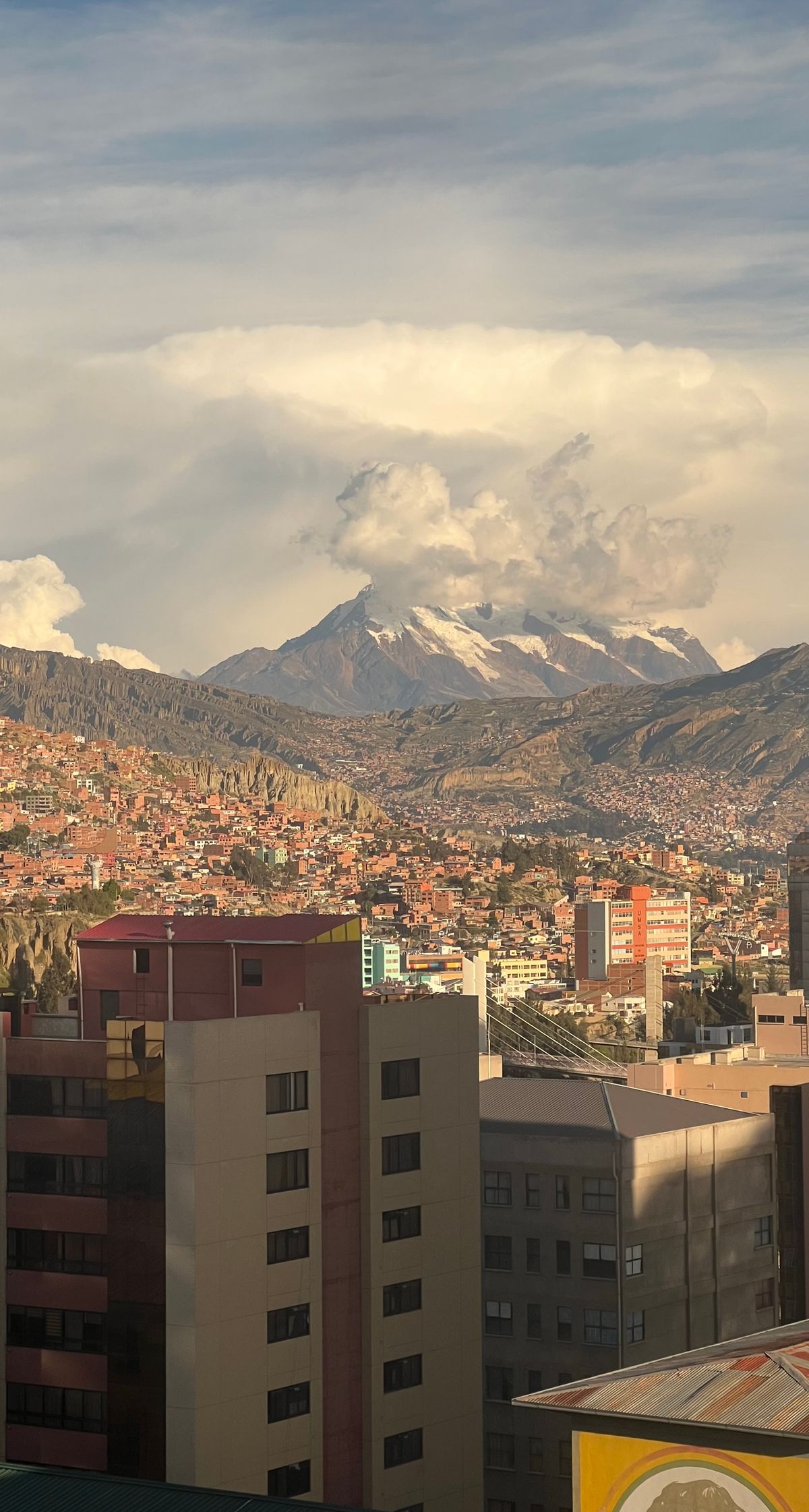
Landing at El Alto International Airport (LPB) means stepping out at 4,061.5 metres (13,325 ft) — the highest international airport in the world. From wheels-down to your hotel in central La Paz you should budget about 90 minutes: roughly 15 minutes to disembark, 20 to 40 in the immigration queue, 15 for bags, and 30 to 40 in a taxi down into the canyon. An official airport taxi to the centre runs 80 to 120 bolivianos. This guide walks through each of those steps the way a local would explain them to a friend, and covers Viru Viru in Santa Cruz too, since that is where most international flights actually land.
What actually happens when you land at El Alto
The walk to immigration
The first thing you notice is not the terminal. It is the walk. El Alto’s arrivals corridor is flat and short, and yet by the end of it many first-time visitors are breathing like they climbed a hill. That is not fitness — it is 4,061 metres. Roughly 40% less oxygen reaches your lungs with each breath than at sea level.
Do not race for the front of the queue. There is nothing to win there, and arriving at passport control with your heart pounding is a bad way to start a trip.
Immigration and SIGEMIG
Bolivian passport control at El Alto is straightforward but not fast. Two things speed it up dramatically:
- Your SIGEMIG QR code, saved as a screenshot. SIGEMIG is Bolivia’s free online entry registration, mandatory for nearly all foreign arrivals including visa-free nationalities. Airport wifi is patchy; a screenshot always loads.
- A printed or offline copy of your first night’s accommodation. Officers routinely ask for an address.
Expect 20 to 40 minutes at busy times, which at El Alto means the early-morning bank of arrivals from Lima, Santiago and São Paulo, and the late-night Madrid connection.
If you have not completed SIGEMIG, officers can usually register you on the spot, but you will be pulled aside and it adds real time. Do it before you fly.
Baggage, customs and the exit hall
Bags come out slowly. Fifteen to twenty minutes is normal. Customs is a green-channel/red-channel setup and most tourists walk straight through.
The exit hall is small and it will feel crowded. There is a cluster of taxi drivers immediately past the doors. Some are official, some are not, and the difference matters.
The altitude: what 4,061 metres does to you in the first hour
Central La Paz sits at about 3,640 m — some 400 metres below the airport. So the drive from El Alto into the city is a descent, and many people feel noticeably better by the time they reach their hotel. That single fact reassures more arriving travellers than anything else I tell them.
Still, the first 24 hours matter. What locals actually do:
- Move at half speed. Everything: walking, lifting your bag, climbing the hotel stairs.
- Drink water constantly. The altiplano air is extremely dry and dehydration amplifies every altitude symptom.
- Skip alcohol on day one. One beer at 3,640 m does not feel like one beer.
- Eat light. Soup, bread, fruit. Heavy meals sit badly.
- Say yes to the coca tea. Almost every hotel offers mate de coca on arrival. It genuinely helps, and it is completely legal and normal in Bolivia.
The mistake I see most often is not altitude sickness itself — it is a traveller landing at 7am, dropping their bags, and immediately walking uphill to a viewpoint. Give the first afternoon to your body. The city will still be there tomorrow.
If you have a choice, consider flying into Santa Cruz (373 m) first and acclimatising upward over a few days. If you land straight into La Paz, build a genuinely empty first afternoon into your itinerary.
Getting from El Alto airport into La Paz
The airport is 13 km west of central La Paz, but those 13 km include a dramatic drop off the altiplano rim into the bowl the city sits in.
Official taxi — the default choice
Look for the official radio taxi desk inside the terminal rather than accepting an offer in the car park. Rates to Sopocachi, San Pedro or the centre run 80 to 120 bolivianos (roughly USD 8 to 12 in July 2026). To the Zona Sur — Calacoto, San Miguel, Achumani — expect more, since it is a longer descent.
Meters are essentially never used. Agree the fare before you get in. This is not haggling in a tense sense; it is simply how it works, and drivers expect the question.
Journey time: 30 to 40 minutes typically, closer to 25 late at night. Thursday and Sunday are major market days in El Alto and traffic can be genuinely slow.
Pre-booked hotel transfer
Most mid-range and upper hotels in La Paz will send a driver for a fixed price, usually a little above the taxi rate. After a long-haul flight arriving at altitude, having someone holding a sign with your name on it is worth the difference. This is what I recommend for anyone arriving at night or travelling with children.
The cheap way: minibus plus Teleférico
Local minibuses run from outside the airport into El Alto for a handful of bolivianos. From there you can pick up Mi Teleférico, the cable-car network that connects El Alto to La Paz — a single line costs 3 bolivianos, with each connecting line adding 2.
It is spectacular. Riding down into the bowl of La Paz with Illimani ahead of you is one of the great urban journeys anywhere. But it is not a good idea with luggage on your first arrival, when you are unacclimatised and carrying everything you own. Save the Teleférico for day two, when it becomes the best-value sightseeing in Bolivia.
If you are arriving at Viru Viru instead
Many international routes into Bolivia land in Santa Cruz de la Sierra, not La Paz. Viru Viru International Airport (VVI) sits at just 373 m and is Bolivia’s busiest, handling 4,116,329 passengers in 2023 against El Alto’s 2,607,457.
Practically, this changes everything about your arrival:
- No altitude issues. You will step into heat and humidity instead.
- The airport is 17 km north of the city centre, roughly 25 to 30 minutes by taxi.
- Domestic connections onward to La Paz, Cochabamba and Sucre are frequent, mostly on Boliviana de Aviación.
If your itinerary allows it, arriving at Viru Viru and flying up to La Paz two or three days later is the gentlest possible introduction to Bolivia.
Money at the airport in 2026
This has changed recently and it is worth understanding before you land.
Bolivia held its currency at a fixed 6.96 bolivianos per US dollar for well over a decade. In late June 2026 the government ended that peg and moved to a floating rate, with the official value settling around 9.7 bolivianos per dollar. In practical terms, the large gap between the official rate and the informal “parallel” rate that frustrated travellers for years has largely closed.
What that means at the airport:
- Change a small amount only. Enough for your taxi and first day: 200 to 300 bolivianos is plenty.
- Better rates are in the city. The exchange houses on Calle Camacho in central La Paz consistently beat the airport.
- Bring clean, undamaged USD bills if you plan to exchange cash. Torn or heavily marked notes are refused, and this is not negotiable anywhere in Bolivia.
- ATMs in arrivals work. They dispense bolivianos and are the simplest option if you would rather not carry cash.
- Carry small notes. No taxi driver in Bolivia wants to break a 200 boliviano bill at 6am.
Rates are moving month to month right now. Check the current number the week you travel rather than trusting any figure published earlier in the year — including this one.
SIM cards and staying connected
There are phone counters in the arrivals area selling Entel, Tigo and Viva SIMs. Bring your passport; registration is required by law. A tourist data package is inexpensive and coverage in La Paz, Uyuni, Copacabana and Santa Cruz is decent.
An eSIM bought before you fly is the lower-friction option and saves you standing at a counter while acclimatising. Either way, do not count on arriving with no connectivity plan — El Alto’s public wifi is unreliable and the taxi rank is not where you want to be troubleshooting.
Flying out: what El Alto departures are like
A few things surprise people on the way home:
- Arrive three hours early for international flights. Check-in queues at El Alto are slower than the terminal’s size suggests.
- Take-offs are long. At 4,061 m the air is thin enough that aircraft need far more runway — hence the 4,000 m main strip. The roll feels endless. It is entirely normal.
- Weight restrictions are real. Most wide-body aircraft cannot depart El Alto at full load, which is why some long-haul routes stop in Santa Cruz to refuel.
- Spend your last bolivianos before security. The shops airside are limited and changing bolivianos back outside Bolivia is difficult and expensive.
A short local checklist for your first hour
- SIGEMIG QR code saved as a screenshot, not a browser tab
- Hotel address written down offline
- A warm layer in your carry-on — El Alto is cold year-round and brutally so at night
- 200 to 300 bolivianos changed at the airport, no more
- Official taxi desk inside the terminal, fare agreed before departure
- Nothing scheduled for your first afternoon
Bolivia rewards travellers who slow down, and the country starts making that argument the moment you step off the plane. Take the hint.
Key facts
- → El Alto International Airport (LPB) sits at 4,061.5 m (13,325 ft), the highest international airport in the world.
- → El Alto lies 13 km west of central La Paz and handled 2,607,457 passengers in 2023.
- → Viru Viru International Airport (VVI) in Santa Cruz sits at just 373 m and handled 4,116,329 passengers in 2023, making it Bolivia's busiest airport.
- → An official taxi from El Alto airport to central La Paz costs about 80 to 120 bolivianos (roughly USD 8 to 12 in July 2026) and takes 30 to 40 minutes.
- → A single Mi Teleférico cable-car line costs 3 bolivianos, with each connecting line adding 2 bolivianos.
- → El Alto's main runway is 4,000 m long because thin air at 4,061 m requires a much longer take-off roll.
- → Central La Paz sits around 3,640 m, roughly 400 m lower than the airport, so the drive down is also a descent.
Frequently asked questions
How long does it take to get from El Alto airport to central La Paz? +
Plan on 30 to 40 minutes in an official taxi. The airport is only 13 km from the centre, but the road drops around 400 vertical metres down the canyon wall into the city, and traffic through El Alto can be heavy on weekday mornings and on Thursday and Sunday market days. Late at night the same trip takes about 25 minutes.
Will I get altitude sickness the moment I land in La Paz? +
Most people feel something within the first hour: shortness of breath climbing stairs, a light headache, a racing pulse. That is normal at 4,061 m and usually eases within 24 to 48 hours. What matters is what you do next. Move slowly, skip alcohol on day one, drink far more water than feels necessary, and eat light. If symptoms worsen instead of easing, descend.
Can I change money at El Alto airport? +
Yes, but only change what you need for the first day. The airport casas de cambio offer a noticeably worse rate than the exchange houses on Calle Camacho in central La Paz. Bolivia moved to a floating exchange rate in late June 2026, so rates have been shifting; check the day's number before you accept any offer. ATMs in the arrivals hall dispense bolivianos and are generally reliable.
Do I need the SIGEMIG form if I fly into El Alto? +
Yes. SIGEMIG is Bolivia's free online entry registration and it applies to arrivals by air as well as by land, including visa-free nationalities. Complete it on the official migracion.gob.bo portal before you fly and save the QR code to your phone as a screenshot, because airport wifi is unreliable. Officers at El Alto scan it during passport control.