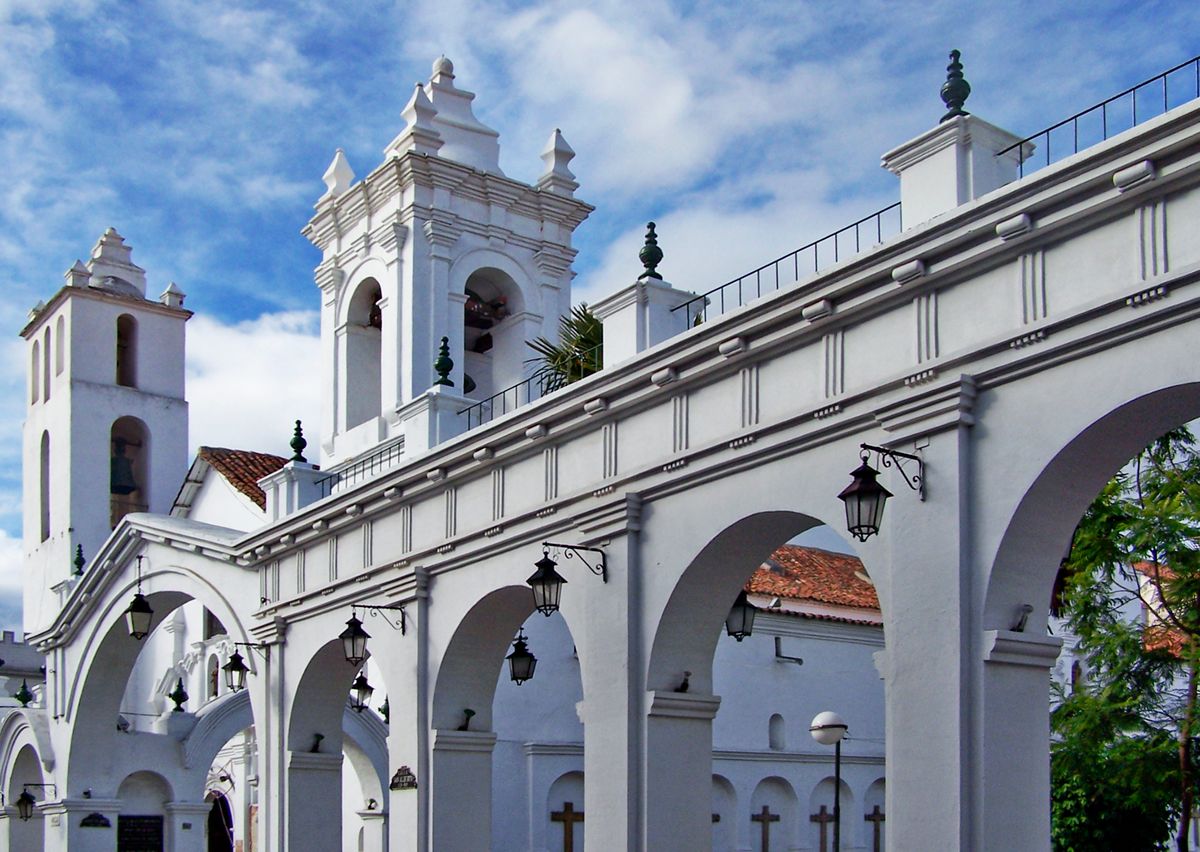
The best things to do in Sucre, Bolivia begin on Plaza 25 de Mayo and fan outward: to the balcony where a young republic declared its independence in 1825, to a cliff on the city’s edge that holds the largest set of dinosaur footprints on Earth, and to a Sunday market where the Yampara people still trade textiles woven exactly as their grandmothers made them. Sucre is Bolivia’s constitutional capital and, for many travellers, its most beautiful city — a compact grid of whitewashed mansions and bell towers at 2,790 m (9,150 ft), warm enough for a T-shirt at midday yet cool under the stars. This is our local guide to what to see, when to come and how to get here.
Why visit Sucre?
If La Paz is Bolivia’s dizzying, vertical heart, Sucre is its serene soul. Founded by the Spanish in 1538, the city grew rich on the silver of nearby Potosí and spent that fortune on churches, convents and courtyards. In 1991, UNESCO inscribed the Historic City of Sucre on its World Heritage list, recognising how its 16th-century religious buildings blend local craftsmanship with European style.
Locals call it La Ciudad Blanca — the White City — and the nickname is more than poetry. A municipal ordinance requires the historic buildings to be whitewashed every year, giving the centre a luminous, uniform glow that is unforgettable at golden hour. Add a mild valley climate, wide pedestrian plazas and some of the friendliest streets in the country, and it is easy to see why so many travellers plan a two-day stop and end up staying a week.
Sucre is where Bolivians go to breathe. After the altitude of the altiplano, its gentle 2,790 metres and spring-like air feel like a reward.
The best things to do in Sucre
1. Stand where Bolivia was born: Casa de la Libertad
Begin at Plaza 25 de Mayo, the leafy main square ringed by white arcades. On its northern side stands the Casa de la Libertad, the single most important building in Bolivian history. It was here, on 6 August 1825, that the country’s founders signed the Declaration of Independence, giving birth to the Republic of Bolivia — later named after the liberator Simón Bolívar.
Today the house is a museum of that revolution, displaying the original independence act, portraits of the founders and Bolivia’s first flag. Guided visits walk you through the story of a nation. Entry costs around 15 bolivianos (about US$2), and it is open on weekdays and Saturday mornings. Give yourself an hour.
2. Walk with dinosaurs at Cal Orck’o
Just 5 km from the city centre, a working cement quarry accidentally exposed one of the planet’s great palaeontological wonders. Cal Orck’o is a near-vertical limestone wall — roughly 1.5 km long and 110 m high — carrying the largest known concentration of dinosaur footprints in the world: more than 5,000 tracks from at least eight species, pressed into a Cretaceous shoreline about 68 million years ago and later tilted upright by the rising Andes.
Among the tracks is a 581-metre trackway, thought to be the longest continuous dinosaur trail ever recorded, and a 366-metre path left by a juvenile theropod that guides affectionately call Johnny Walker. The site is presented as Parque Cretácico, with life-size dinosaur replicas, viewing platforms and a small museum. A “Dino Truck” shuttle runs from the cathedral in the centre. It is one of the most family-friendly and genuinely astonishing half-days in Bolivia.
3. Climb to La Recoleta for the best view
For the classic Sucre panorama, walk uphill to La Recoleta, a 17th-century Franciscan monastery on Plaza Pedro de Anzures. Its stone archway frames the whole white city spilling across the valley below, and the courtyard shelters a cedar tree said to be more than a thousand years old. Come in the late afternoon, when the light turns the rooftops amber, then linger at one of the café terraces nearby with a coffee or a glass of Tarija wine.
4. Discover Andean weaving at the Museo de Arte Indígena
Bolivia’s textiles are among the finest in the Americas, and the Museo de Arte Indígena (ASUR) is the place to understand why. Its collection focuses on two living traditions: the fierce, angular Jalq’a weavings full of dreamlike creatures, and the ordered, colourful cloth of the Tarabuco people. Weavers often work on-site, and you will never look at a market poncho the same way again. It is a short, rewarding visit that puts the region’s craft in context before you shop.
5. Time a Sunday for the Tarabuco market
If your visit includes a Sunday, head to Tarabuco, a village about 60 km (90 minutes) southeast of Sucre. Its weekly market is one of the most authentic in Bolivia: members of the Yampara communities gather to sell hand-woven textiles, ch’uspas (coca pouches), instruments and produce, many still in traditional dress with their distinctive helmet-shaped monteras. Shared taxis and tourist minibuses leave early from Sucre. For a spectacle, aim for the second Sunday of March, when the Pujllay festival fills the streets with dance, music and colour to honour a historic battle.
6. Slow down: rooftops, chocolate and salteñas
Half the pleasure of Sucre is simply being in it. Climb the bell tower of the Iglesia de San Felipe Neri for a rooftop stroll among the white domes. Wander the Mercado Central for fresh juice and street snacks. And do not leave without two local obsessions: Sucre’s salteñas — juicy baked empanadas eaten mid-morning — and its artisan chocolate, sold by long-standing local makers whose cacao comes from the Bolivian lowlands. A café on the plaza, a warm salteña, a bar of chocolate: this is the White City at its best.
How to get to Sucre
By air (fastest): Bolivia’s flag carrier, Boliviana de Aviación (BoA), runs several daily flights from La Paz to Sucre’s modern Alcantarí Airport, about 30 km from the centre. The hop takes roughly one hour and costs around US$75–150 one way. There are also connections from Santa Cruz and Cochabamba.
By bus (cheapest): Overnight bus cama (sleeper) services connect La Paz and Sucre in 10–13 hours for US$20–40. They leave in the evening and arrive at dawn, saving you a night’s lodging. Buses from Potosí take only about three hours and make an easy, scenic day link.
A note on altitude: At 2,790 m, Sucre is far gentler than La Paz (3,650 m) or Uyuni (3,656 m). If you have already spent time in the highlands, you will feel comfortable here; if Sucre is your first stop, still take the first day slowly and drink plenty of water.
Best time to visit Sucre
Sucre enjoys a mild, spring-like climate all year, but the dry season from May to October brings the clearest skies and easiest travel — ideal for photographing those white façades against blue. The wet season (November to March) is greener and quieter, with warm afternoons and occasional downpours; it also coincides with the Pujllay festival in March. Whenever you come, pack layers: valley days are warm, but nights cool quickly once the sun drops behind the hills.
Ready for the White City?
Sucre rewards travellers who slow down. Give it a couple of unhurried days and you will trade the breathlessness of the altiplano for colonial courtyards, dinosaur footprints and some of the warmest hospitality in Bolivia. Pair it with Potosí for history, or use it as a mellow base to acclimatise before Uyuni. However you weave it into your route, Bolivia’s constitutional capital may just become the highlight you did not expect.
Key facts
- → Sucre sits at 2,790 m (9,150 ft), is Bolivia's constitutional capital, and was inscribed as a UNESCO World Heritage Site in 1991 for its colonial architecture.
- → The Cal Orck'o cliff holds the world's largest collection of dinosaur footprints — more than 5,000 tracks from at least 8 species on a limestone wall about 1.5 km long and 110 m high, dating to roughly 68 million years ago.
- → Cal Orck'o includes a 581 m trackway, among the longest continuous dinosaur trails ever recorded, and a 366 m trail left by a juvenile theropod nicknamed 'Johnny Walker.'
- → The Casa de la Libertad, on Plaza 25 de Mayo, is where Bolivia's Declaration of Independence was signed on 6 August 1825; entry costs about 15 bolivianos (US$2).
- → Boliviana de Aviación flies La Paz to Sucre in about 1 hour for roughly US$75–150, while the overnight bus takes 10–13 hours for US$20–40.
Frequently asked questions
How many days do you need in Sucre? +
Two to three days is ideal. One day covers the historic centre — Plaza 25 de Mayo, the Casa de la Libertad, La Recoleta and the rooftop viewpoints. A second day is perfect for the Cal Orck'o dinosaur park and the textile museum. If your visit includes a Sunday, keep that morning free for the Tarabuco market, about 90 minutes away. Many travellers stay longer to study Spanish, as Sucre is one of South America's most affordable and pleasant places to learn.
How do you get from La Paz to Sucre? +
The fastest way is to fly: Boliviana de Aviación (BoA) runs several daily flights from La Paz to Sucre's Alcantarí Airport, taking about one hour for roughly US$75–150 one way. The budget alternative is the overnight sleeper bus, which takes 10–13 hours and costs US$20–40. Buses leave La Paz in the evening and arrive the next morning, so you save a night's accommodation. Both options are reliable and easy to book.
When is the Tarabuco market held? +
The famous indigenous market of Tarabuco runs every Sunday, about 60 km (90 minutes) southeast of Sucre. Vendors from the Yampara communities sell hand-woven textiles, ponchos and crafts in the region's distinctive style. Shared taxis and tourist minibuses leave Sucre early on Sunday mornings. If you can time your trip for the second Sunday of March, you will also catch Pujllay, Tarabuco's vivid festival commemorating a 19th-century battle.