Long before the Inca marched into the Andes, another civilization was already carving its gods into stone beside Lake Titicaca. Tiwanaku, 72 km west of La Paz and about two hours by road, is the greatest archaeological site in Bolivia and one of the most important pre-Inca ruins in all of South America. If you have come this far up onto the Altiplano — for Uyuni, for Titicaca, for La Paz itself — Tiwanaku is the piece of the puzzle that explains where the whole Andean world came from. Here is everything you need to plan the visit in 2026, from a Bolivian who never gets tired of walking these stones.
What is Tiwanaku?
Tiwanaku (also spelled Tiahuanaco) was the capital of a powerful Andean state that dominated the southern Andes for centuries. Archaeologists trace occupation of the site back roughly two thousand years, and it reached its apogee between AD 500 and 900, when the city held an estimated 10,000 to 20,000 people — an extraordinary number for a settlement at 3,850 m above sea level. It was inscribed as a UNESCO World Heritage Site in 2000 for its monumental architecture and its role as the spiritual and political heart of a civilization that shaped the entire region.
This matters for how you see it. Tiwanaku is not “an old Inca site.” It is centuries older than the Inca Empire, and the Inca themselves regarded it as a sacred, mythical place — the location where, in Andean belief, the creator god Viracocha brought the sun, moon and humankind into being. When you stand in the plaza, you are standing at what many Andean peoples considered the birthplace of the world.
Tiwanaku is the deep root of Andean civilization. The Inca did not build it — they inherited it, and treated it as holy ground. That single fact reframes everything you see here.
The monuments you came to see
The site is compact enough to walk in a couple of hours, but dense with meaning. These are the pieces not to miss.
The Gate of the Sun
The Gate of the Sun (Puerta del Sol) is Tiwanaku’s signature image and the one you will recognize. It is a single doorway carved from one block of andesite weighing roughly 10 tons. Across its lintel runs a carved frieze centered on a commanding figure — the “Staff God,” holding a staff in each hand — often identified with Viracocha and flanked by rows of winged attendants. Scholars still argue about whether the frieze encodes a calendar. What no one disputes is the skill: this is precision stonework made without iron tools.
Kalasasaya and the Ponce Monolith
Kalasasaya is the great ceremonial platform, a rectangular enclosure ringed by upright stone pillars and aligned to the movements of the sun. Inside stands the Ponce Monolith, a tall carved figure covered in intricate low-relief iconography — a human form dressed, quite literally, in the symbols of Tiwanaku’s cosmology.
The Semi-Subterranean Temple
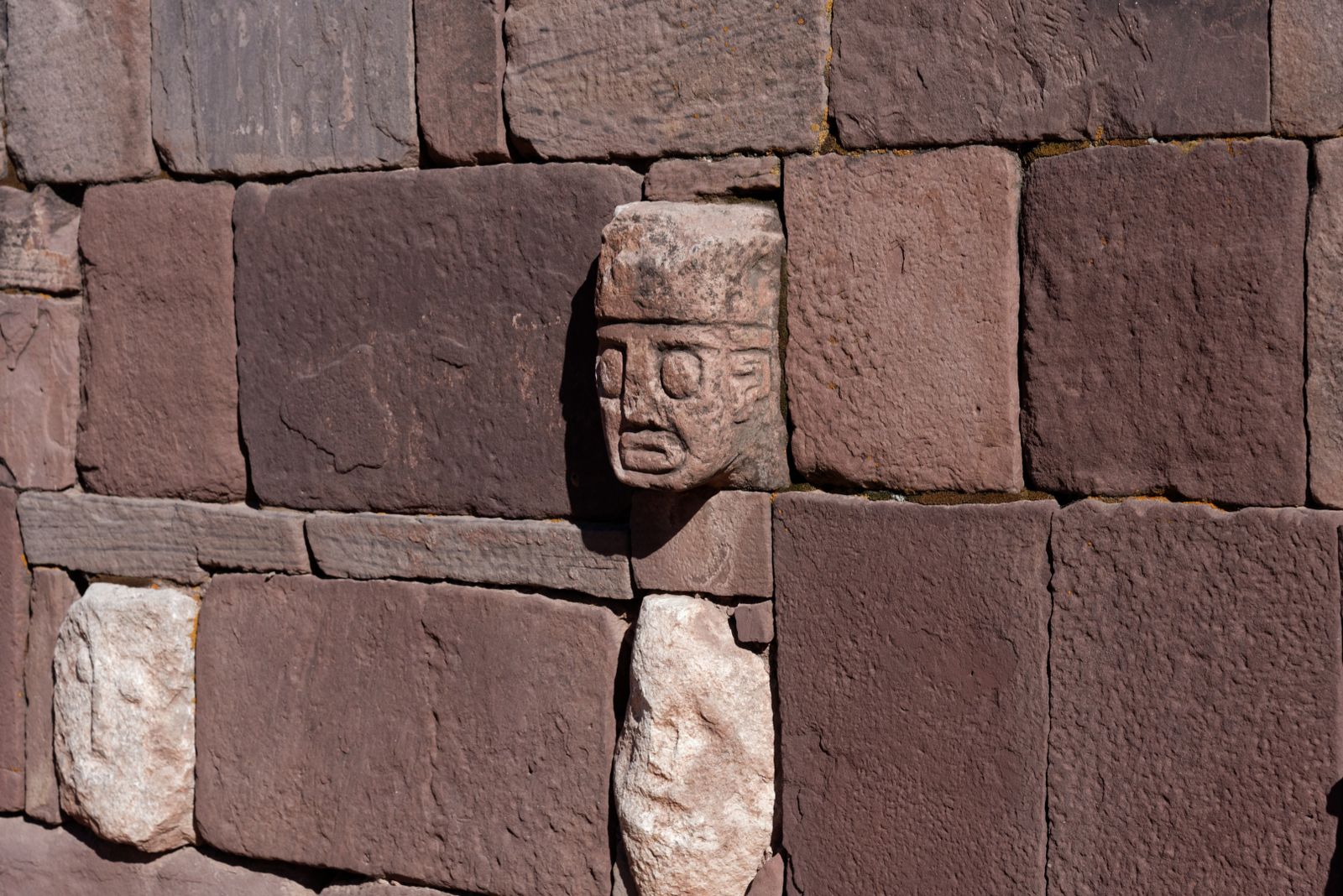
Just beside Kalasasaya, a sunken courtyard — the Semi-Subterranean Temple — has walls studded with dozens of carved stone heads (cabezas clavas), each face different. Theories range from a gallery of conquered peoples to a representation of the diverse ethnic groups the state absorbed. Whatever the truth, walking down into that courtyard surrounded by staring faces is the most atmospheric moment on the site.
Akapana
The Akapana is a terraced pyramid about 16.5 m tall, built of earth faced with stone. Much of its cut stone was carried off over the centuries, so today it reads as a stepped mound rather than a sharp pyramid — but from the top you get the lay of the whole ceremonial center and the Altiplano stretching toward the lake.
Puma Punku
A short distance from the main complex, Puma Punku is the site that launched a thousand internet theories. Its scattered blocks include stones cut with such flat faces, sharp interior angles and repeated modular shapes — the famous “H-blocks” — that they look machined. They were not: they are the product of extraordinary Andean stonemasonry. Your Tiwanaku ticket includes Puma Punku, and it is absolutely worth the extra walk.
How to get to Tiwanaku from La Paz
Tiwanaku sits 72 km (44 miles) west of La Paz, on the road toward the Lake Titicaca town of Guaqui and the Peruvian border. Count on about two hours each way. You have three realistic options:
- Organized full-day tour (easiest). Most La Paz agencies run a Tiwanaku day trip for roughly US$30–50 per person, including hotel pickup around 8:00–9:00, transport, and a guide who brings the stones to life. This is what I recommend for first-time visitors — the guiding is the whole point.
- Public minibus (cheapest). Minibuses to Tiwanaku leave from the Cementerio zone in La Paz for around 15–20 bolivianos (about US$2–3) each way. It is a genuine local experience but you arrive without a guide, so read up first.
- Private taxi. A round-trip private car runs about US$65 and gives you full control of timing — good for photographers who want early light or a group splitting the cost.
When to visit
Tiwanaku is open daily from 9:00 to 16:00. Because it is entirely outdoors at high altitude, the weather matters more than the season for how much you enjoy it.
- Dry season (May–October) brings clear skies, sharp light and the best photos, but bitterly cold mornings — the Altiplano can drop below freezing at night. Go for it, just dress in layers.
- Wet season (November–March) is greener and milder by day, with a real chance of afternoon rain. Mornings are usually your safest window.
There is one date that stands apart. Every 21 June, thousands of people gather at Tiwanaku before dawn for Willkakuti, the Aymara New Year (the southern winter solstice), to receive the first rays of the sun over the Kalasasaya with their hands raised. It is now a national holiday in Bolivia and one of the most powerful living-culture experiences in the country — but expect crowds, cold and heavy demand for transport and lodging.
Practical tips for your visit
A few things I tell everyone before they go:
- Bring cash in bolivianos. Foreign admission is about 100 bolivianos (US$15) and the gate does not take cards. The ticket covers both archaeological complexes and the two museums.
- Don’t skip the museums. The on-site Ceramic Museum and Lithic Museum hold the finest pieces, including the towering Bennett Monolith. Ten quiet minutes there will change how you read the ruins outside.
- Respect the altitude. At 3,850 m, Tiwanaku is roughly as high as La Paz. Acclimatize in the city for a day or two first, walk slowly, and carry water. If you are coming straight from the lowlands, this is not the day to rush.
- Sun and cold at once. The Altiplano sun burns fast even when the air is cold. Sunscreen, a hat, sunglasses and a warm layer are all essential on the same morning.
- Hire a guide. Whether it comes with your tour or you take one at the entrance, a good guide turns a field of grey stones into a coherent, astonishing story. It is the single best money you will spend here.
- Combine it smartly. Tiwanaku pairs naturally with a broader Titicaca trip, since both sit on the same western Altiplano — a logical extension of the classic La Paz–Copacabana route.
Is Tiwanaku worth visiting?
Honestly? Yes — with the right expectations. Tiwanaku does not overwhelm you the way Machu Picchu does with sheer scenery; centuries of stone-robbing and weathering have left much of it as foundations and fragments. What it offers instead is depth. This is the source, the civilization the Andes were built on top of, and standing at the Gate of the Sun with a guide who can read the carvings is a quieter but genuinely profound experience. For anyone curious about who was here before the Inca — and about where Andean people believe the world began — it is unmissable.
Pair it with La Paz and Lake Titicaca, give it a knowledgeable guide, bring your bolivianos and a warm jacket, and Tiwanaku becomes one of the most rewarding days on the entire Bolivian Altiplano.
Key facts
- → Tiwanaku lies 72 km (44 miles) west of La Paz at about 3,850 m above sea level, roughly a two-hour drive from the city.
- → The site was the capital of a pre-Inca state that peaked between AD 500 and 900, with an estimated population of 10,000–20,000 people around AD 800.
- → The Gate of the Sun is carved from a single block of andesite weighing roughly 10 tons.
- → The Akapana is a terraced earth-and-stone pyramid about 16.5 m tall.
- → Foreign admission is about 100 bolivianos (US$15), cash only, and includes the on-site Ceramic and Lithic museums; the site is open daily 9:00–16:00.
- → Tiwanaku was inscribed as a UNESCO World Heritage Site in 2000.
Frequently asked questions
How do you get to Tiwanaku from La Paz? +
Tiwanaku is 72 km west of La Paz, about a two-hour drive. The easiest option is a full-day organized tour (roughly US$30–50 per person) with hotel pickup, transport and a guide. Independently, minibuses leave from the Cementerio zone in La Paz for around 15–20 bolivianos each way. A private taxi round-trip costs about US$65.
How much does it cost to enter Tiwanaku? +
Foreign visitors pay around 100 bolivianos, roughly US$15, in 2026. The ticket covers the two archaeological complexes (Tiwanaku and Puma Punku) plus the Ceramic and Lithic museums on site. Bring cash in bolivianos, since cards are not accepted at the gate. A local guide at the entrance costs extra and is well worth it to make sense of the stones.
How much time do you need at Tiwanaku? +
Plan for two to three hours at the site itself: about 90 minutes for the main Tiwanaku complex and museums, plus a short drive and walk to Puma Punku nearby. With travel from La Paz, it is a comfortable full-day trip of eight to nine hours door to door. If you love archaeology, take a guide and slow down — the detail rewards patience.
What is the Gate of the Sun at Tiwanaku? +
The Gate of the Sun (Puerta del Sol) is Tiwanaku's most famous monument: a monolithic doorway carved from a single block of andesite weighing about 10 tons. Its lintel is engraved with a central 'Staff God' figure, often linked to Viracocha, surrounded by winged attendants and a calendar-like frieze. Its exact original position and meaning are still debated by archaeologists today.