Is the Salar de Uyuni a wonder of the world? Honestly, not an official one — it was never a finalist in the famous 2011 New7Wonders of Nature vote. And yet almost every traveler who crosses that blinding white plain walks away convinced they have just seen one of the planet’s true marvels. The truth is that Bolivia is not a one-wonder country. Squeeze the largest salt flat on Earth, the highest navigable lake, blood-red flamingo lagoons, 6,000-metre volcanoes and the most biodiverse rainforest in South America into a single nation, and you get a place with more natural wonders per square kilometre than almost anywhere on the continent. Here is the honest, fact-checked list — starting with the one everybody asks about.
Is the Salar de Uyuni Really a “Wonder of the World”?
Let’s settle the question first. The New7Wonders of Nature campaign, run by the Swiss-based New7Wonders Foundation, announced its seven winners in 2011: the Amazon, Halong Bay, Iguazú Falls, Jeju Island, Komodo, the Puerto Princesa Underground River and Table Mountain. The Salar de Uyuni was not among the 28 official finalist candidates, let alone the final seven.
So officially, no. In every other sense, yes. The salt flat is so singular that travel writers reach for the same phrase again and again: the “eighth wonder of the world.” It is a title nobody awards but everybody uses — and once you have stood on the flat at dawn, watching the horizon dissolve into sky, you understand why. Bolivia’s wonders don’t need a committee’s stamp. They earn the word the moment you see them.
Salar de Uyuni: The Largest Salt Mirror on Earth
The Salar de Uyuni covers 10,582 km² at 3,656 metres above sea level in Bolivia’s southwest — the largest salt flat in the world, bigger than several small countries. Beneath the crust lies an estimated 10 billion tonnes of salt and somewhere between 50 and 70 percent of the world’s known lithium reserves, the metal that powers electric-car batteries.
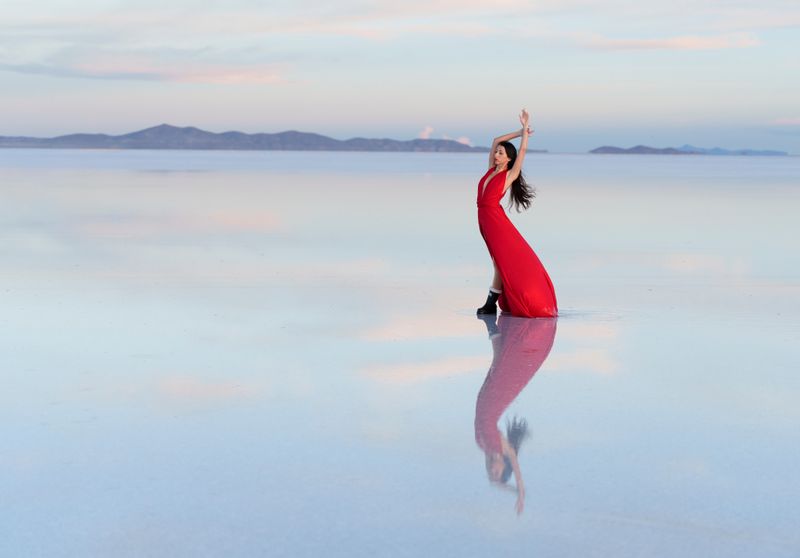
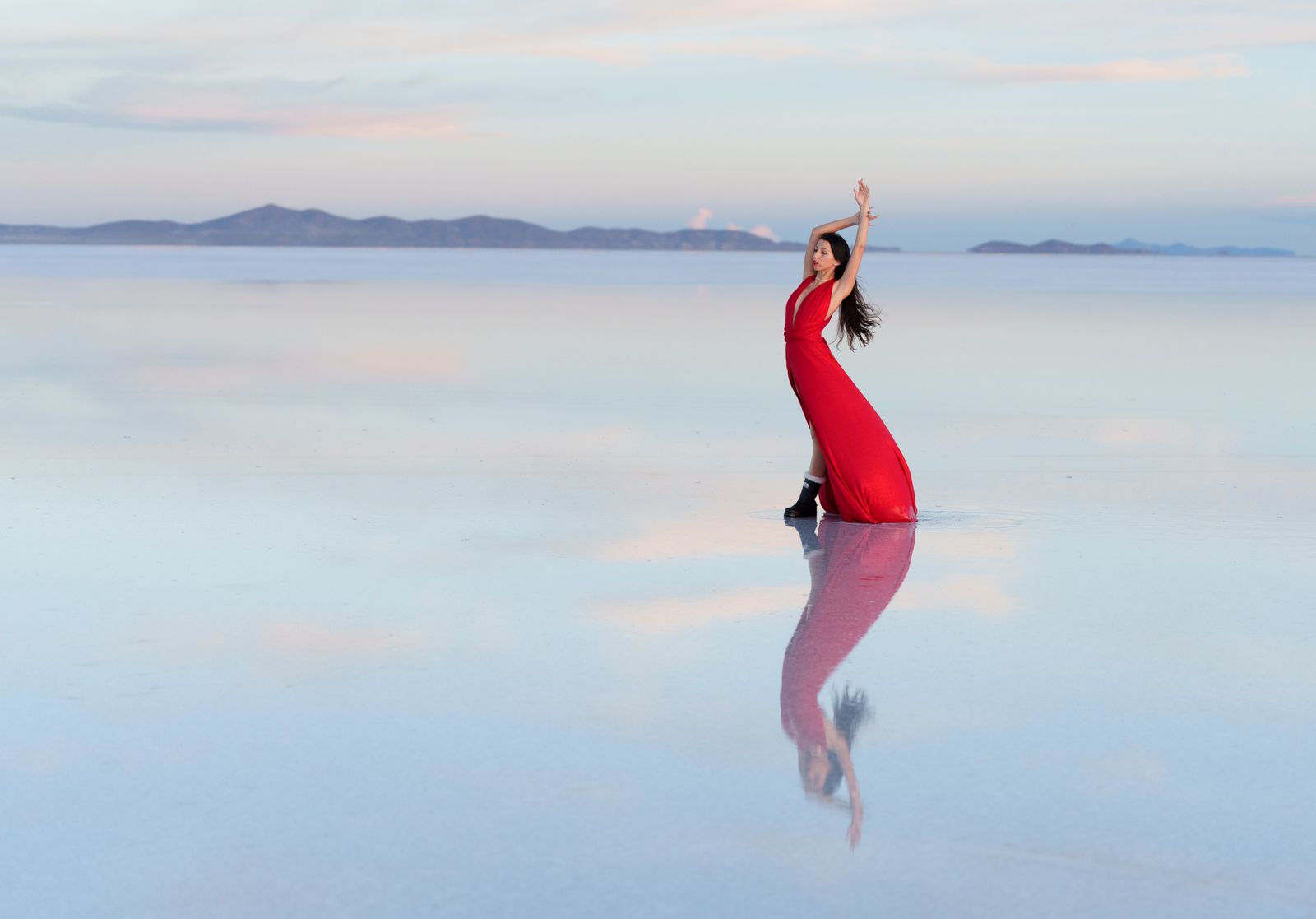
What makes it a wonder is not the size but the transformation. In the rainy season, roughly November to March, a thin sheet of water 2 to 5 centimetres deep settles over the salt and turns the entire plain into a flawless mirror. Sky and ground merge; people appear to walk on clouds. This is the famous mirror effect, and January and February are its peak. In the dry season the water vanishes, leaving a cracked mosaic of white hexagons stretching to the curve of the Earth. Two completely different wonders, same place, depending on when you come.
Lake Titicaca: The Highest Navigable Lake in the World
Straddling the border with Peru, Lake Titicaca sits at 3,812 metres, making it the highest navigable lake on the planet and the largest lake in South America by volume. For the Andean world it is not merely scenery — it is a birthplace. Inca tradition holds that the founding ancestors, Manco Cápac and Mama Ocllo, emerged from its waters on the Island of the Sun.
Today you can take a boat from Copacabana to that same island, walk among pre-Inca terraces and sleep in a lakeside village where the water is an impossible deep blue. At this altitude the light is thin and brilliant, the nights are cold, and the lake feels less like a body of water than a high-altitude sea. It is the cultural and geographic heart of the Bolivian Altiplano.
Laguna Colorada and the Red Lagoons of the Southwest
Two hundred kilometres south of Uyuni, the landscape stops behaving like Earth. Laguna Colorada, the “Red Lagoon,” glows rust-red at 4,278 metres — a colour produced by algae and mineral sediments in its shallow, salty water. Wading through it are up to 50,000 flamingos of three Andean species: the James’s, Andean and Chilean flamingos, the rare James’s flamingo being the star of the show.
Laguna Colorada anchors the Eduardo Avaroa reserve, a circuit that also includes the emerald Laguna Verde beneath the Licancabur volcano, the Sol de Mañana geysers steaming at 4,850 metres, and the surreal wind-carved rocks of the Dalí Desert. It is the highlight of the classic southwest circuit — see our Flamingo Route — and one of the strangest high-altitude landscapes anywhere on the planet.
Nevado Sajama: The Roof of Bolivia
If the salt flat is Bolivia’s most famous wonder, Nevado Sajama is its most commanding. This dormant, snow-capped volcano rises to 6,542 metres, the highest point in the country, inside Bolivia’s oldest national park. On its flanks grow the queñua (Polylepis) trees that form the highest-altitude woodlands on Earth, surviving above 4,800 metres where almost nothing else does.
Sajama is wilderness in the truest sense: vicuñas grazing on the puna, natural hot springs steaming against a backdrop of white peaks, geysers, and a horizon lined with the twin Payachata volcanoes on the Chilean border. It sees a fraction of Uyuni’s visitors, which is precisely its appeal.
Madidi: The Most Biodiverse Park on Earth
Drop off the Altiplano into the Amazon basin and Bolivia reveals a wonder of a different kind. Madidi National Park protects 18,958 km² running from Andean peaks down to lowland rainforest, and that vertical range makes it one of the most biodiverse protected areas on the planet: more than 1,000 recorded bird species, alongside jaguars, tapirs, giant otters and pink river dolphins.
This is where Bolivia connects to a genuine New7Wonders winner. The Amazon rainforest — of which Madidi is a superb slice — was voted one of the official New7Wonders of Nature in 2011. So while the salt flat missed the list, Bolivia is not shut out of it at all: a piece of the country’s own territory sits inside a recognised wonder.
Noel Kempff Mercado: Bolivia’s Real “Lost World”
Far to the northeast, on the Brazilian border, the Noel Kempff Mercado National Park rises out of the forest as a wall of sheer sandstone tepuis. The Huanchaca Plateau here is said to have inspired Arthur Conan Doyle’s 1912 novel The Lost World, and standing beneath its cliffs and waterfalls, the comparison feels earned. The park was inscribed as a UNESCO World Heritage Site in 2000 and shelters over 900 bird species across cerrado, rainforest and pre-Cambrian rock.
It is Bolivia’s most remote wonder — reachable mainly by light aircraft from Santa Cruz — and for that reason one of the least visited World Heritage Sites in the Americas.
So How Many Wonders Does Bolivia Have?
If you are counting official titles, Bolivia’s answer runs through the Amazon. If you are counting the landscapes that stop you in your tracks, the number climbs quickly: the salt mirror, the highest lake, the red lagoon, the roof-of-the-country volcano, the Amazon’s richest corner and a genuine Lost World. Few countries pack this much variety — desert, ice, jungle and sky — into a single passport stamp.
Seeing them takes planning, because they don’t share a season. The Uyuni mirror wants the summer rains; the lagoons and the Amazon reward the dry winter; the high volcanoes are best from May to October. Read our guide on when to visit Bolivia to time your trip, and remember that most of these wonders sit above 3,600 metres — give yourself a day or two in La Paz to acclimatise before chasing them. Official list or not, Bolivia’s wonders are waiting, and they are every bit as extraordinary as the name suggests.
Key facts
- → The Salar de Uyuni is the world's largest salt flat at 10,582 km² and 3,656 m above sea level.
- → The Salar de Uyuni was not among the 28 official finalists of the New7Wonders of Nature campaign (2011), despite being widely called the 'eighth wonder of the world'.
- → Lake Titicaca is the world's highest navigable lake at 3,812 m above sea level.
- → Nevado Sajama is Bolivia's highest peak at 6,542 m.
- → Laguna Colorada sits at 4,278 m and hosts up to 50,000+ flamingos of three Andean species.
- → Madidi National Park spans 18,958 km² and has recorded more than 1,000 bird species.
Frequently asked questions
Is the Salar de Uyuni a wonder of the world? +
Not officially. The Salar de Uyuni was not a finalist in the 2011 New7Wonders of Nature vote. But as the planet's largest salt flat — 10,582 km² that turns into a giant mirror in the rainy season — it is routinely called the 'eighth wonder of the world' by travelers and media. It is a world-class natural wonder in every practical sense.
What are Bolivia's greatest natural wonders? +
The headline natural wonders are the Salar de Uyuni (largest salt flat), Lake Titicaca (highest navigable lake, 3,812 m), Laguna Colorada (red flamingo lake, 4,278 m), Nevado Sajama (highest peak, 6,542 m), Madidi National Park (Amazon biodiversity) and Noel Kempff Mercado, the tepui plateau that inspired 'The Lost World'.
Which Bolivian natural wonder is a UNESCO World Heritage Site? +
Noel Kempff Mercado National Park was inscribed as a UNESCO World Heritage Site in 2000 for its intact Precambrian tepuis, cerrado and Amazonian forest. Bolivia also holds several cultural UNESCO sites, such as Tiwanaku and the city of Potosí, but Noel Kempff is the flagship natural-heritage wonder.
When is the best time to see Bolivia's natural wonders? +
It depends on the wonder. The Uyuni mirror effect peaks in the rainy season (December–March), while the dry season (May–October) is better for the high-Andean lagoons, trekking and Amazon wildlife. Many travelers combine both by visiting in the shoulder months of April or November.