Bolivia measures its year less in months than in festivals. Between the miniatures of Alasita in January and the skeletal Ñatitas of November, the calendar is packed with parades, pilgrimages and street rituals — three of them recognised by UNESCO as Intangible Cultural Heritage of Humanity. If you want to understand the country, time your trip around one of them. Here is the month-by-month guide to Bolivia’s biggest celebrations, with the confirmed 2026 dates for the ones that move.
January — Alasita and the miniatures of La Paz
The festival year opens on 24 January with Alasita, a fair in La Paz devoted to Ekeko, the pot-bellied Aymara god of abundance. The logic is charming and entirely serious: you buy a miniature of whatever you want in the coming year — a tiny house, a toy car, bundles of fake dollars, a miniature university diploma, even a little passport — and have it blessed, first by an Andean yatiri with incense and then, if you like, by a Catholic priest. Locals believe the miniature must be received as a gift or bought exactly at noon on the 24th to work.
UNESCO inscribed Alasita on its Representative List in 2017. Around 5,000 artisans set up stalls, and the fair runs for several weeks around Plaza Murillo and the fairgrounds. It is the easiest major festival to attend — no tickets, no crowds crushing a parade route — and one of the most revealing about how Andean and Catholic belief fuse in Bolivia.
February — the Carnival of Oruro
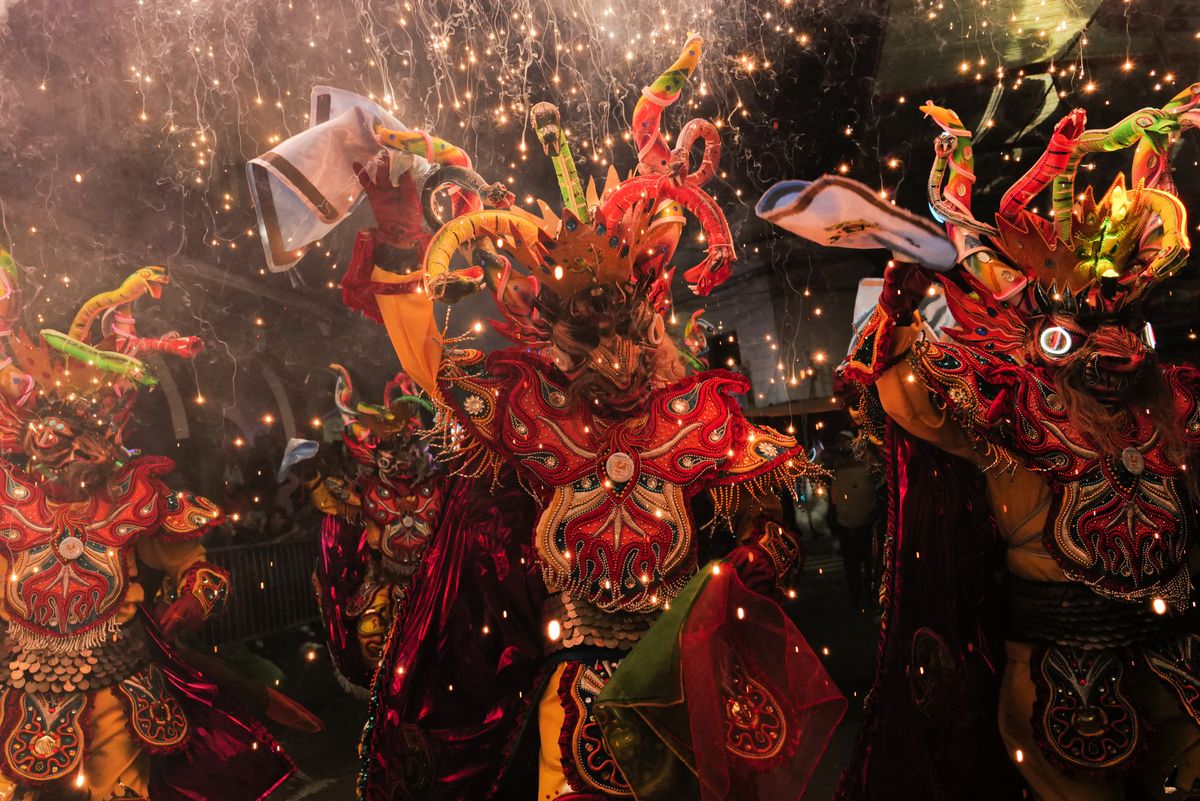
If you see one Bolivian festival, make it the Carnival of Oruro. Held in the mining city of Oruro, it was among the first celebrations UNESCO ever proclaimed a Masterpiece of the Oral and Intangible Heritage of Humanity, back in 2001. In 2026 the main parade — the Sábado de Peregrinación — falls on Saturday 14 February, with the wider carnival running roughly 7–17 February. Because it is anchored to Lent, the date shifts every year, always landing on the Saturday before Ash Wednesday.
The centrepiece is the Entrada: some 28,000 dancers and 10,000 musicians process about four kilometres toward the sanctuary of the Virgen del Socavón, the miners’ patron. The signature dance is the Diablada, a battalion of masked devils led by Lucifer and the Archangel Michael, but you will also see the Morenada, Caporales and dozens of other troupes. The procession can last twenty hours; dancers vow to perform for three consecutive years as a promise to the Virgin. Oruro sells out months ahead — book a bed and a grandstand seat as early as you can, and expect water balloons and foam to be part of the experience.
March or April — Holy Week and the Copacabana pilgrimage
Bolivia’s Semana Santa (Holy Week) is moveable; in 2026 Easter Sunday falls on 5 April. The most striking observance is the pilgrimage to Copacabana on the shore of Lake Titicaca, home to the Virgen de Copacabana, the country’s patroness. Thousands of pilgrims walk through the night from La Paz — roughly 150 kilometres — arriving footsore on Good Friday. In Copacabana itself you will also see the bendición de movilidades, where drivers decorate cars with flowers and garlands to have them blessed outside the basilica.
Holy Week is a quiet, reflective counterpoint to the noise of Carnival, and a good moment to combine devotion with a boat trip to the Isla del Sol, the mythical birthplace of the Inca.
May and June — Gran Poder and the Andean New Year
Late May and June belong to La Paz. The Fiesta del Señor Jesús del Gran Poder is the city’s largest folkloric celebration and, since 2019, a UNESCO-listed one. It gathers around 40,000 dancers, 69 fraternities and 7,000 musicians who wind through the steep streets of the city in a display of devotion and status — the elaborate, hand-embroidered costumes can cost thousands of dollars. The date tracks the feast of the Holy Trinity, usually late May or early June; in 2026 organisers postponed the Entrada to 20 June because of social unrest in the city, a reminder that Bolivian dates can move for reasons beyond the church calendar.
On 21 June, high on the altiplano, comes a very different celebration: Willkakuti, the Aymara New Year, marking the winter solstice. Thousands gather at Tiwanaku before dawn to raise their palms to the first rays of the returning sun. It is now an official national holiday, and smaller solstice gatherings take place at ceremonial sites across the highlands.
June — San Juan, the coldest night
The night of 23 June is San Juan, traditionally the coldest of the Bolivian winter and once marked by countless bonfires across El Alto and the altiplano. Air-quality laws have curbed the fires in recent years, but the fireworks, hot api (a purple-maize drink) and grilled sausages endure. If you are in La Paz in late June, San Juan is an easy, atmospheric night to experience — just dress for genuine cold, because at 3,600 metres it bites.
August — Independence and the Virgen de Urkupiña
6 August is Bolivia’s Independence Day, Día de la Patria, marking the 1825 founding of the republic, with military and civic parades in every town. But the month’s great pilgrimage is the Virgen de Urkupiña in Quillacollo, near Cochabamba, on 14–16 August 2026. Close to half a million people attend. The ritual heart of it is the climb to the Calvario hill, where pilgrims chip a small stone from the rock to carry home as a symbolic loan from the Virgin — to be repaid the following year. Around it swirls one of Bolivia’s biggest entradas, with fraternities dancing the Morenada and Caporales for days. August, deep in the dry season, is one of the best months to travel the valleys for exactly this reason.
November — Todos Santos and the Ñatitas
On 1–2 November, Bolivians mark Todos Santos (All Saints) and the Day of the Dead. Families build home altars laden with t’antawawas — sweet bread shaped like babies and figures — and spend the night in cemeteries sharing food with departed relatives. It is intimate rather than touristic, and among the most moving things you can witness in the country.
A week later, on 8 November, La Paz holds the extraordinary Fiesta de las Ñatitas, when families bring human skulls — kept at home as protective spirits, often inherited — to the Cementerio General to be crowned with flowers, given cigarettes and coca, and blessed. It is uniquely Bolivian, a survival of Andean ancestor veneration wrapped inside a Catholic feast.
Planning a festival trip
A few practical notes. First, the moveable festivals — Carnival, Holy Week, Corpus Christi and Gran Poder — shift with the church calendar, so confirm dates before booking; the fixed ones (Alasita 24 January, San Juan 23 June, Independence 6 August, Todos Santos 1–2 November) are reliable anchors. Second, accommodation in Oruro at Carnival and Quillacollo at Urkupiña vanishes months ahead and prices multiply — reserve early. Third, festivals are the one time petty theft spikes in the crowds, so carry a money belt and leave valuables at your hotel; our safety guide covers this in detail.
Finally, remember that these are living religious events, not performances staged for visitors. Watch, photograph respectfully, accept the foam and the chicha offered to you, and you will see a side of Bolivia that the salt flats and jungle lodges, for all their beauty, cannot show you. For more on the beliefs behind the dances, read our guide to Bolivian culture and traditions.
Key facts
- → The Carnival of Oruro was proclaimed a UNESCO Masterpiece of the Oral and Intangible Heritage of Humanity in 2001; its main parade gathers around 28,000 dancers and 10,000 musicians.
- → In 2026 the Oruro Carnival's main pilgrimage parade (Sábado de Peregrinación) falls on 14 February, with the wider festival running 7–17 February.
- → The Alasita fair opens every 24 January in La Paz around Ekeko, the Aymara deity of abundance, and was inscribed by UNESCO in 2017 with around 5,000 participating artisans.
- → The Fiesta del Gran Poder in La Paz, inscribed by UNESCO in 2019, involves about 40,000 dancers, 69 fraternities and 7,000 musicians on the Saturday linked to the feast of the Holy Trinity.
- → The Virgen de Urkupiña festival in Quillacollo (14–16 August) draws roughly 500,000 pilgrims who carry symbolic stones home from the Calvario hill.
Frequently asked questions
When is the Oruro Carnival in 2026? +
The main folkloric parade — the Sábado de Peregrinación — falls on Saturday 14 February 2026, with the wider carnival running roughly 7–17 February. Because it is tied to Lent, the date shifts each year; it is always the Saturday before Ash Wednesday. Book Oruro accommodation months in advance.
What is the biggest festival in La Paz? +
The Fiesta del Gran Poder, held on the Saturday near the feast of the Holy Trinity (late May or June), is La Paz's largest folkloric celebration, with around 40,000 dancers. In 2026 it was moved to 20 June because of social unrest. Alasita, every 24 January, is the city's other signature event.
Which Bolivian festivals are UNESCO heritage? +
Three intangible-heritage festivals are on UNESCO's Representative List: the Carnival of Oruro (2001), the ritual journeys of the Alasita fair in La Paz (2017) and the Gran Poder festival in La Paz (2019). All three centre on Andean-Catholic devotion, folkloric dance and fraternities that rehearse for months.
When is the best time to see festivals in Bolivia? +
February (Carnival) and the May-to-August religious season are the busiest. If you want the most colour in a single trip, aim for Carnival in Oruro; for guaranteed dry weather, target Gran Poder, San Juan (23 June) and Urkupiña (August). Todos Santos in early November is quieter and deeply local.