Four and a half kilometres northwest of Sucre, a cement company spent the 1990s cutting into a hillside and exposed the largest collection of dinosaur footprints ever documented at a single site. The quarry workers who first noticed the marks assumed they were looking at something odd in the rock. They were looking at 12,092 footprints left by animals that walked across a lakeshore roughly 68 million years ago, in the last stretch of the Cretaceous before the asteroid.
The site is called Cal Orck’o — Quechua for “lime hill” — and it is one of the strangest things you can see in Bolivia. It is also one of the most misunderstood. Half the travellers who go come away thrilled; the other half come away wondering what they just paid for. The difference comes down almost entirely to how you plan the visit. This guide covers the science, the logistics, and the practical details that decide which group you end up in.
What Is Cal Orck’o?
Cal Orck’o is the exposed face of the FANCESA cement quarry, and it carries a fossil trackway surface of about 65,000 square metres — roughly nine football pitches of rock, standing almost on end. The footprints are preserved in oolitic limestone belonging to the El Molino Formation, a rock unit that formed across the Bolivian highlands and eastern valleys during the Late Cretaceous.
The numbers on the wall
Systematic high-resolution mapping ran from 1998 to 2015 and produced the figures used today: 12,092 individual footprints arranged into 465 separate trackways, representing at least nine distinct track morphotypes. Sauropods — the long-necked, elephant-legged giants — account for about 26% of the trackways. The rest were left by theropods walking on two legs, armoured ankylosaurs, and plant-eating ornithopods.
You will still find “over 5,000 footprints” quoted almost everywhere online, including on signage at the site. That number comes from the initial surveys of the 1990s and was simply never updated as mapping continued. Both figures describe the same wall; one is twenty years out of date.
The single most famous feature is a theropod trail nicknamed “Johnny Walker,” commonly cited at around 347 metres and often described as the longest continuous dinosaur trackway in the world. More recent reporting from the site puts an even longer trail at 581 metres. Measurements of this kind depend on how much of a trackway survives and how it is traced across the face, so treat the exact figure as approximate — the point is that a single animal’s walk is preserved for the length of several city blocks.
Why the wall is vertical
This is the part that confuses most visitors, and it is worth getting straight before you arrive. Dinosaurs did not walk up a cliff.
The tracks were pressed into flat, wet sediment at the margin of a shallow lake. Seasonal flooding buried each surface under fresh mud, sealing the prints; the whole package eventually hardened into limestone. Then, over the following tens of millions of years, the tectonic collision that built the Andes tilted the entire block upward until the ancient lakebed was standing at close to ninety degrees. What you see today is a horizontal ground surface that has been rotated onto its edge.
That rotation is also the site’s biggest conservation problem. A flat fossil surface is protected by whatever lies on top of it. A vertical one takes rain, frost and gravity directly on the face, and slabs periodically break away. Several well-documented trackways photographed in the 1990s have already been lost. If you have been putting Sucre off, this is a genuine argument for going sooner rather than later.
How to Visit Cal Orck’o and Parque Cretácico
There is exactly one legal way to see the wall: Parque Cretácico, a park opened on the quarry rim in 2006. The quarry itself is an active industrial site and cannot be entered independently — attempting to approach the face from below is both illegal and genuinely dangerous.
Getting there from Sucre
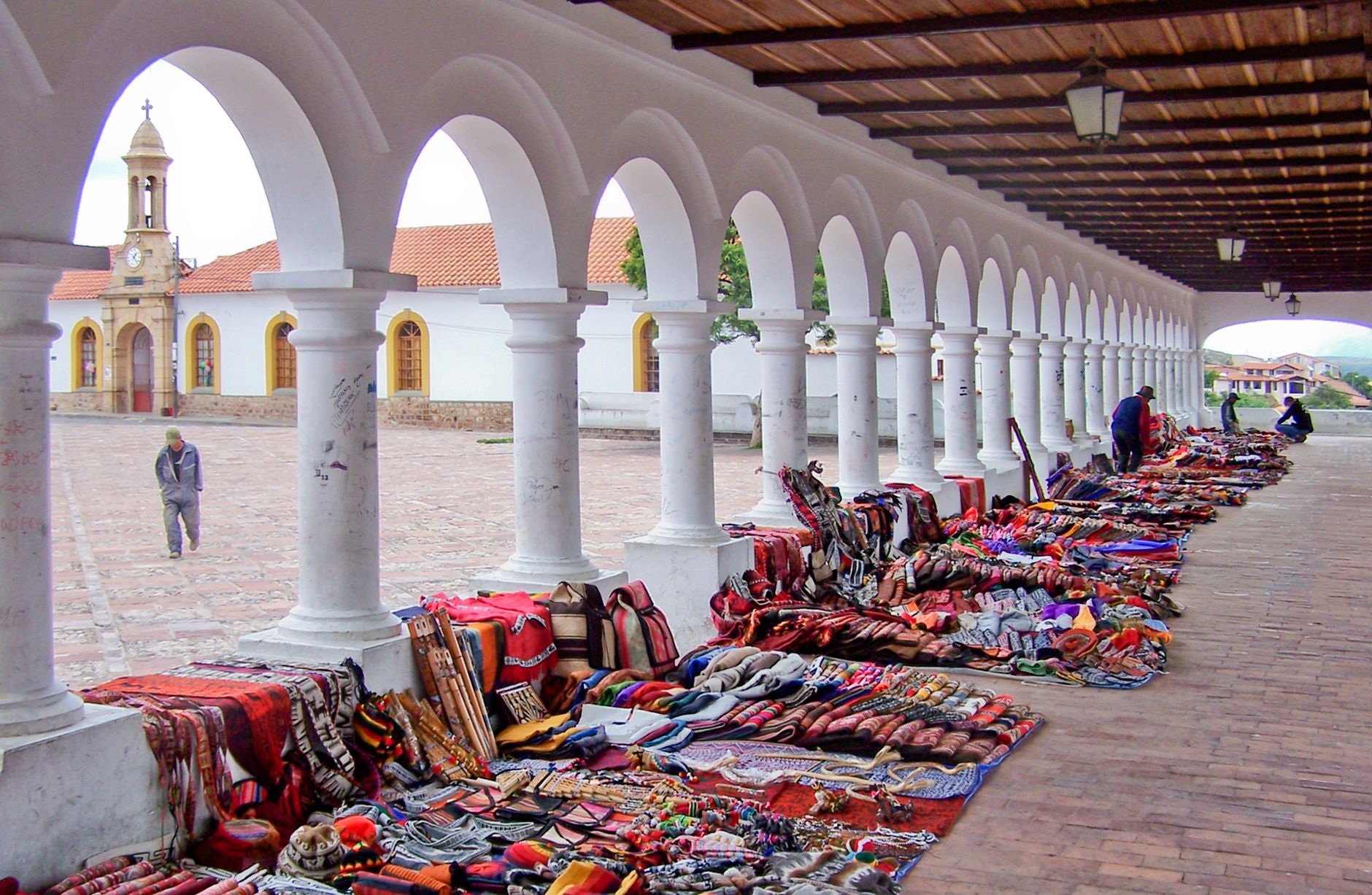
The Dino Truck is the option most travellers take: an open-sided tourist bus that departs from beside the cathedral on Plaza 25 de Mayo several times a day, costs roughly 20–25 bolivianos including the return leg, and is timed to line up with the guided walks at the park. It is slow and unashamedly touristy, but it removes every logistical decision from your day.
Public micros heading towards the cement plant pass the park entrance and cost about 2 bolivianos. Ask for “Parque Cretácico” or “Fancesa” — drivers know it. This is the cheapest option and takes about 25 minutes with stops.
A taxi from the historic centre runs roughly 30–40 bolivianos one way and takes 15 minutes. For a pair or a small group this is usually the best value, and it lets you choose your own timing. Agree the fare before you get in, as covered in our guide to getting around Bolivia.
Opening hours and tickets
Parque Cretácico generally opens Tuesday to Sunday from around 09:00 to 17:00, with reduced hours on Mondays or closure for maintenance. Foreign adult entry sits at roughly 30 bolivianos — about US$4 — with lower rates for Bolivian nationals, students and children. Bring cash in small notes; card payment is unreliable and there is no ATM at the site.
Hours, prices and the guided-walk schedule all shift from season to season. Confirm the current times at the tourist office on Plaza 25 de Mayo, or ask your accommodation to call ahead. Turning up half an hour after the last guided descent is the single most common way to be disappointed here.
The viewing platform and the guided walk
Entry gets you onto a terrace overlooking the pit, with the wall several hundred metres opposite. Fixed telescopes are mounted along the railing, and interpretive panels identify the main trackways.
The part worth planning around is the guided walk — often signposted as the Dino Walk — which takes small groups down a path towards the base of the wall for a much closer view. These run at set times through the middle of the day, typically a handful of departures between roughly midday and mid-afternoon, and they are what turn the visit from “distant rock face” into something you remember. Ask for the schedule at the ticket window the moment you arrive, and build the rest of your time around the next departure.
What You Actually See at the Site
Set your expectations correctly and you will enjoy this far more.
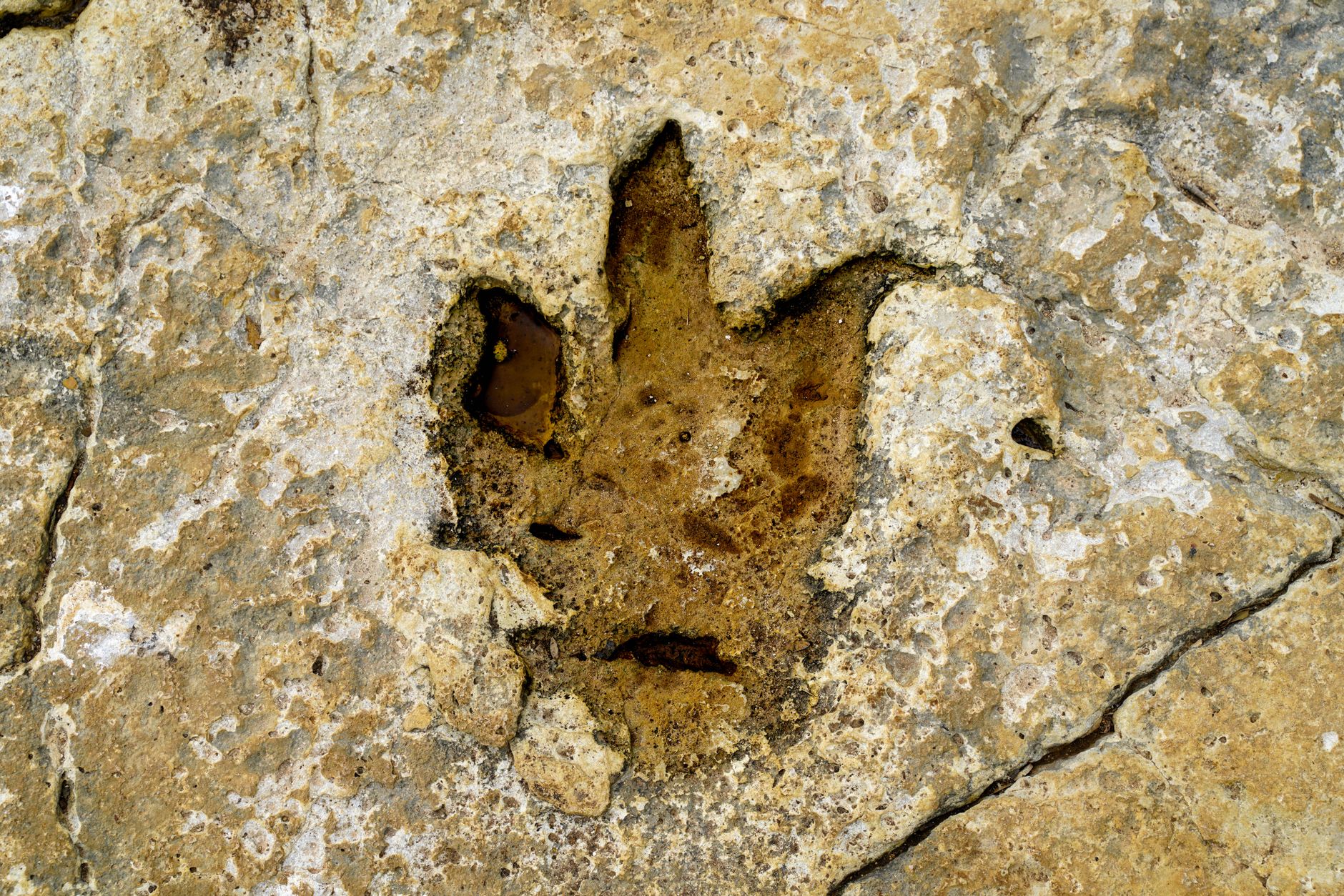
From the terrace, the footprints read as texture and pattern rather than as crisp individual prints. Sauropod trails show up as regular lines of pale circular depressions marching diagonally across the face. Theropod trackways are finer and more angular, three-toed and irregularly spaced. Once your eye adjusts — and it takes a few minutes — you start to see the wall as a record of movement rather than a slab of grey rock: animals crossing, pausing, changing direction.
Bring optics. This is the single most useful piece of advice in this guide. Binoculars, or a camera with a 200 mm-plus zoom, transform the experience. Without them, the mounted telescopes are your only close view and there is usually a queue. The same kit earns its place elsewhere in the country too, as our Bolivia photography guide sets out.
The park also holds a set of life-size dinosaur replicas along a landscaped walking route, plus a small palaeontology museum with casts and interpretive displays. The replicas are aimed squarely at families with young children and are not scientifically rigorous, but they are well made and photograph well. If you are travelling with kids, they are half the reason to come.
The Best Time of Day and Year to Go
Time of day matters more than season. Low, angled light rakes across the wall and throws the depressions into relief; overhead midday sun flattens everything into uniform grey. Mid-morning and mid-afternoon are dramatically better than noon. Because the guided walks cluster around the middle of the day, the practical compromise is to arrive for a late-morning descent and stay through the early afternoon.
Season affects visibility and access. Sucre’s dry season, roughly May to September, brings clear skies and reliable conditions, and it overlaps with the best window for travel across most of the country — see our guide to the best time to visit Bolivia for the full picture. The wet season from December to March can bring afternoon cloud and haze, and heavy rain occasionally closes the guided walk for safety.
At 2,790 m, Sucre is mild year-round: expect roughly 18–22 °C by day and single digits at night. The terrace is fully exposed, so sun protection matters more than warm layers.
How Much Time to Budget
Allow two to three hours door to door from central Sucre. That breaks down as 15–25 minutes of travel each way, 30–45 minutes on the terrace and at the telescopes, 45–60 minutes for the guided walk if you catch one, and 20–30 minutes for the replica trail and museum.
Cal Orck’o slots neatly into a half day, which makes it easy to combine with the rest of the city. A standard two-day Sucre plan puts the colonial centre, the Casa de la Libertad and La Recoleta on day one, and Cal Orck’o on the morning of day two — the pattern we recommend in our full guide to things to do in Sucre. If your visit falls on a Sunday, note that the Tarabuco market takes the whole morning, so plan the dinosaur wall for a different day.
How Cal Orck’o Compares to Torotoro
Bolivia has a second world-class dinosaur site, and travellers regularly ask which one to choose. They are not really substitutes.
Cal Orck’o is about scale and accessibility. Thousands of tracks in one view, twenty minutes from a UNESCO-listed colonial city, visitable in a half day with no special preparation. You see the tracks from a distance.
Torotoro National Park, roughly 130 km south of Cochabamba, is about proximity. The footprints there lie on flat riverbed slabs you can walk right up to and photograph from a metre away, set inside a canyon landscape with caves and waterfalls. Getting there takes a rough four-to-six-hour drive and the visit needs two to three days. Our Torotoro National Park guide covers the logistics.
If you want to stand beside a dinosaur footprint, go to Torotoro. If you want to grasp how many dinosaurs there once were, go to Cal Orck’o. Travellers on a longer route through the country often fit in both, as sketched in our 7, 10 and 14-day Bolivia itineraries.
Practical Tips for Your Visit
- Carry small bolivianos. Entry, the Dino Truck and any snacks are all cash-only in practice, and change for a 100 Bs note can be scarce — see our money and cash guide.
- Confirm the guided-walk times before you leave the city. The whole visit hinges on this.
- Bring binoculars or a zoom lens. Repeated because it is the difference between a good visit and a flat one.
- Sun protection is essential. The terrace has almost no shade and UV at 2,790 m is fierce.
- Skip the on-site restaurant unless you need it. Prices are inflated and central Sucre eats far better for less.
- Allow for altitude. Sucre is gentler than La Paz, but if you have flown in from the lowlands, take the first day slowly — our altitude guide explains the sensible acclimatisation order.
- Go on a weekday if you can. Weekends bring Bolivian family groups and long telescope queues.
Is Cal Orck’o Worth It?
Yes — with the right framing. Cal Orck’o is not a polished museum experience, and any guide that sells it as one is setting you up to be let down. It is an industrial quarry face that happens to carry the single densest record of dinosaur movement anywhere on the planet, viewed across an open pit, in a country that has not had the resources to build the world-class interpretive centre the site deserves.
That is also exactly what makes it memorable. There is no glass, no staged lighting, no queue management. You stand on a terrace on the edge of Sucre, look across a hole in the ground at a wall of rock, and slowly realise that the pale marks tracking diagonally across it are the footprints of animals that were alive in the final chapter of the Cretaceous — and that some of those marks may not survive the next few decades of weather.
Go in the morning, bring binoculars, catch the guided walk, and give it two hours. It will be one of the odder and better things you do in Bolivia.
Key facts
- Cal Orck'o holds 12,092 individual dinosaur footprints across 465 separate trackways, the largest number recorded at any single site on Earth.
- The main track-bearing surface covers roughly 65,000 m² and sits 4.4 km northwest of Sucre, on the edge of the FANCESA cement quarry.
- The tracks were made about 68 million years ago in the Middle Maastrichtian, the final stage of the Late Cretaceous, in the oolitic limestone of the El Molino Formation.
- At least 9 distinct track morphotypes have been identified at the site, with sauropod trails accounting for about 26% of all trackways.
- Parque Cretácico opened on the quarry rim in 2006 and is the only legal access point to the wall; foreign adult entry costs around 30 bolivianos (about US$4).
Frequently asked questions
How do you get from Sucre to Cal Orck'o?
Cal Orck'o is 4.4 km northwest of Sucre, so the trip takes 15–25 minutes. The cheapest tourist option is the Dino Truck, an open-sided bus that leaves from beside the cathedral on Plaza 25 de Mayo several times a day and includes the return trip for around 20–25 bolivianos. Public micros running towards the cement plant cost about 2 bolivianos and drop you at the park gate. A taxi from the centre costs roughly 30–40 bolivianos one way. Times and fares change, so confirm the day before at your hotel or the tourist office on the plaza.
How many dinosaur footprints are there at Cal Orck'o?
Mapping carried out between 1998 and 2015 documented 12,092 individual footprints arranged in 465 distinct trackways, made by at least nine different track types including sauropods, theropods, ankylosaurs and ornithopods. Sauropod trails account for around 26% of the trackways. Older figures of about 5,000 tracks still circulate widely online — they come from the earliest surveys of the 1990s and have since been more than doubled by later fieldwork.
Why is the Cal Orck'o wall vertical?
The footprints were made on flat, damp ground at the edge of a shallow Cretaceous lake, then buried and turned to stone. Millions of years later, the tectonic collision that raised the Andes tilted the whole rock package upwards until the old lakeshore stood almost on end. Nothing about the tracks themselves is vertical — the ground they were pressed into simply rotated. Because the wall now faces the weather instead of lying flat beneath it, slabs of rock periodically break away, and some trackways photographed in the 1990s no longer exist.
Is Cal Orck'o worth visiting?
Yes, if you go with the right expectation. This is a working quarry face seen from a distance, not a museum hall — you look across an open pit at a rock wall several hundred metres away, and the tracks read as patterns rather than crisp individual prints. Bring binoculars or a zoom lens and time your visit for one of the guided walks that descend towards the base, and it becomes genuinely impressive. Turn up at noon with no optics and it can feel underwhelming. Budget two to three hours including transport.