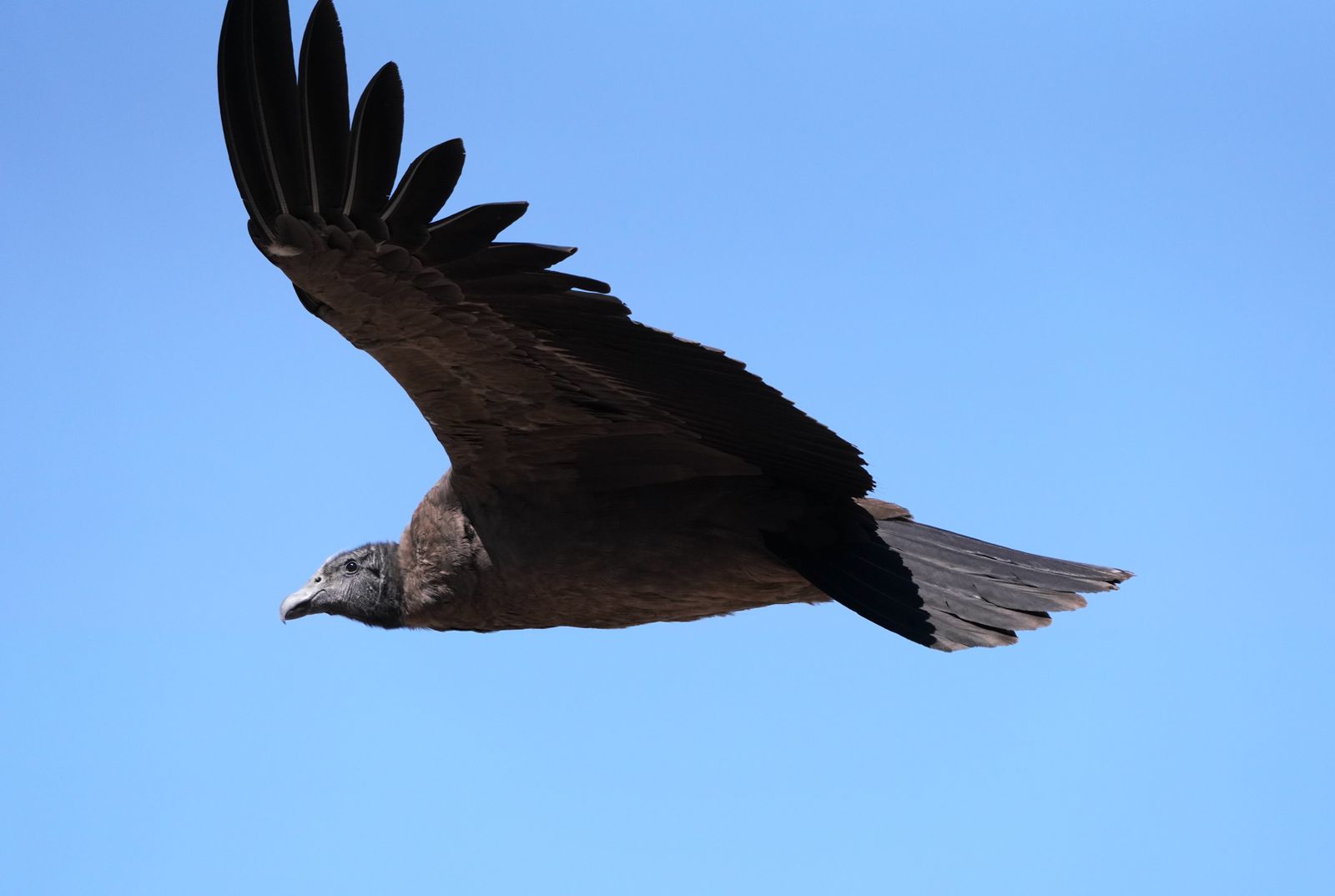
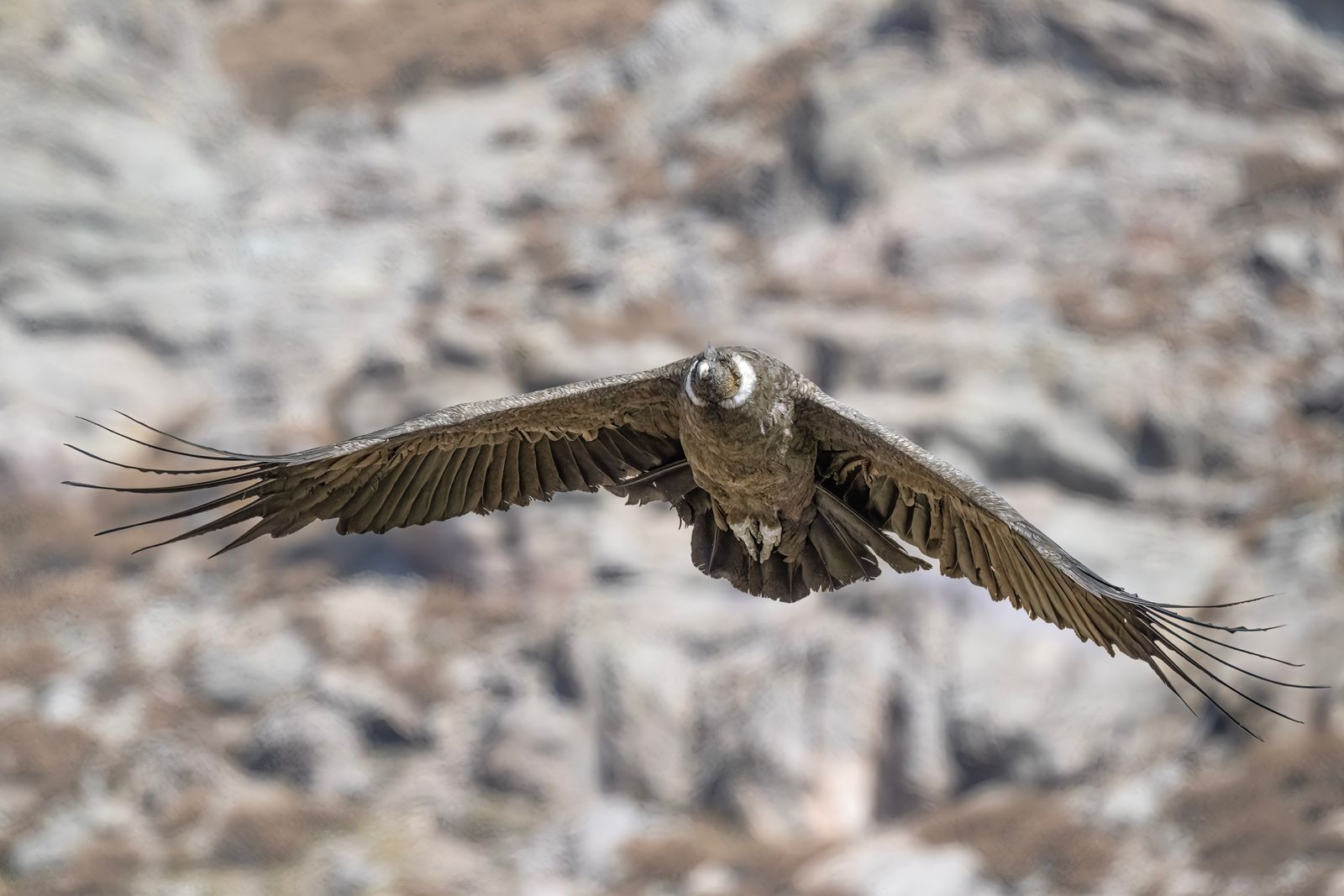
There is a moment, standing on the rim of a Bolivian canyon, when a shadow crosses the rock in front of you before you hear anything at all. Then the bird arrives: three metres of black wing, silent, close enough that you can count the individual fingers of feathers at the wingtips. The Andean condor is the largest flying bird on earth by combined weight and wingspan, and Bolivia is one of the last places where you can watch one without standing in a crowd of two hundred people. In Peru’s Colca Canyon, condor-watching is a ticketed queue at dawn. In Bolivia, it is usually you, a local guide, and the wind.
Why Bolivia Is the Best Place to See a Condor Without the Crowds
Condors live the length of the Andes, from Venezuela to Tierra del Fuego, but the viewing experience varies enormously. Peru’s Cruz del Cóndor viewpoint in the Colca Canyon has the reliability of a bus timetable and the atmosphere of one too: hundreds of visitors arrive by tour bus before 8 a.m. every day of the high season. Ecuador’s condor population has collapsed to little more than a hundred birds. Argentina and Chile hold strong populations, but the good sites are remote and expensive to reach.
Bolivia sits in between in the best possible way. The altiplano and its deep valley canyons hold a healthy population, several viewpoints are genuinely accessible on a normal traveller’s budget, and you will rarely share them with anyone. This is the same logic that makes the whole country worth the detour: the wildlife in our Bolivian species guide is comparable to its neighbours’, but the infrastructure around it is quieter, cheaper and far less packaged.
The other advantage is combination. Bolivia’s condor sites sit next to other things you already want to do: dinosaur footprints preserved in open rock, a 6,542 m volcano, hot springs at 4,200 m, and some of the most photogenic high country in South America.
What You Are Actually Looking At
The Andean condor (Vultur gryphus) is a vulture, not an eagle, and the numbers are genuinely hard to picture until one passes overhead.
A wingspan of up to 3.3 metres — wider than a compact car is long. Males weigh 11–15 kg, females 8–11 kg. Only the wandering albatross has a longer wingspan, and no flying bird on earth combines this much wing with this much body weight.
That weight is why condors are such extraordinary gliders. Wild condors fitted with flight recorders turned out to flap their wings for roughly 1% of their flying time. One tracked bird flew for more than five hours and over 160 km without a single wingbeat. What looks like effortless soaring is exactly that: the bird reads thermals and ridge lift and pays almost nothing for the ride.
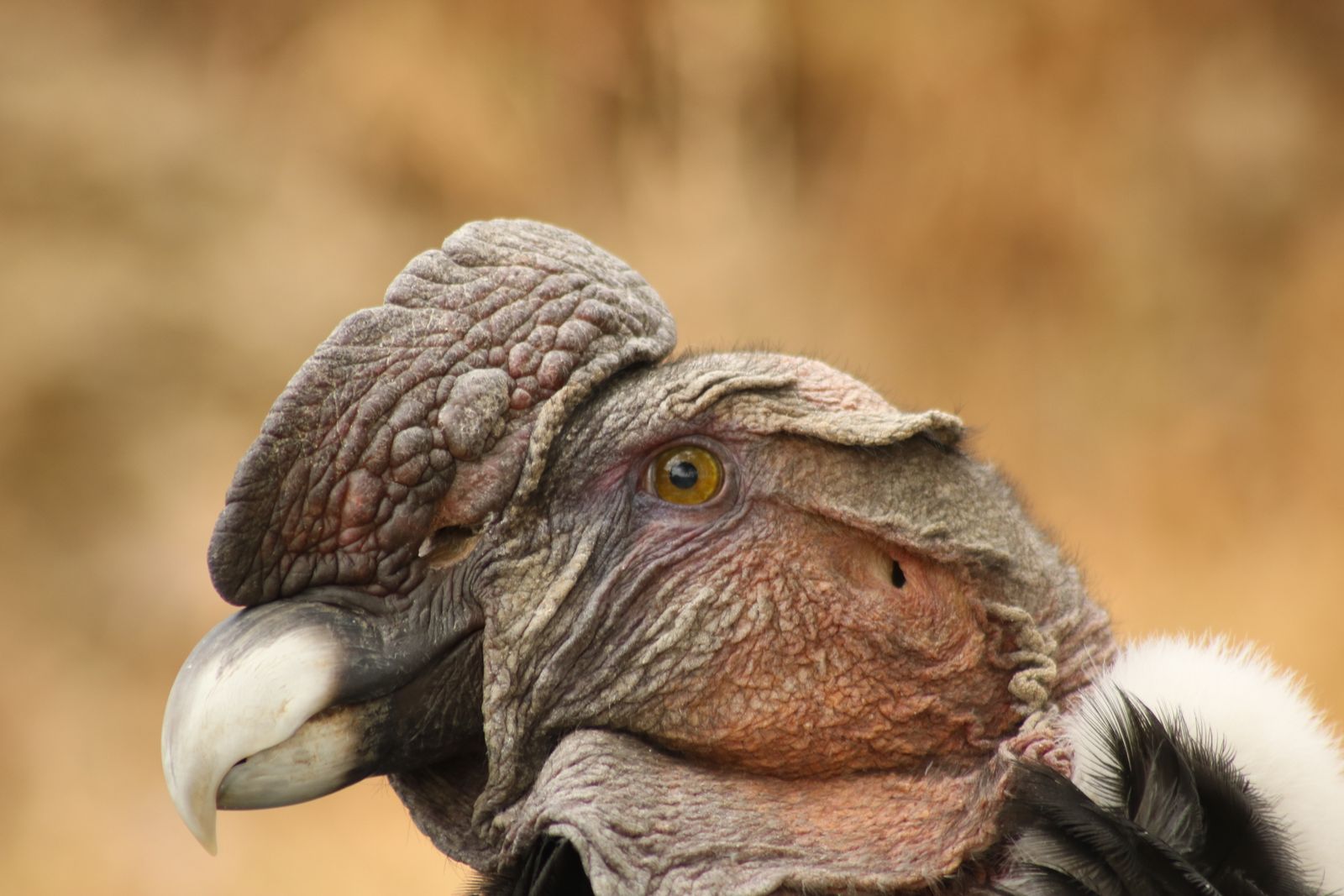
How to tell a condor from a vulture in flight
Bolivian skies are full of large dark birds, and most of them are not condors. Three field marks settle it:
- Size and shape. A condor’s wings are long, broad and held flat like a plank, with deeply separated primary feathers at the tips. Turkey vultures hold their wings in a shallow V and rock from side to side as they fly.
- The white. Adult condors have a broad white ruff at the base of the neck and a large white panel on the upper surface of each wing. Nothing else in the Andes looks like this.
- The flapping. If it beats its wings repeatedly, it is almost certainly not a condor.
Male or female, adult or teenager
Unusually for birds of prey, the male is both the larger and the more ornamented sex. Males have a fleshy caruncle, or comb, on top of the head and a wattle at the throat; females have neither. Males have brown eyes, females red. Juveniles are a dull greyish-brown all over and take six to eight years to develop full adult plumage — so a brown “condor” is not a different species, just a teenager.
Where to See Andean Condors in Bolivia
Torotoro National Park, the most accessible option
If you only have time for one condor site, make it Torotoro. The park sits in northern Potosí department, 130 km from Cochabamba on a now largely paved road, about 4 hours by shared taxi or bus. The canyon of the Río Torotoro drops some 250 m, and the El Vergel viewpoint at the head of the canyon stairway is the standard lookout: you stand on the rim, level with or above the birds, and watch them come up the canyon on the morning thermals.
Torotoro is also the most efficient stop in Bolivia for a traveller with limited time, because condors are not the only reason to go. The park holds thousands of dinosaur footprints in open rock, the Umajalanta cave system and the Ciudad de Itas formations. Read the full Torotoro National Park guide before you book, and pair it with a night or two in Cochabamba.
Logistics: park entry is around 100 Bs (about US$15) for foreign visitors, plus a compulsory local guide shared between your group, roughly 150–300 Bs per excursion depending on the route. Basic hostels in Torotoro village run 60–150 Bs a night. Two nights is the right amount of time.
Sajama National Park, condors over Bolivia’s highest volcano
Sajama, Bolivia’s oldest national park, surrounds the 6,542 m Nevado Sajama volcano near the Chilean border, about 4 to 5 hours from La Paz. Condors patrol the ridges here alongside vicuñas, flamingos and the world’s highest forest of queñua trees. It is less of a guaranteed show than Torotoro and more of a slow, wide-open landscape where you scan the ridgelines and wait — which is exactly what some people want. The Sajama National Park guide covers the hot springs, the village lodgings and the crossing into Chile.
Logistics: park entry around 100 Bs, simple community lodgings in Sajama village from 80–200 Bs. Most travellers arrive via Patacamaya on the La Paz–Arica road, which makes this the natural condor stop if you are heading to or from northern Chile.
Apolobamba, the serious wildlife option
The Apolobamba range, on the Peruvian border north of La Paz, is where Bolivian birders go. This is high, remote country at 4,000 to 5,000 m with one of the densest condor populations in the country, plus vicuña herds and the traditional chaku shearing roundup. The gateway town is Charazani, roughly 8 hours from La Paz by bus. Come here if wildlife is the point of your trip rather than a bonus, and budget at least three days.
Tarija and the southern valleys
The Sama Biological Reserve above Tarija and the canyons of the Cintis valley hold condors too, and this is the most comfortable version of the trip in the whole country: watch birds in the morning and be tasting high-altitude wine in a Tarija bodega by the afternoon. Sightings are less predictable here, so treat them as a bonus rather than the plan.
The southwest circuit and the Cordillera Real
Condors turn up regularly along the high passes of the classic Uyuni southwest circuit and above the trekking routes of the Cordillera Real near La Paz — the Condoriri massif is named for the bird, and its main peak reads as a condor with its wings spread. If you are already trekking in Bolivia, keep your eyes on the ridgelines.
When to Go, and What Time of Day
The dry season, May to October, is the right window. Skies are clear, thermals are strong, and the roads into Torotoro, Sajama and Apolobamba are reliable. The wet season from November to March brings cloud that flattens both the light and the updrafts, and can make rural roads slow or impassable. Our best time to visit Bolivia guide breaks the seasons down region by region.
Within the day, the window is narrow and worth planning around. Condors need warm air to fly, so they sit on their roosting ledges until the sun has heated the rock. Expect the first birds to lift off around 9:00 to 10:00, with the strongest activity between 10:00 and 14:00. A guide who tells you to leave at 5 a.m. for a condor viewpoint is selling you a sunrise, not a bird.
What It Costs and How to Budget It
Bolivia’s advantage here is not just the absence of crowds, it is the price. A realistic two-night Torotoro trip from Cochabamba — transport, park fees, guide and simple lodging — comes to roughly US$70–110 per person travelling in a small group. The equivalent organised condor excursion in Peru’s Colca Canyon, with entry ticket and tour, typically runs US$60–120 for a single day trip. In Bolivia you are getting a park, a canyon, a cave system and a dinosaur trackway for the price of one morning next door.
Carry cash in bolivianos. There are no reliable ATMs in Torotoro, Sajama village or Charazani, and card payment is effectively non-existent in all three. Our money in Bolivia guide covers where to withdraw before you leave the city.
Why the Condor Means More Here Than a Photograph
The condor is not just wildlife in Bolivia. In Aymara it is the mallku, a word that also means leader or lord and is used for the mountain spirits themselves; in Quechua it is the kuntur, the root of the Spanish cóndor. In Andean cosmology the condor represents the upper world, the Hanan Pacha, alongside the puma of the middle world and the serpent of the underworld — a three-part structure you will see carved into the stonework at Tiwanaku and woven into textiles across the altiplano.
It is also a state symbol: the Andean condor stands above the shield on Bolivia’s coat of arms, the version of the flag flown by government institutions. If you have read our guide to the Bolivian flag’s meaning and history, you have already seen the bird without registering it.
This matters practically, too. Because the condor is culturally loaded, communities around Torotoro and Apolobamba have a real stake in protecting roosting cliffs, and the guiding work is community-run. The fee you pay stays close to the bird.
Is the Andean Condor Endangered?
Yes. The IUCN Red List classifies Vultur gryphus as Vulnerable, with an estimated global population of fewer than 10,000 mature individuals and a declining trend. The threats are secondary poisoning from carcasses laced to kill pumas and foxes, lead from ammunition in the carrion they eat, collisions with power lines, and persecution based on the false belief that condors kill livestock. They do not: condors are scavengers, and useful ones, stripping carcasses before disease spreads.
Recovery is slow because condors reproduce slowly. A pair lays a single egg roughly every two years, incubates it for about two months, and the young bird stays dependent for up to two years after hatching. The upside of that strategy is longevity: wild condors regularly pass 50 years, and captive birds have lived beyond 70.
Practical Tips Before You Go
- Acclimatise first. Torotoro village sits at about 2,600 m, but the Sajama and Apolobamba viewpoints are at 4,000–4,700 m. Spend two nights in La Paz, Sucre or Cochabamba first and read the altitude guide.
- Bring the right layers. Canyon rims are windy and high-altitude mornings are near freezing even in the dry season, while midday sun at 4,000 m burns fast. Windproof shell, fleece, hat, high-factor sunscreen.
- Binoculars beat a long lens for actually enjoying the birds; 8x42 is ideal. For photography, 200–400 mm is plenty, since condors often pass within 30 metres of a canyon viewpoint. Our photography locations guide has more on shooting the altiplano.
- Hire your guide in the village, not online. In Torotoro, guides are assigned through the local association office on the main square and the rate is fixed and posted.
- Give the birds room. Never approach a roosting cliff or a feeding condor. A bird disturbed at a nest site may abandon a single egg it will not replace for two years.
Bolivia rewards travellers willing to add one extra leg to the obvious route. A condor morning at Torotoro or a ridgeline afternoon at Sajama costs very little, sits an easy drive from places you are already going, and gives you the one wildlife encounter in South America that genuinely changes scale on you. Then the shadow crosses the rock, and you stop taking photographs for a second, and you just watch.
Key facts
- The Andean condor has a wingspan of up to 3.3 m and males weigh 11-15 kg, making it the largest flying bird on earth by combined weight and wingspan.
- Condors flap their wings for only about 1% of their flight time and can glide for more than 160 km without a single wingbeat.
- The species is listed as Vulnerable on the IUCN Red List, with an estimated global population of fewer than 10,000 mature individuals.
- Torotoro National Park sits 130 km from Cochabamba, a drive of roughly 4 hours, and its El Vergel canyon viewpoint is Bolivia's most accessible condor lookout.
- A pair raises a single chick roughly every two years, and the young bird depends on its parents for up to two years after hatching.
- Andean condors regularly live more than 50 years in the wild and over 70 in captivity, one of the longest lifespans of any bird.
- Bolivia's coat of arms, used on the state version of the national flag, features an Andean condor above the shield.
Frequently asked questions
Is it worth going to see condors in Bolivia if I only have 10 days?
Yes, if you build it into a route you are already travelling. Torotoro National Park adds two nights to a Cochabamba stop and gives you dinosaur tracks, a canyon and condors in the same trip. If your ten days are Uyuni-focused instead, add Sajama on the way to or from Chile rather than making a separate journey.
Is Bolivia better than Colca Canyon in Peru for seeing condors?
For the experience, yes. Colca's Cruz del Condor viewpoint is more reliable but receives hundreds of visitors at dawn and feels like a queue. In Bolivia you will usually share a canyon rim with your guide and nobody else. Sightings take a little more patience, but the birds are wild, unfed and unhabituated.
Do I need a guide or special equipment to see Andean condors?
A guide is compulsory inside Torotoro National Park and strongly recommended in Sajama and Apolobamba, where local guides know the roosting cliffs. You do not need specialist gear: binoculars help, and a zoom lens of 200 mm or more is enough for flight shots. Warm layers matter more than optics, since every viewpoint sits between 2,600 m and 4,700 m.
What time of day are Andean condors most active?
Mid-morning to early afternoon, roughly 9:00 to 14:00. Condors depend on thermal updrafts and rarely leave their cliffs until the sun has heated the rock. Dawn is good for watching them perched on ledges; the flying show starts a couple of hours later.
Is it safe to travel to these areas on my own?
Yes. Torotoro, Sajama and Charazani are small, quiet rural towns where the practical risks are altitude and rough roads, not crime. Travel by day, carry cash in bolivianos because there are no reliable ATMs, and acclimatise in La Paz, Sucre or Cochabamba before going above 4,000 m.