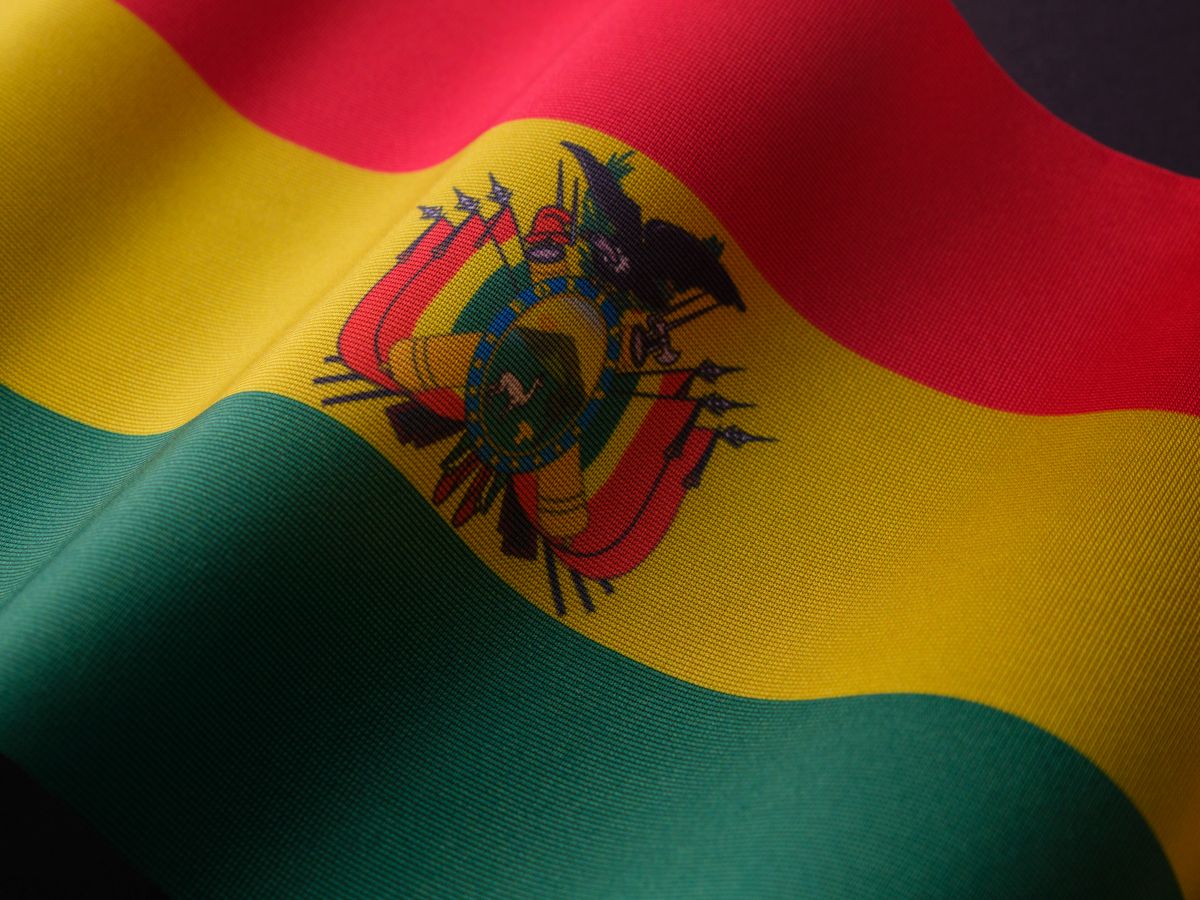
The Bolivian flag is one of the simplest in South America: three horizontal bands of red, yellow and green, each the same height. Yet in Bolivia you will almost never see it alone. On government buildings it flies next to the Wiphala, a chequerboard of 49 coloured squares; on the state version it carries a crowded coat of arms topped by a condor; and every August it hangs from balconies across the country. This guide explains what each colour means, how the flag changed from 1825 to today, what the coat of arms shows, why Bolivia has a second national flag and where you will see all of them when you travel.
What Do the Colors of the Bolivian Flag Mean?
The official meanings were first written down in a decree of 14 December 1888, under President Gregorio Pacheco, and restated in Supreme Decree 241 of 5 August 2009, which regulates all of Bolivia’s national symbols today:
- Red represents the blood shed by the heroes for the birth and preservation of the republic.
- Yellow represents the country’s wealth and resources, especially the minerals of its subsoil.
- Green represents the richness of its natural areas and hope.
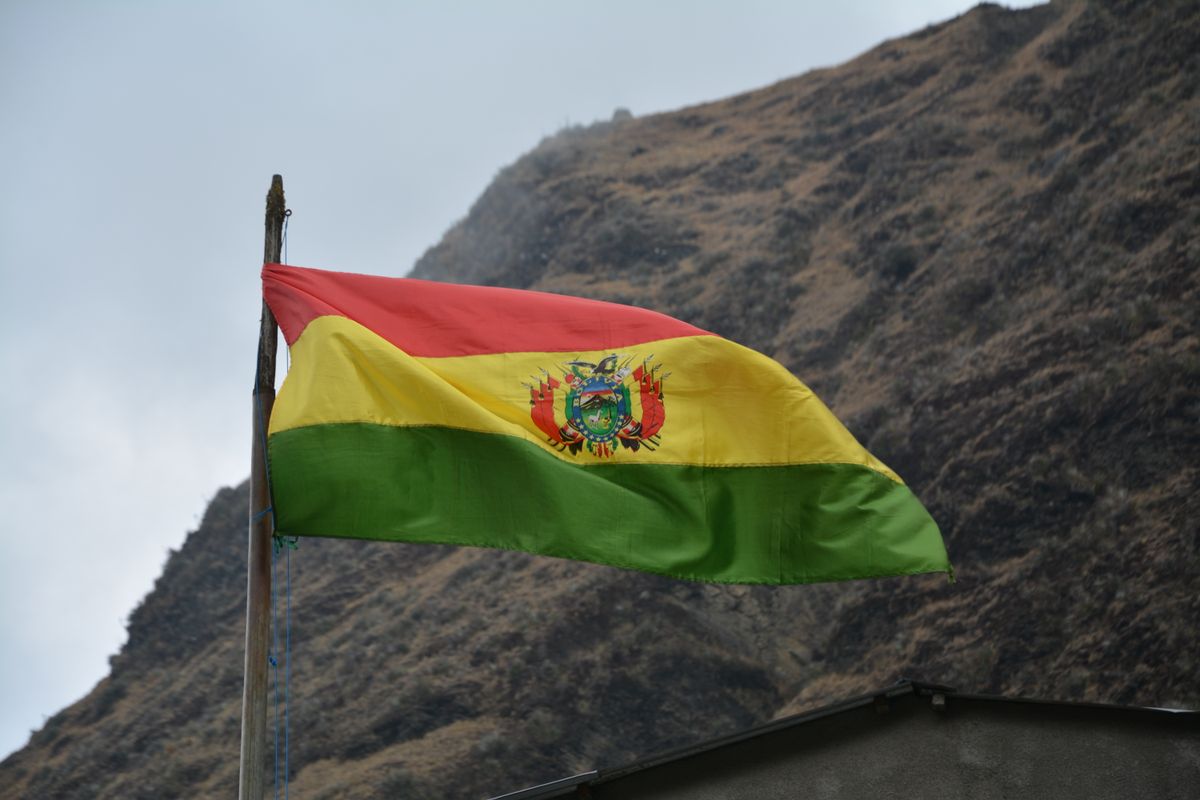
Those three ideas map neatly onto Bolivia’s landscape. The yellow band is a reminder that the country’s history was built on mining, from the silver of the Cerro Rico of Potosí to the tin barons of the 20th century and today’s lithium under the Salar de Uyuni. The green band stands for the other half of the country that many visitors never picture: the Amazon, the Chiquitania and the Pantanal cover more than half of Bolivia’s territory. The red is the most political colour, tied to the independence war that ended with the act signed in Sucre on 6 August 1825, which our guide to Bolivian Independence Day covers in detail.
A popular legend about the rainbow
Many Bolivians learn at school that President Manuel Isidoro Belzu chose the colours after seeing a rainbow near Pasto Grande, on a journey through the highlands in 1851, and that the red, yellow and green bands were the ones that stood out most. It is a legend rather than a documented fact, but it is still repeated every Flag Day, and it explains why the flag is sometimes described as “the rainbow of Belzu”.
Official colours and proportions
Supreme Decree 241 fixes the size of the flag at 7.5 units high by 11 units wide, a ratio of 15:22, with each band 2.5 units high. The decree also defines exact shades, so the red is a deep scarlet rather than a crimson, the yellow is bright and slightly warm, and the green is a dark forest green. If you buy a flag in a market in La Paz you will notice the proportions vary, but official buildings follow the decree.
How Has the Bolivian Flag Changed Since 1825?
The tricolour you see today is Bolivia’s fourth design. The country went through three flags in its first 26 years, which is why dates can be confusing.
1825: the first flag
Eleven days after independence, on 17 August 1825, the General Assembly in Chuquisaca created the first national flag. It had three bands, green, red and green, with a wider red band in the centre. On the red band sat five gold stars framed by olive and laurel branches, one for each of the five provinces that signed the act: Charcas, Potosí, La Paz, Cochabamba and Santa Cruz. There were two versions: a bandera mayor for the state, with the stars, and a simpler bandera menor for civil use.
1826: Sucre’s yellow band
On 25 July 1826, under President Antonio José de Sucre, the stars were dropped and a yellow band appeared, giving a yellow, red and green tricolour with the national coat of arms in the centre. The design was revised again on 5 April 1831 under Andrés de Santa Cruz, keeping the same three colours.
1851: Belzu’s red, yellow and green
The current order was adopted on 31 October 1851 under Manuel Isidoro Belzu and confirmed by law on 5 November 1851. The new flag was raised for the first time on 7 November 1851 in Oruro, at the Faro de Conchupata, a hill that today holds a monument to the event. That makes Oruro the birthplace of the modern flag, a detail worth remembering if you visit the city for its carnival.
1888 and 2009: meanings and rules
The 1888 decree gave each colour its official meaning. Much later, Supreme Decree 241 of 5 August 2009 updated the rules for all the national symbols after the new Constitution came into force, defining sizes, shades, protocol order and the use of the Wiphala.
What Is on the Bolivian Coat of Arms?
The state flag carries the national coat of arms in the centre of the yellow band. The civil flag, the one ordinary people fly at home, has only the three bands. The coat of arms is dense with symbols:
- An oval with the Cerro Rico of Potosí, the silver mountain that financed the Spanish empire, with a rising sun behind it and a small chapel at its foot.
- A llama, standing for the Andean fauna and the camelids that sustained highland life. Our guide to llamas vs alpacas explains why this animal matters so much in Bolivia.
- A sheaf of wheat and a palm tree, representing the farmland of the valleys and the plants of the lowlands.
- The word BOLIVIA in gold capitals on the upper half of a blue border, and ten gold stars on the lower half, traditionally read as the nine departments plus the Litoral province lost to Chile in the War of the Pacific (1879–1884).
- An Andean condor on top, wings spread, as a symbol of freedom.
- Three tricolour flags on each side, with cannons, rifles, an axe and a Phrygian liberty cap, framed by laurel and olive branches for victory and peace.
The current version dates from 2004. Earlier versions were adopted in 1825, 1826 and 1888, and the tenth star was added in 1961.
What Is the Wiphala and Why Is It a National Symbol?
The Wiphala is a square flag made of 49 small squares arranged in a 7-by-7 grid, using seven colours: red, orange, yellow, white, green, blue and violet. The squares run diagonally, so each colour forms a stripe from corner to corner, with a diagonal of white squares through the centre. It is associated with the Andean Indigenous peoples, above all the Aymara and Quechua, and with the idea of Qullasuyu, the southern quarter of the Inca world.
Article 6 (section II) of the 2009 Constitution lists the national symbols of the Plurinational State of Bolivia: the red, yellow and green tricolour, the national anthem, the coat of arms, the Wiphala, the cockade (escarapela), and two national flowers, the kantuta and the patujú. Supreme Decree 241 sets the protocol: on official buildings the Wiphala flies beside the tricolour, and in 2010 it was also adopted as a war flag by the armed forces.
For travellers, the Wiphala is the flag you will see at protests, community celebrations and roadside offerings in the Altiplano, and printed on taxi stickers, bags and ponchos. It is also a political symbol. It was closely linked with the governments of Evo Morales (2006–2019), and some Bolivians, especially in the eastern lowlands, identify more with the green and white flag of Santa Cruz or with the patujú flower. Treat it with the same respect as the tricolour and avoid using it as a costume prop. To understand where it comes from, read our guide to the Aymara people of Bolivia.
The kantuta and the patujú
The two national flowers are often painted beside the flags. The kantuta (Cantua buxifolia) is a red, yellow and green bell-shaped flower from the Andes that happens to share the tricolour’s colours. The patujú (Heliconia rostrata) is the red, yellow and green heliconia of the tropical lowlands. Together they represent the two halves of the country: the highlands and the east.
What Is the Maritime Claim Flag?
Bolivia lost its coastline to Chile in the War of the Pacific, and the demand for sovereign access to the sea is still a national cause. Law 920 of 27 March 2017 created the Maritime Claim Flag (Bandera de la Reivindicación Marítima): a blue field with the tricolour and the Wiphala in the upper corner, surrounded by nine gold stars. You will see it on 23 March, Day of the Sea, when schools and the navy parade in La Paz and cities hold acts in memory of Eduardo Abaroa, the hero of the battle of Calama (1879). Yes, landlocked Bolivia has a navy, which patrols Lake Titicaca and the Amazon rivers.
When Is Flag Day and When Will You See the Flag Most?
Flag Day is on 17 August, the anniversary of the first flag of 1825. It was made official by a decree of 30 July 1924. It is not a public holiday, but schools hold flag-raising ceremonies, students swear loyalty to the flag and public buildings are decorated.
August is the month of the flag in general. Between 6 August (Independence Day), 7 August (Armed Forces Day) and 17 August (Flag Day), homes, shops and offices hang the tricolour from windows, and the streets fill with it. If you are travelling in that period, check our Bolivia festivals calendar to plan around parades and closures.
Where travellers see the flags
- Plaza Murillo in La Paz, where the tricolour and the Wiphala fly in front of the Government Palace and the Legislative Assembly, and a guard changes regularly.
- Casa de la Libertad in Sucre, which holds the original Act of Independence and historic flags.
- Faro de Conchupata in Oruro, the hill where the current flag was first raised in 1851.
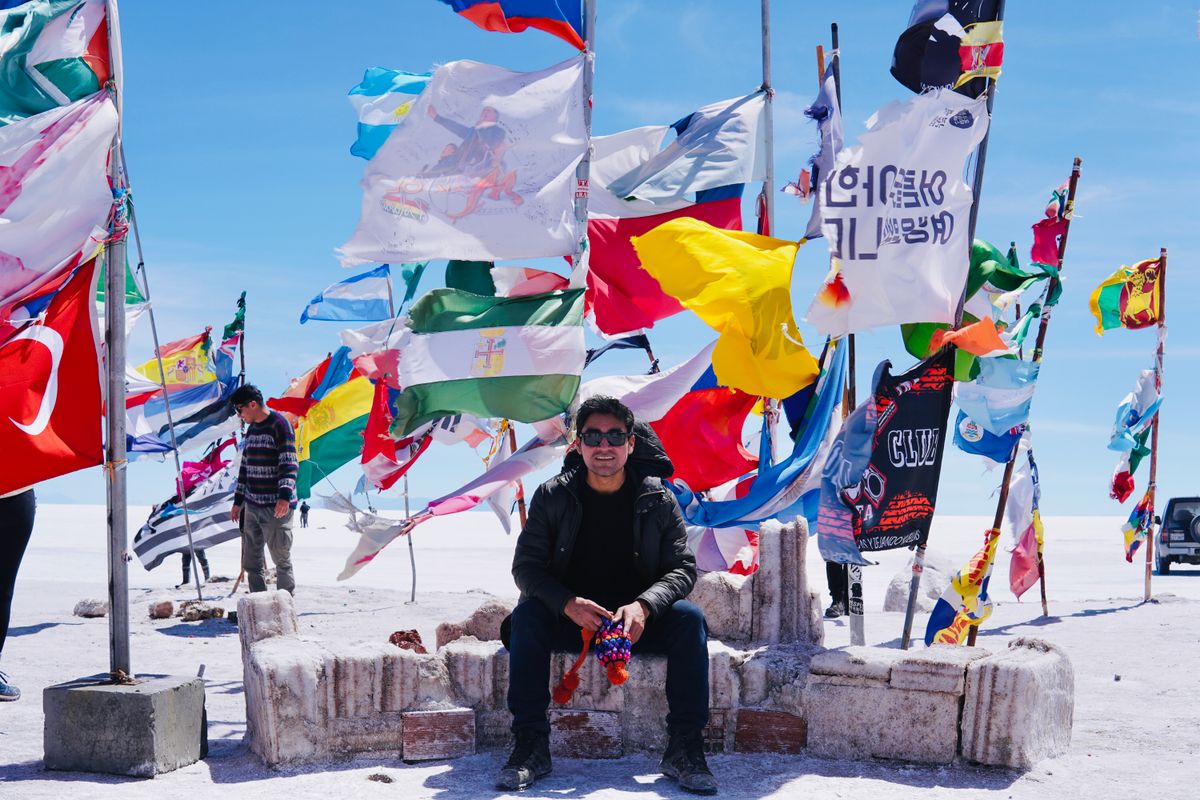
- The flag monument on the Salar de Uyuni, near the old Playa Blanca salt hotel, where travellers leave flags from their own countries beside the Bolivian one.
- Every main square in the country, where a flagpole with the tricolour, and usually the Wiphala, stands in front of the town hall.
How Should You Treat the Bolivian Flag as a Visitor?
Bolivians take their national symbols seriously, and a few simple rules help:
- Stand still during the anthem and the flag-raising. In schools and civic acts people stand, remove hats and stop talking. As a visitor, do the same.
- Don’t wear the flag as a costume or use it as a towel, mat or backdrop for joke photos. The Wiphala deserves the same care.
- Buying a flag is fine. Markets in La Paz, including the stalls near the Witches’ Market, sell tricolours, Wiphalas and patches for a few bolivianos, and many travellers carry one home.
- Photos at the Uyuni flag monument are welcome, as long as you don’t climb on the flagpoles or damage the salt structures.
- Avoid flags at protests. Blockades and marches are common in Bolivia, and a foreigner waving a Wiphala or a regional flag can be read as taking sides.
Flags That Look Like Bolivia’s
The red, yellow and green combination is shared with several other countries, so it is easy to mix them up:
- Ghana uses the same three horizontal bands in the same order, but with a black star in the centre.
- Lithuania has horizontal bands of yellow, green and red, in a different order.
- Guinea and Mali use red, yellow and green in vertical bands.
- Ethiopia has green, yellow and red horizontal bands with an emblem in the centre.
If you see red over yellow over green with no emblem, or with a coat of arms topped by a condor, you are looking at Bolivia.
The Flag as a Key to Bolivian Culture
The story of Bolivia’s flags is a short course in the country’s identity. The tricolour speaks of independence, mining and nature; the coat of arms of Potosí’s silver and the lost sea; the Wiphala and the two flowers of a state that since 2009 calls itself plurinational. Once you can read them, you will start noticing them everywhere: at a school parade in a village near Lake Titicaca, on a truck in the Yungas or at a carnival in Oruro. To go further, our guide to Bolivian culture and traditions and our overview of Bolivian traditional clothing show how these symbols appear in daily life.
Key facts
- Bolivia's current red, yellow and green flag was adopted on 31 October 1851 under President Manuel Isidoro Belzu and first raised on 7 November 1851 in Oruro.
- The meanings of the colours were first defined by a decree of 14 December 1888 and restated by Supreme Decree 241 of 5 August 2009.
- The official proportions of the Bolivian flag are 7.5 units high by 11 units wide (15:22), with three bands of equal height.
- Bolivia's first flag was created on 17 August 1825, and a decree of 30 July 1924 made 17 August the national Flag Day.
- Article 6 of the 2009 Constitution lists the Wiphala, a 7-by-7 grid of 49 squares in seven colours, among Bolivia's national symbols.
- The coat of arms carries ten gold stars, the Cerro Rico of Potosí, a rising sun, a llama and an Andean condor.
- Law 920 of 27 March 2017 established the Maritime Claim Flag, a blue field with nine gold stars and the tricolour and Wiphala in the upper corner.
Frequently asked questions
What do the colors of the Bolivian flag mean?
Red represents the blood shed by Bolivia's heroes for the birth and preservation of the republic, yellow represents the country's mineral wealth and resources, and green represents the richness of its natural areas and hope. These meanings were set by an 1888 decree and restated by Supreme Decree 241 in 2009.
Why does Bolivia have two flags?
Bolivia has one national flag, the red, yellow and green tricolour, but the 2009 Constitution also recognises the Wiphala, a square flag of 49 coloured squares associated with the Andean Indigenous peoples, as a national symbol. On official buildings the two fly side by side.
When is Bolivian Flag Day?
Bolivian Flag Day is on 17 August. It commemorates the creation of the country's first flag on 17 August 1825, eleven days after independence, and was made official by a decree of 30 July 1924.
What is the difference between the Bolivian flag and the Ghana flag?
Both use red, yellow and green horizontal bands in the same order, but Ghana's flag has a black five-pointed star in the centre of the yellow band. Bolivia's civil flag has no emblem, and its state flag carries the national coat of arms instead.