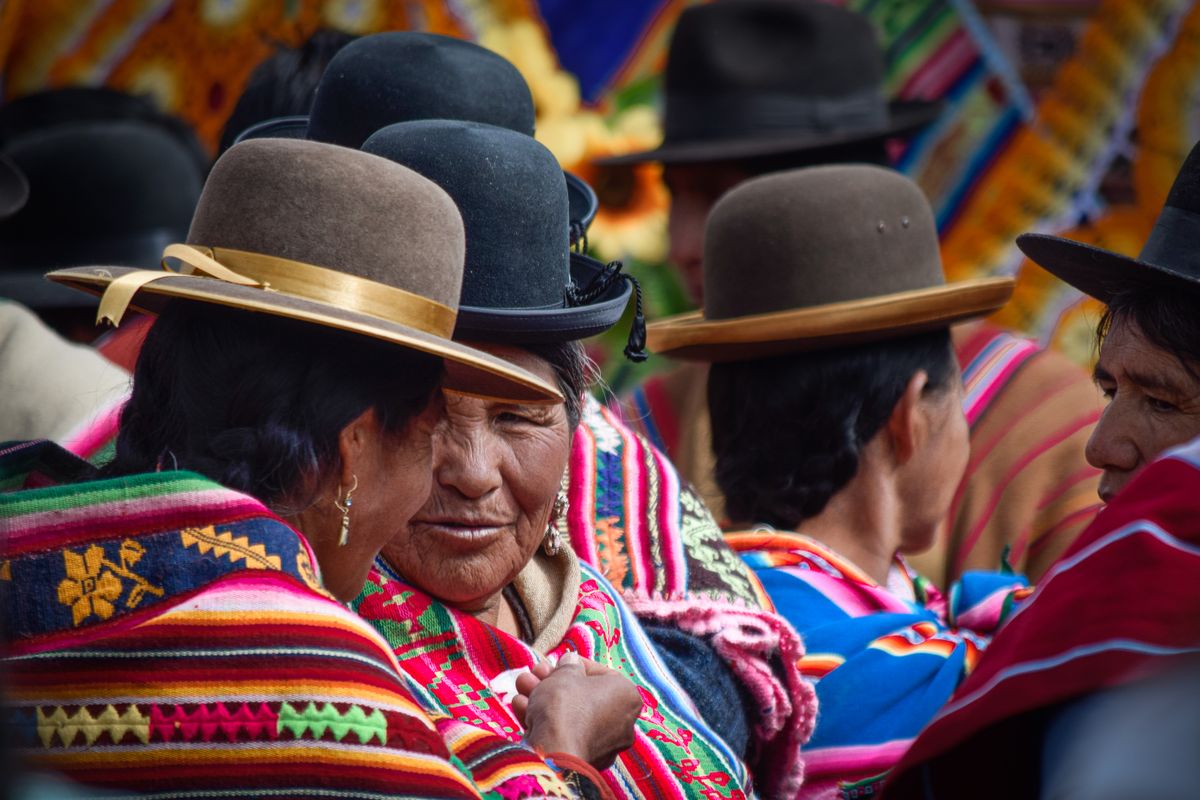
Walk out of the airport at El Alto at seven in the morning and the first thing that strikes most visitors is not the altitude. It is the clothing. Women in pleated skirts the colour of boiled sweets, bowler hats balanced at an improbable angle, striped cloth bundles knotted across their backs — standing in the queue for a minibus, checking their phones, arguing about the fare. Nobody is performing. This is simply what a great many Bolivians wear to go to work.
That is the thing most guides to Bolivian traditional clothing get wrong. They treat it as folklore, something brought out for festivals. In Bolivia a large share of the population wears traditional dress every single day, and what looks to an outsider like an unchanging costume is in fact a living wardrobe with fashions, seasons, price brackets and status codes that shift from one decade to the next. This guide explains what the garments are, where they came from, how they differ across the regions of the country, and how to look at them without turning people into scenery.
What Bolivians Actually Wear Today
Roughly speaking, Bolivia has three overlapping wardrobes. There is ordinary global clothing — jeans, football shirts, puffer jackets — which is what most men and most younger urban women wear. There is daily traditional dress, worn overwhelmingly by women and concentrated on the Altiplano and in the valleys. And there is festival costume, which is spectacular, expensive, hired or commissioned for a specific dance, and has almost nothing to do with the first two.
Who wears pollera and who does not
The dividing line is not really ethnicity, it is generation and self-identification. A woman who wears pollera is described as being de pollera; a woman who wears trousers or a straight skirt is de vestido. Many families contain both, and it is common for a grandmother and a mother to be de pollera while the daughter is not. The choice is loaded: for most of the twentieth century women in pollera were barred from smart restaurants, from some public buildings and even from certain buses in La Paz.
That history is the reason Bolivia legislated on it. Article 5 of Law 045, the law against racism and all forms of discrimination enacted on 8 October 2010, explicitly lists vestimenta — clothing — among the grounds on which discrimination is prohibited. In 2013 the municipality of La Paz went further and declared the chola paceña and her dress Intangible Cultural Heritage of the city through ordinance 446/2013.
The vocabulary you will hear
Chola and cholita are the words used for a woman in pollera. Both were insults for most of their history and both have been substantially reclaimed, but the tone depends entirely on who is speaking. Use cholita the way Bolivians do — descriptively, not as a label you attach to a stranger — and you will be fine. The phenomenon has its own showcase in the ring, which is why cholita wrestling in La Paz is less of a tourist gimmick than it first appears: the fighters wrestle in full pollera on purpose.
The Cholita Outfit, Piece by Piece
The silhouette that appears on every postcard of Bolivia is built from four or five separate garments, each with its own rules.
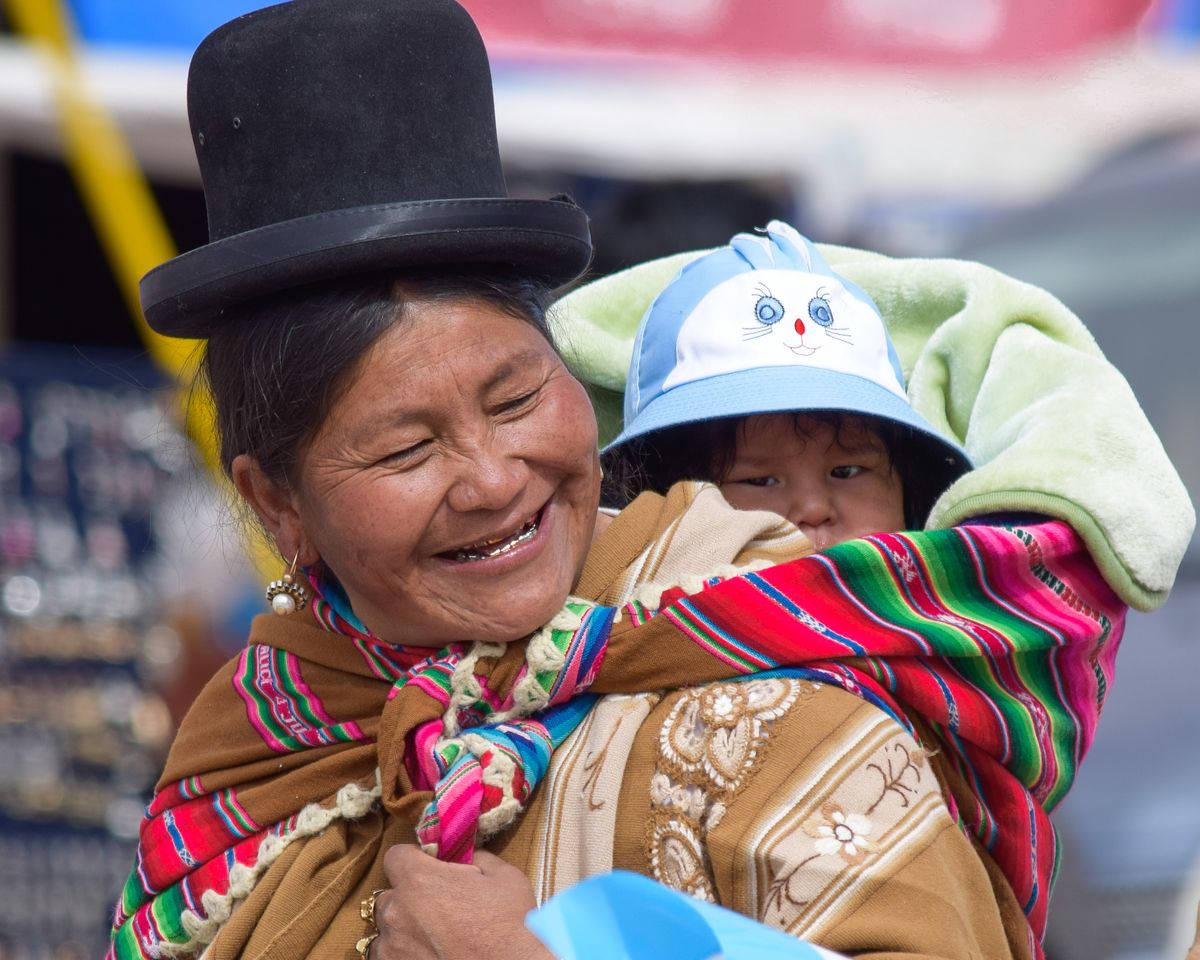
The pollera
The pollera is the gathered, pleated skirt, worn short of the ankle and built from several metres of fabric. Underneath go two to five underskirts, which is what gives the shape its volume and why a cholita occupies a satisfying amount of space on a narrow pavement. Fabric moves with fashion — velvet and heavy brocade in winter, lighter satins and printed synthetics in summer — and hemlines, colours and trims change from year to year exactly as they do anywhere else.
The manta and the aguayo
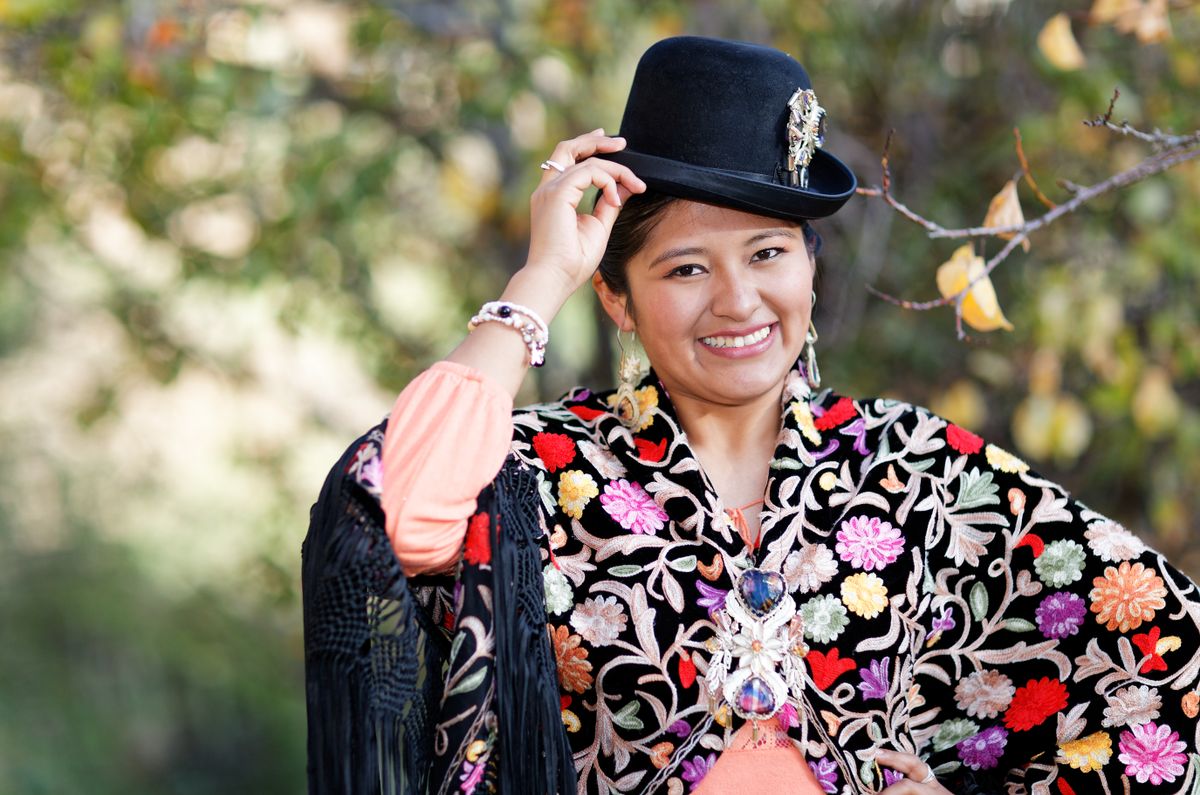
Two different cloths, often confused. The manta is the fine shawl fastened at the chest with a brooch, frequently embroidered, sometimes woven from alpaca or even vicuña, and it is the expensive item. The aguayo is the rectangular utility cloth knotted across the back, striped in bands of hard colour, used to carry a baby, a sack of potatoes or a morning of shopping. One is jewellery; the other is infrastructure.
The bombín
The bowler hat sits high on the head, tilted, held on with nothing but balance and occasionally a pin. It reached the Altiplano in the early twentieth century, and the origin story you will hear from every guide — a shipment sent for European railway workers that turned out too small and was offloaded onto Indigenous women — is charming, universally repeated and entirely undocumented. What is well attested is that by the 1920s the hat had become standard, and that in some communities the angle at which it is worn signals marital status.
The jewellery, and what it all costs
Heavy earrings, brooches and chains in gold or gold plate complete the outfit. Visitors routinely underestimate what this costs. A single good manta can run to several hundred dollars, a quality bombín well over a hundred, and a complete high-end outfit reaches into the thousands of US dollars. Most women build one up over years, piece by piece, which is precisely why the outfit reads as a statement of prosperity and not merely of tradition.
Where the Clothing Came From: A Decree in 1781
Here is the detail that reframes everything above. The pollera is not, in origin, Indigenous dress. It is Spanish.
In 1781, in the aftermath of the great Andean rebellions led by Túpac Amaru II in Peru and Túpac Katari around La Paz, the Spanish crown inspector Antonio de Areche issued a decree banning Indigenous Andean dress, along with Indigenous language use in official contexts and any public display of Inca ancestry. Andean people were ordered into the clothing of Spanish peasants: the gathered skirt, the shawl, the brimmed hat. The point was humiliation and erasure.
What happened next is the interesting part. Over two centuries, Andean women took the imposed uniform and rebuilt it — richer fabrics, louder colours, new proportions, a hat that was never Spanish at all — until the garment designed to mark them as subjugated became the most recognisable emblem of Indigenous identity in the country. It is one of the more complete reversals in the history of dress, and it explains why the outfit is defended so fiercely today. You can read more about the people at the centre of that story in our guide to the Aymara of Bolivia.
Traditional Dress for Men
Traditional clothing for men has held on less strongly in the cities but remains everyday wear in rural communities.
The chullo
The chullo is the knitted hat with earflaps, worn across the Andes and made from alpaca, llama or sheep wool. In some communities the pattern and the way the flaps are tied are community-specific. It is also, straightforwardly, the most practical thing you can put on your head at 4,000 m before sunrise — see our Bolivia packing list for what else to bring.
The poncho
The poncho is woven as a single rectangle with a slit for the head, and its colour is a regional signature: deep red in parts of the Altiplano, striped browns and ochres in the valleys, black among some Quechua communities in Potosí. In many places a fine poncho is an inherited object rather than a purchase.
Regional dress in the valleys
Around Tarabuco, in the valleys east of Sucre, Yampara men wear the montera, a stiff leather hat shaped unmistakably like a Spanish conquistador helmet — another colonial form absorbed and kept. Pair it with the red-and-black weaving of the region and you have one of the most distinctive outfits in South America. The music and dances that go with it, Pujllay and Ayarichi, were inscribed on the UNESCO Representative List of the Intangible Cultural Heritage of Humanity in 2014.
How Dress Changes Across Bolivia
The ten ecosystems of Bolivia produce very different wardrobes, and lumping them together is the commonest error in writing about the country.
- Altiplano (La Paz, El Alto, Oruro): pollera, manta, bombín, aguayo. The look most people mean by “Bolivian traditional clothing”.
- Valleys (Sucre, Tarabuco, Potosí): shorter, darker polleras; flat or helmet-shaped hats; and the extraordinary Jalqa weavings, dense black-and-red fields filled with khurus, imaginary animals, which you can watch being made at the ASUR textile museum in Sucre.
- Chipaya, Oruro department: Uru-Chipaya women wear their hair in dozens of fine braids and dress in dark woollen tunics unlike anything else in the Andes.
- Beni and the Amazon: no wool at all. The macheteros of San Ignacio de Moxos dance in vast headdresses of macaw and egret feathers during the Ichapekene Piesta, inscribed by UNESCO in 2012.
- Chiquitania and the Santa Cruz lowlands: light cotton, the embroidered tipoy dress, and a mestizo tradition shaped by the Jesuit missions.
Festival Costume Is a Different Universe
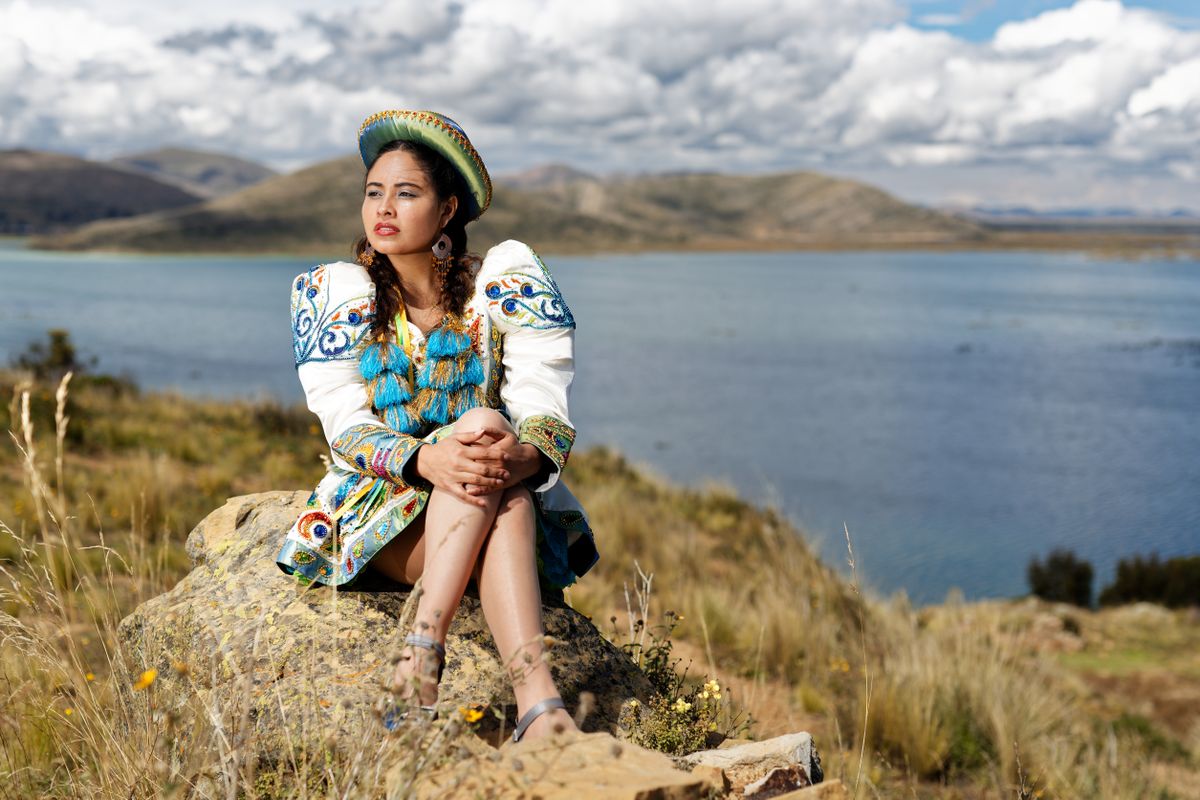
Do not confuse daily dress with the costumes of the Carnival of Oruro, proclaimed a UNESCO Masterpiece of the Oral and Intangible Heritage of Humanity in 2001 and inscribed on the Representative List in 2008. A Diablada devil mask can weigh several kilos and cost more than a small car; Morenada costumes are embroidered with thousands of beads and sequins and are commissioned from specialist workshops in Oruro and La Paz months in advance. These are theatrical objects, worn for a day or two a year by dancers who spend the rest of the year in jeans. Our Bolivian music, instruments and dances guide covers what is actually being danced underneath all that embroidery.
The Fibres: Alpaca, Llama, Vicuña and Sheep
Andean textile quality is largely a question of micron count. Vicuña fibre measures roughly 12 microns, the finest natural animal fibre in the world, which is why a vicuña shawl is a genuine luxury object and why the animal is strictly protected. Alpaca runs about 18 to 25 microns depending on grade, llama about 20 to 30, and sheep wool — introduced by the Spanish — is coarser but cheap and warm. If you want to understand which animal you are actually looking at on the Altiplano, our guide to llamas versus alpacas sorts it out.
A warning worth having: a great deal of what is sold to tourists as alpaca in La Paz is acrylic or an acrylic blend. Real alpaca is cool to the touch, has no squeak when rubbed between the fingers, and lacks the uniform, slightly plasticky sheen of synthetic yarn.
Where to See It, and How to Photograph It
The honest answer to “where do I see traditional clothing in Bolivia” is: everywhere, immediately, for free. But a few places concentrate it.
- Feria 16 de Julio, El Alto, on Thursdays and Sundays — one of the largest markets in South America, and the place where the clothing is actually bought and sold.
- Mercado Rodríguez and the streets above the Witches Market in La Paz, for everyday trade.
- Tarabuco market, on Sundays, 65 km from Sucre, for Yampara dress and weaving.
- Museo de Arte Indígena (ASUR), Sucre, where Jalqa and Tarabuco weavers work on site.
- Any patronal festival — the Bolivian festivals calendar will tell you what is on while you are there.
On photography, the rule is simple and non-negotiable: ask first. Many older Aymara and Quechua women will decline, and a refusal is not a negotiation. If someone agrees, a small payment is normal and expected at markets and viewpoints where posing for photographs is part of the income. Photographing someone from behind as they walk away, or shooting from a moving vehicle, is how most visitors get it wrong.
A Last Note
The clothing you see in Bolivia is not a survival from an untouched past. It is the result of a ban, a workaround, a century of exclusion and a deliberate reclamation, and it is still moving: designers in El Alto now show pollera collections on catwalks, and the cholitas escaladoras climb 6,000 m peaks in full skirts. If you want the fuller cultural context around all of this, start with our complete guide to Bolivian culture and traditions.
Key facts
- Antonio de Areche, the Spanish crown inspector, issued a decree in 1781 after the Tupac Amaru II and Tupac Katari rebellions that banned Indigenous Andean dress and imposed Spanish peasant clothing across the Andes.
- Article 5 of Bolivian Law 045, enacted on 8 October 2010, lists clothing (vestimenta) among the grounds on which discrimination is prohibited.
- La Paz municipal ordinance 446/2013 declared the chola pacena and her dress Intangible Cultural Heritage of the municipality.
- Vicuna fibre measures roughly 12 microns in diameter, the finest natural animal fibre in the world; alpaca runs about 18 to 25 microns and llama about 20 to 30.
- Pujllay and Ayarichi, the music and dances of the Yampara culture around Tarabuco, were inscribed on the UNESCO Representative List of the Intangible Cultural Heritage of Humanity in 2014.
- The Ichapekene Piesta of San Ignacio de Moxos, where macheteros dance in headdresses of macaw and egret feathers, was inscribed by UNESCO in 2012.
- The Carnival of Oruro was proclaimed a UNESCO Masterpiece of the Oral and Intangible Heritage of Humanity in 2001 and inscribed on the Representative List in 2008.
Frequently asked questions
What is traditional clothing in Bolivia called?
There is no single name, because Bolivia has more than thirty Indigenous nations and each has its own dress. The best-known outfit is that of the chola pacena of La Paz: a pleated pollera skirt, an embroidered manta shawl, a bombin bowler hat and often an aguayo, the rectangular woven cloth used to carry goods or a baby on the back. Andean mens dress centres on the chullo, a knitted earflap hat, and the poncho.
Why do Bolivian women wear bowler hats?
The bombin appeared on the Altiplano in the early twentieth century and was adopted by Aymara women in and around La Paz. The story usually told is that a shipment of hats intended for European railway workers arrived too small and was sold to local women instead; it is repeated everywhere but has never been documented. What is certain is that by the 1920s the hat had become a marker of urban Indigenous identity, and it has stayed one for a century.
Is it disrespectful for tourists to wear Bolivian traditional clothing?
Buying and wearing an alpaca jumper, a chullo or a woven scarf is completely normal and supports local weavers. Dressing up in a full cholita outfit as a costume is different: the pollera carries a specific history of humiliation and reclamation, and wearing it as fancy dress reads badly. Many operators in La Paz and Sucre do offer supervised dressing sessions with local families, which is a respectful way to try it.
How much does a full cholita outfit cost?
Far more than visitors expect. A single embroidered manta can cost several hundred dollars, a good bombin well over a hundred, and the gold or gold-plated jewellery worn with it hundreds more. A complete, high-quality outfit runs into the thousands of US dollars and is usually built up over years, one piece at a time, which is exactly why it functions as a statement of status and not only of heritage.
What is an aguayo?
An aguayo is a rectangular handwoven cloth, usually striped in bands of intense colour, that Andean women knot across the back to carry a baby, market shopping, firewood or anything else. It is the single most useful garment on the Altiplano and the one you will see most often. Patterns and colour combinations vary by community, and older pieces woven in natural dyes are collected as textile art.
Sources
- Pollera — Wikipedia
- Cholita — Wikipedia
- Pujllay and Ayarichi, music and dances of the Yampara culture — UNESCO
- Ichapekene Piesta, the biggest festival of San Ignacio de Moxos — UNESCO
- Carnival of Oruro — UNESCO
- Ley N 045 contra el Racismo y toda forma de Discriminación (8 de octubre de 2010) — Lexivox