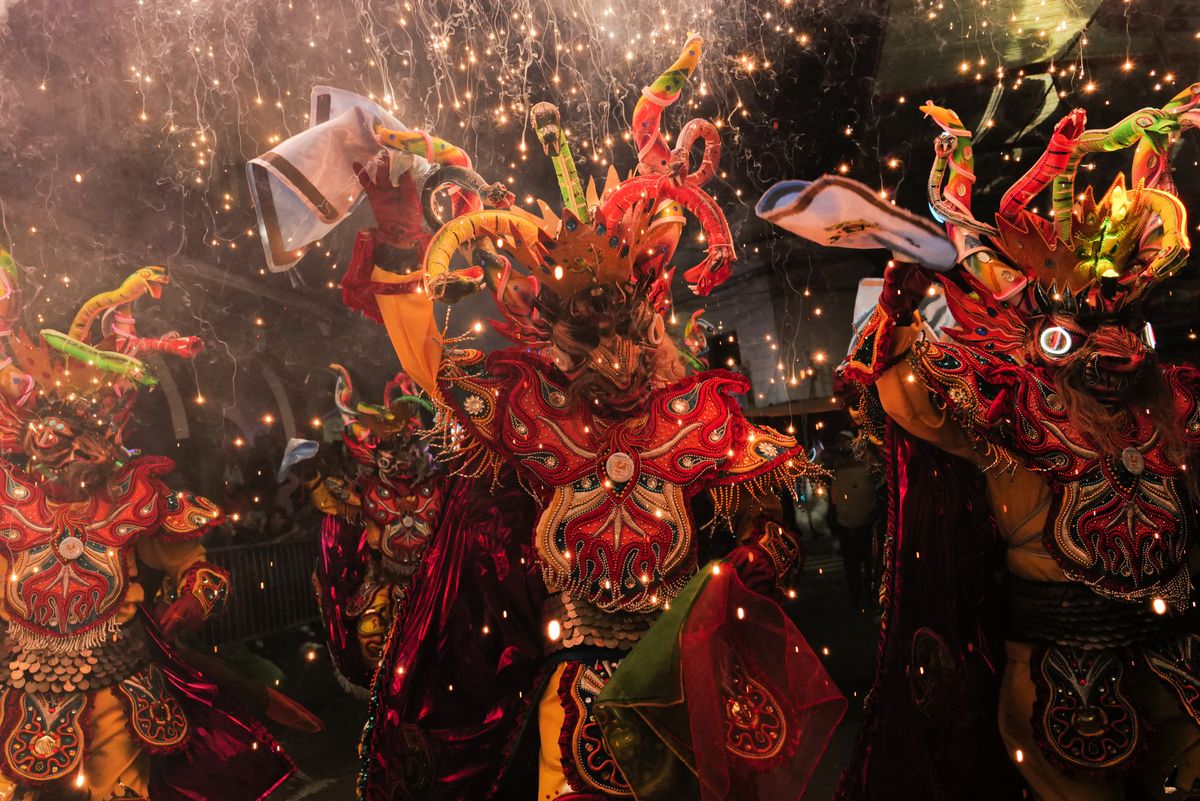
Stand on a street corner in La Paz during festival season and Bolivian music arrives before you see it: the thump of a bass drum, a wall of brass, the rattle of a dancer’s matraca. Walk into a highland village in the dry season and it is the breathy call-and-response of panpipes. Sit in a colonial church in the Chiquitania and you might hear a baroque violin sonata copied by an indigenous musician 300 years ago.
Bolivian music is not one sound but a meeting of several traditions: Andean, Spanish colonial, Afro-Bolivian and Amazonian. It is also unusually alive. Bolivia has seven music-and-dance festivals on UNESCO’s Intangible Cultural Heritage lists, and folk dances are practised by schools, neighbourhood associations and professional troupes all year round.
This guide covers the instruments you will hear, the rhythms and dances behind them, the artists worth listening to before your trip, and where to hear the real thing live.
The Instruments Behind Bolivian Music
Most traditional Bolivian music is built on three families of instruments: small strings, wind instruments made from cane or wood, and drums. Spanish guitars, violins and, since the 20th century, full brass bands have been absorbed into the mix.
The charango
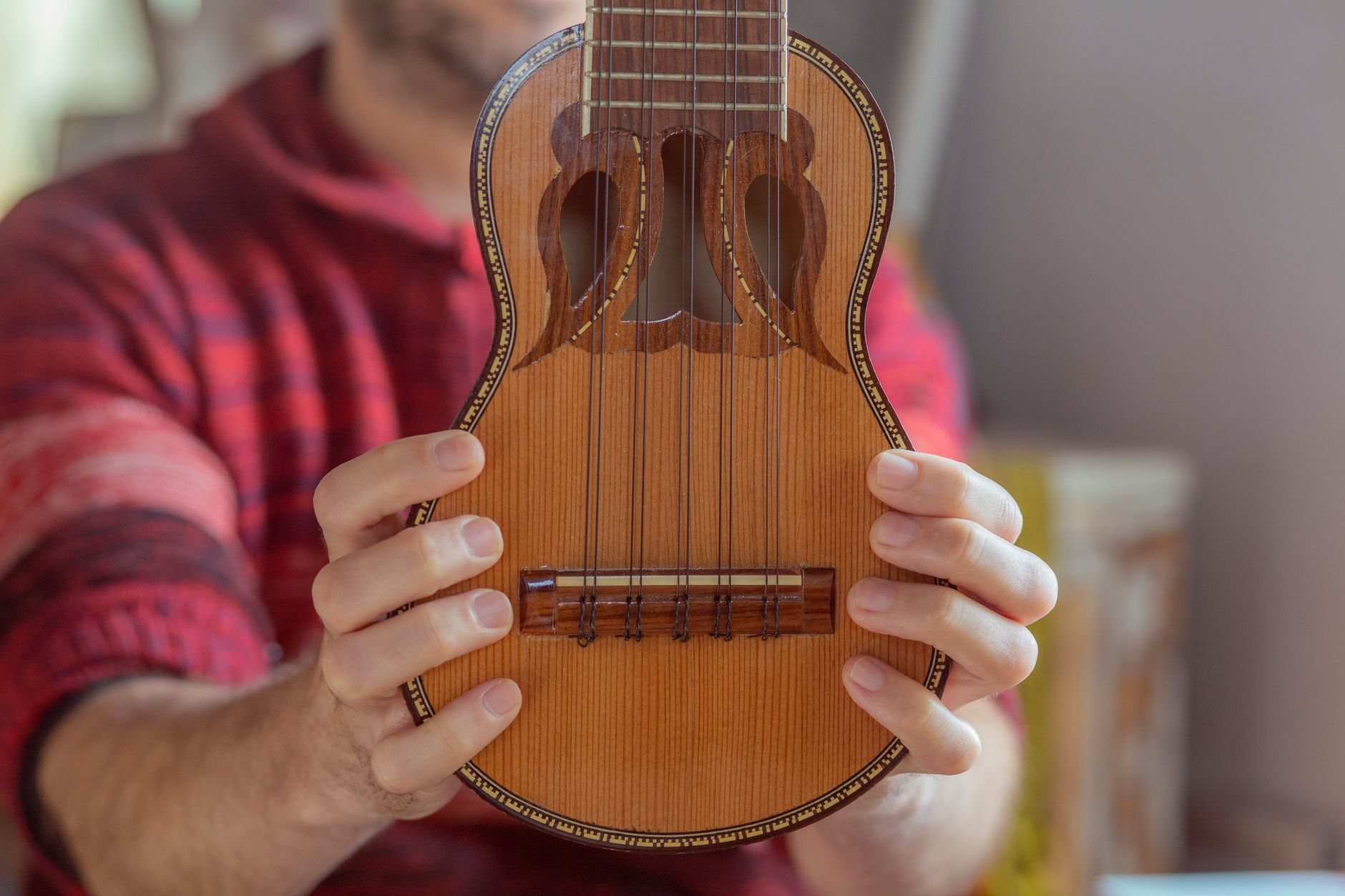
The charango is the instrument most people associate with Bolivia. A standard charango is about 66 cm long, with a 37 cm string scale and 10 strings arranged in 5 double courses. Its tuning is re-entrant (G–C–E–A–E), which keeps all strings within one octave and gives it that bright, shimmering strum.
Traditionally the back was made from the dried shell of an armadillo, though most modern charangos are carved entirely from wood. Evidence suggests the instrument developed in Potosí in the early 18th century, when the silver city was one of the richest in the world, but because neither Bolivia nor Peru existed as states at the time, its origin is still disputed. Peru declared the charango national cultural heritage in 2007.
Siku (zampoña)
The siku, called zampoña in Spanish, is the Andean panpipe, and it is strongly associated with Aymara communities around Lake Titicaca. The most common version has 13 cane pipes in two rows: 6 in the ira row and 7 in the arka row. You cannot play a full scale on a single row, so traditionally two musicians share one melody, alternating notes in a technique that produces a distinctive stereo sound. Large siku ensembles are called sikuris.
Quena, tarka and pinkillo
The quena is a notched end-blown flute, traditionally made of cane, that carries many of the melodies you will recognise from Andean folk recordings. The tarka is a wooden duct flute with a hoarse, reedy tone, played in groups in a style called tarqueada. The pinkillo is another duct flute of the highlands. In many Altiplano communities these flutes are played in the rainy season, while panpipes belong to the dry season, so the instruments you hear depend on the time of year.
Drums and brass bands
The bombo (a large double-headed bass drum) and the wankara (a highland drum) provide the pulse. At big festivals, though, the sound is dominated by brass bands of trumpets, trombones, tubas, cymbals and snare drums. The Carnival of Oruro alone brings together roughly 10,000 musicians in about 150 bands.
The Rhythms and Dances of Bolivia
In Bolivia, music and dance are rarely separated. Most genres are named after the dance that goes with them, and each dance tells a story about the country’s history.
Diablada
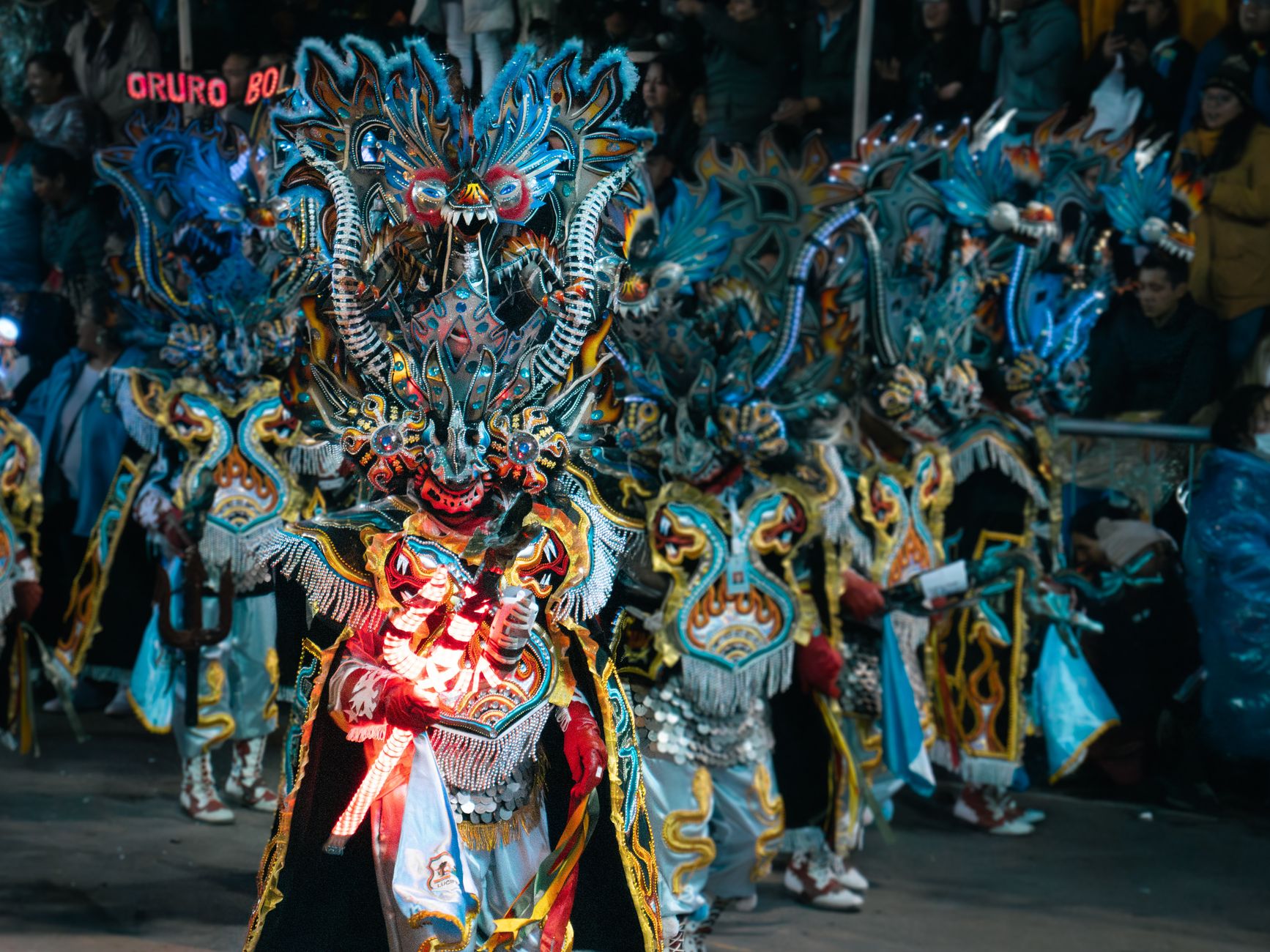
The Dance of the Devils is the emblem of the Oruro Carnival. Dancers wear heavy horned masks and embroidered costumes, and the choreography stages the struggle between the Archangel Michael and the forces of evil, blending Catholic imagery with Andean mining beliefs about the underworld.
Morenada
The Morenada is one of the most popular dances at La Paz’s Gran Poder festival and the Oruro Carnival. Its slow, swaying rhythm is marked by the matraca, a rattle that dancers spin as they move. Costumes are huge and heavy, and a morenada troupe can include hundreds of dancers.
Caporales
Caporales is the most energetic and youthful of the big festival dances, full of high kicks, bells on the boots and short, flared skirts. It was created in 1969 by the Estrada Pacheco family and grew out of the saya, where the caporal was the overseer character. In June 2011 a Supreme Decree declared Caporales, along with other dances, Cultural and Intangible Heritage of Bolivia. Today it is danced by Bolivian communities in Argentina, Chile, Peru, Spain and the United States.
Saya afroboliviana
The saya is the music of the Afro-Bolivian communities of the Yungas, descendants of enslaved Africans brought to colonial Bolivia. It is built on drums, a scraper and call-and-response singing, often about everyday life and resistance. It is the root of Caporales, and it is also the style in which Los Kjarkas originally recorded “Llorando se fue”.
Tinku, huayño and the lowland rhythms
The tinku comes from northern Potosí, where it grew out of a ritual encounter between communities. It is danced with a stomping, martial step. The huayño is the classic Andean rhythm shared with Peru, and the kullawada and llamerada evoke weavers and llama herders. In the lowlands the mood changes completely: the taquirari of Santa Cruz and Beni and the chovena of Beni are lighter and more tropical, while the cueca is danced with handkerchiefs across the valleys of Chuquisaca, Cochabamba and Tarija.
Baroque Music in the Bolivian Lowlands
One of the most surprising chapters in Bolivian music took place far from the Andes. In the 17th and 18th centuries, Jesuit missionaries in the Chiquitos and Moxos regions trained indigenous communities to build violins and organs and to perform European sacred music. Local musicians went on to copy and compose their own works.
When the mission churches were restored in the late 20th century, researchers found about 5,500 sheets of music in Chiquitos and 7,000 in Moxos. Since 1996 the cultural association APAC has organised the Festival Internacional de Música Renacentista y Barroca Americana “Misiones de Chiquitos” every two years. The 15th edition ran from 17 to 26 April 2026 across 21 venues. If you plan to visit the Jesuit missions of Chiquitos, check the next festival dates, because hearing this music inside the wooden churches it was written for is unforgettable.
Further north in Beni, the Ichapekene Piesta of San Ignacio de Moxos, inscribed by UNESCO in 2012, keeps mission-era music and dance alive every July.
Famous Bolivian Musicians and Songs
If you want to listen before you travel, these names are a good place to start.
- Los Jairas were formed in La Paz in 1965 by Edgar “Yayo” Jofré, with the charango player Ernesto Cavour and the Swiss quena player Gilbert Favre. They helped move Andean folk music from village festivals to concert halls.
- Ernesto Cavour (1940–2022) was Bolivia’s great charango master. In 1962 he founded what is now the Museo de Instrumentos Musicales de Bolivia in La Paz, with around 2,000 instruments, and he invented several instruments of his own. He received the Order of the Condor of the Andes in 2013.
- Los Kjarkas were founded in 1965 in Capinota, Cochabamba, by the brothers Gonzalo, Élmer and Ulises Hermosa with Gastón Guardia and Ramiro de la Zerda. Their song “Llorando se fue” was reworked by French producers into Kaoma’s 1989 hit “Lambada” without credit. French courts later ruled in favour of the Hermosa brothers, and Kaoma had to pay compensation.
- Luzmila Carpio, born in 1949 in Qala Qala, Potosí, sings in Quechua and Spanish with a famously high voice inspired by birdsong. She served as Bolivia’s ambassador to France from 2006 to 2010.
- Savia Andina, Kalamarka (founded in 1984) and Wara are other key groups of Andean folk and fusion.
These artists grew out of the same cultural mix described in our guide to Bolivian culture and traditions, and many of their lyrics use Quechua and Aymara words. Our guide to the languages spoken in Bolivia explains where each language lives.
Bolivia’s UNESCO-Listed Music and Dance Festivals
Bolivia’s festivals are where its music is most powerful. These are the celebrations built around music and dance that UNESCO has inscribed on its Intangible Cultural Heritage lists.
| Festival | Place | UNESCO year | When it happens |
|---|---|---|---|
| Carnival of Oruro | Oruro | 2001 (proclaimed), 2008 (inscribed) | February or March, before Lent |
| Ichapekene Piesta | San Ignacio de Moxos, Beni | 2012 | July |
| Pujllay and Ayarichi (Yampara music and dance) | Tarabuco, Chuquisaca | 2014 | March (Pujllay) |
| Gran Poder | La Paz | 2019 | May or June |
| Grand Festival of Tarija | Tarija | 2021 | August to September |
| Ch’utillos | Potosí | 2023 | August |
| Virgin of Guadalupe | Sucre | 2025 | September |
Exact dates move from year to year, especially for festivals linked to Easter and Holy Trinity. Our Bolivia festivals calendar lists the dates for 2026.
Where to Hear Bolivian Music Live
You do not need to plan a whole trip around a carnival to hear good music in Bolivia.
La Paz
La Paz is the easiest place to start. The Museo de Instrumentos Musicales de Bolivia sits on Calle Jaén, the city’s best-preserved colonial street, and displays charangos of every shape alongside panpipes, drums and Cavour’s inventions. In the evenings, look for a peña, a folk music venue where dinner comes with live Andean music and dance. Several peñas are in the historic centre near Calle Sagárnaga and the Witches’ Market. The Gran Poder parade usually fills central La Paz with tens of thousands of dancers in late May or June. For more ideas, see our list of things to do in La Paz.
Oruro, Potosí and Sucre
Oruro is the capital of Bolivian brass bands, and during Carnival you will hear them for almost 20 hours straight. In Potosí, the August festival of Ch’utillos brings dance groups from across Bolivia and neighbouring countries. From Sucre, it is easy to reach Tarabuco for the Pujllay in March and its Sunday market, where Yampara musicians play the pinkillo and wear spurred sandals that ring as they dance. Our guide to things to do in Sucre covers the trip.
The Yungas, Cochabamba and Tarija
In the Yungas, Afro-Bolivian communities near Coroico still perform the saya at local fiestas. Near Cochabamba, the home region of Los Kjarkas, the town of Quillacollo hosts the huge Urkupiña festival in August. In Tarija, the valley’s own music features the erke, a long horn, and the caña, a cane trumpet several metres long, especially during the Grand Festival.
Practical Tips for Music Lovers in Bolivia
- Buy a wooden charango. The Andean hairy armadillo (Chaetophractus nationi), whose shell was used for traditional charangos, is protected in Bolivia and listed on CITES Appendix II with a zero export quota. Carrying an armadillo-shell charango out of the country can get it confiscated at customs.
- Respect the dancers. Festival troupes are often religious fraternities dancing as a promise to the Virgin, not performers for tourists. Do not walk through the parade, and ask before taking close-up portraits.
- Mind the altitude. Festival days in La Paz (about 3,640 m) and Oruro (about 3,706 m) are long, loud and often involve alcohol. Drink water, wear sun protection and read our La Paz altitude guide before you go.
- Book early for Carnival. Seats in the grandstands along the Oruro route and hotel rooms sell out weeks ahead.
- Learn a few rhythms. Being able to recognise a morenada from a caporal will make any parade far more meaningful, and Bolivians love it when visitors can name their dances.
Bolivian music is one of the best ways into the country’s culture. Whether it is a charango solo in a small peña or 150 brass bands in Oruro, you will leave with a rhythm in your head that stays long after your trip.
Key facts
- A standard charango is about 66 cm long, with a 37 cm string scale and 10 strings arranged in 5 double courses.
- The most common siku panpipe has 13 pipes split into two rows: 6 in the ira row and 7 in the arka row.
- Caporales was created in 1969 by the Estrada Pacheco family and declared Cultural Heritage of Bolivia by Supreme Decree in June 2011.
- Los Kjarkas were formed in 1965 in Capinota, Cochabamba; their song 'Llorando se fue' became the basis of Kaoma's 1989 hit 'Lambada', and French courts ruled in their favour.
- Ernesto Cavour (1940–2022) founded the Museo de Instrumentos Musicales de Bolivia in La Paz in 1962; it holds around 2,000 instruments.
- Restoration of the Jesuit missions uncovered about 5,500 sheets of 17th- and 18th-century music in Chiquitos and 7,000 in Moxos, celebrated by a biennial festival held since 1996.
Frequently asked questions
What is traditional Bolivian music called?
There is no single name. Traditional Bolivian music is usually described as Andean folk music (música folklórica), and it is organised by rhythm and dance: huayño, morenada, diablada, caporales, saya, tinku, cueca and taquirari. The Afro-Bolivian saya and the Andean huayño are among the oldest living styles.
What is the national instrument of Bolivia?
The charango is the instrument most closely associated with Bolivia. It is a small lute with 10 strings in 5 double courses, and evidence points to its development in Potosí in the early 18th century. Peru also claims it and declared it national heritage in 2007.
Who is the most famous Bolivian band?
Los Kjarkas, formed in 1965 by the Hermosa brothers in Capinota, Cochabamba, are Bolivia's best-known band. Their song 'Llorando se fue' was reworked into the 1989 global hit 'Lambada', and French courts later recognised their authorship.
Where can I hear live Bolivian music as a tourist?
In La Paz, visit the Museo de Instrumentos Musicales on Calle Jaén and look for a peña, a folk music venue with dinner shows. For the full experience, time your trip with the Carnival of Oruro in February or the Gran Poder festival in La Paz, usually held in May or June.